Go makes backend scale easier in production
I break down why big teams picked Go and give you a copy-ready template for explaining the same tradeoffs.

I break down why big teams picked Go and give you a copy-ready template.
I’ve been reading these “companies that use X” posts for years, and most of them feel like they were written by someone who just discovered a logo wall. The list is there, the bragging is there, but the useful part is missing: what problem did Go actually solve, and why did teams keep choosing it when Python, Java, Node, or C++ were already in the building?
That’s why this Netguru piece caught my eye. It doesn’t just name-drop Google, Cloudflare, Uber, and Salesforce. It keeps circling the same engineering pain: concurrency, build speed, deployment size, and the boring reality of running services at scale. That’s the part I care about. Not “Go is popular.” I want to know when it stops being a nice-to-have and starts being the least annoying option left.
Source-wise, I’m pulling from Netguru’s article 19 major companies that use Golang in production, plus the official Go site at go.dev and the project’s case studies page at Case Studies - The Go Programming Language. I’m also linking out to a few of the companies and tools mentioned so you can check the originals, not my shorthand.
Go wins when thread management stops being cute
Get the latest AI news in your inbox
Weekly picks of model releases, tools, and deep dives — no spam, unsubscribe anytime.
No spam. Unsubscribe at any time.
“Go's goroutine-based concurrency model uses M:N threading, many goroutines multiplexed onto a smaller number of OS threads by the Go runtime scheduler.”
What this actually means is simple: Go gives you a cheap way to run lots of concurrent work without making you babysit a giant thread pool. That matters when your service is doing a lot of small, independent jobs at once, like request fan-out, background workers, stream processing, or anything that needs to stay responsive under load.

The Netguru article calls out Cloudflare, Uber, and Twitch for exactly this reason. Cloudflare uses Go in edge and DNS work where latency matters. Uber uses it in dispatch and lookup services. Twitch leans on it for chat and other high-concurrency paths. That’s not accidental. These are the kinds of systems where thread-per-request starts feeling expensive fast.
I ran into this pattern in a fintech service that was perfectly fine in staging and then got weird in production once traffic spiked. The problem wasn’t business logic. It was coordination. We were spending too much time thinking about pools, timeouts, and contention. Go didn’t magically fix the system, but it did make the concurrency model less fragile. That alone saved us from a lot of self-inflicted pain.
If you’re applying this lesson, don’t start with “we need Go.” Start with “do we need a lot of concurrent I/O with low overhead?” If the answer is yes, Go deserves a serious look. If the answer is “we have five endpoints and a cron job,” then you’re probably just collecting new problems.
- Use Go when you need many concurrent requests or workers with predictable overhead.
- Use it when your team keeps fighting thread pools, async complexity, or runtime tuning.
- Don’t use it just because the architecture deck needs a modern-looking language name.
Fast builds are not a luxury when your team ships all day
“Go compiles a large codebase in seconds, not minutes.”
That line sounds small until you live inside it. Fast builds change how often people test, refactor, and actually finish work. When compile times are short, engineers don’t build up the emotional resistance that comes from waiting around for feedback. They try the change, see the result, and move on.
Netguru points at Go’s design choices here: simple syntax, no circular imports, and a compiler built for speed. The article also contrasts Go with larger Java or C++ workflows, where build times can stretch long enough to break momentum. I’ve felt that drag. Once a build takes a few minutes, people stop iterating as much. They batch changes, guess more, and test less often. That’s how bugs get a seat at the table.
This is one reason Go shows up in tooling-heavy companies like Docker, Kubernetes, and Heroku. If your product is also your platform, the language has to stay out of the way. Fast compile times matter even more in CI, where every minute gets multiplied by every engineer and every branch.
My practical rule is boring but effective: if your team spends a noticeable part of the day waiting for builds, Go can pay for itself just by cutting that dead time. Not because it’s glamorous. Because it keeps people moving.
How to apply it:
- Measure your current build and test times before you compare languages.
- Look at how often engineers are blocked by feedback loops, not just raw runtime performance.
- Use Go for services and tools where fast iteration matters more than language expressiveness.
Static binaries make deployment stop being dramatic
“Static binary compilation produces a single self-contained artifact with no runtime dependencies.”
This is one of those Go features that sounds boring until you have to ship and debug real systems. A single binary means you are not dragging in a JVM, a Python interpreter, or a pile of runtime dependencies just to start the thing. In container land, that simplifies images, shrinks startup overhead, and makes rollouts less annoying.
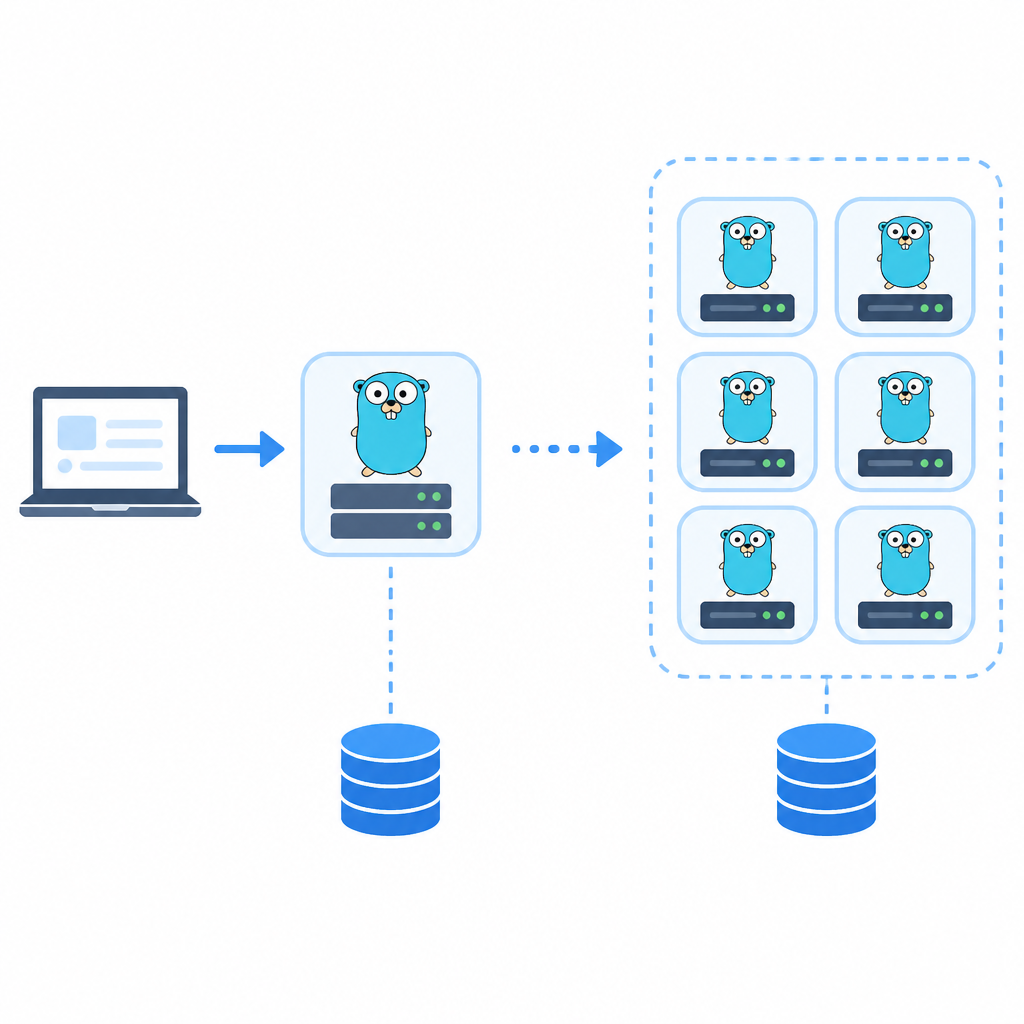
The Netguru article ties this directly to Docker and Kubernetes, which makes sense. These tools live in the infrastructure layer, where small images and predictable startup behavior matter. The article also notes that Go binaries can be dropped into tiny container images, which reduces image size and attack surface. That’s not just a security talking point. It’s also a practical ops win when you’re pushing and pulling images all day.
I’ve seen teams underestimate this and then spend too much time optimizing around the edges. They tune base images, trim dependencies, and still end up with bloated containers because the runtime itself is heavy. Go cuts through that mess. It doesn’t solve bad deployment design, but it removes one of the most annoying parts of it.
If you’re building internal services, CLIs, agents, or anything that has to start quickly and behave the same way everywhere, this is a real advantage. If your deployment story already depends on a runtime ecosystem, then you need to weigh that tradeoff honestly instead of pretending the binary size doesn’t matter.
- Prefer Go for services that ship in containers and need quick startup.
- Use it for CLIs and internal tooling where one binary is easier to distribute.
- Keep an eye on image size, cold start time, and operational simplicity, not just code cleanliness.
Google’s backing matters less than the ecosystem it created
“Google created Go and continues to fund its core development.”
What this actually means is not “Google likes Go, so you should too.” That would be lazy. The useful signal is that Go has been shaped by the same environment that needed Kubernetes, Docker, Prometheus, Terraform, and Istio. In other words, the language got pressure-tested in the exact kind of infrastructure most teams now run.
Netguru makes this point by linking Go to the cloud-native stack. That’s the real story. Go is not just a language with a nice syntax and a clean compiler. It’s the language that ended up sitting under a lot of the tooling teams already depend on. That gives it a practical legitimacy that marketing slides can’t fake.
I’ve had enough “strategic language choices” meetings to know how this goes. Someone wants the team to pick a language because it feels modern. Someone else wants the thing that will still be around in five years. Go tends to win those fights when the workload is infrastructure-heavy, because there’s already a huge trail of production usage behind it.
The right way to use this fact is not worship. It’s risk reduction. If the language is already powering the systems you rely on, your adoption story gets easier. Hiring gets easier too, because you can point to real production use instead of a vague promise.
Useful external references here are the official Go site at go.dev, the Go case studies page at go.dev/solutions/case-studies, and the cloud-native projects themselves: Kubernetes, Docker, and Prometheus.
The companies in the list are really telling the same story
Netguru’s list includes Google, Cloudflare, Uber, Dropbox, Monzo, Facebook, Capital One, ByteDance, SoundCloud, MercadoLibre, Cockroach Labs, Salesforce, American Express, and more. That mix matters. These are not all the same kind of company, and they are not all solving the same problem. But the Go-shaped pain point keeps repeating: high throughput, concurrency, infrastructure, and predictable performance.
That’s why the article’s Salesforce example is useful. Einstein Analytics had performance pressure before launch, and Salesforce migrated a large part of the backend from Python-C hybrid code to Go. The point wasn’t “Python bad.” The point was that the workload needed better multi-threading behavior and more predictable scaling. That’s the kind of tradeoff teams actually make.
I like this because it keeps the decision grounded. Go is not the answer to everything. It’s the answer when your system has grown past the point where a slower runtime or more complex concurrency model is tolerable. That’s a narrower, more honest argument than the usual “best language” nonsense.
If you’re choosing a backend language today, I’d use this list as a pattern detector. Ask which of these companies look like your own operational reality. If you’re building a high-throughput API, a platform service, a CLI, or a distributed system with a lot of concurrent work, you’re in the zone where Go makes sense.
How to apply it:
- Map your workload to the examples in the list, not to the brand names.
- Focus on concurrency, startup time, and deployment size before syntax preferences.
- Use the list as evidence for architecture fit, not as a popularity contest.
What I’d actually tell a team deciding on Go
If I were sitting with a team today, I would not pitch Go as a religion. I’d pitch it as a way to reduce friction in services that need to do a lot, quickly, with fewer moving parts. That’s a much better sales job, and it’s closer to the truth.
Go is strongest when the pain is operational: too much runtime overhead, too much build-time waiting, too much deployment complexity, too much concurrency glue. It is weaker when your app depends on rich frameworks, highly dynamic metaprogramming, or a huge existing ecosystem in another language. That’s fine. No language gets to win every room.
The Netguru article is useful because it shows the same pattern across many companies instead of one polished case study. That gives you a better signal. When the same language keeps showing up in infrastructure, payments, edge networking, and cloud services, I stop treating it like a trend and start treating it like a practical choice.
So my advice is pretty plain: if your current stack is slowing you down in the exact places Go is good at, test it on one service first. Don’t rewrite everything. Pick the hot path, the worker, the gateway, or the CLI. Measure the difference. Then decide with actual evidence instead of conference-room optimism.
The template you can copy
# Why teams choose Go in production

I keep seeing Go show up in the same kinds of systems: high-throughput APIs, internal infrastructure, CLIs, edge services, and microservices that need to stay cheap under load.

## The short version
Go is a good fit when you need:
- lots of concurrent work without heavy thread overhead
- fast builds and quick feedback loops
- small, self-contained deployment artifacts
- a language that fits cloud-native infrastructure

## Where Go helps most
- request fan-out and background workers
- payment or event-processing services
- containerized services with frequent deploys
- tooling that should ship as one binary
- platform code where startup time and memory use matter

## What Go is not great for
- teams that depend on deep framework ecosystems
- apps that need heavy metaprogramming
- projects where the team already has a strong, mature stack in another language

## A practical adoption test
If your service has at least two of these problems, Go is worth a pilot:
1. build times are slowing the team down
2. concurrency is getting hard to reason about
3. container images are too heavy
4. startup time matters
5. the service is mostly I/O-bound

## Copy-ready decision note
We should consider Go for this service because it would reduce operational overhead in the parts of the stack that matter most to us: concurrency, build speed, and deployment simplicity. We are not choosing Go for novelty. We are choosing it because the workload fits the language.

## Pilot plan
1. Pick one service or tool with clear performance pain.
2. Rebuild only the hot path in Go.
3. Measure build time, startup time, memory use, and p95/p99 latency.
4. Compare the result to the current implementation.
5. Keep the pilot only if the numbers improve enough to justify the migration cost.

## One-line summary
Go is worth adopting when your problem is operational friction, not language fashion.
This article is my breakdown of Netguru’s original post, not a rewrite of it. The company examples and core tradeoffs come from that source and the linked Go materials; the framing, commentary, and template are mine.
// Related Articles
- [TOOLS]
9 Cursor alternatives that beat lock-in
- [TOOLS]
AI视频生成工具的胜负手,已经不是单次生成而是全流程生产
- [TOOLS]
Boot.dev’s Go Playground is a better teaching tool than a full IDE
- [TOOLS]
Zhihe A210 turns RISC-V into a dev kit
- [TOOLS]
Meta opens Astryx for agent-readable UI work
- [TOOLS]
Awesome-Agent-Memory maps the field of LLM memory