A low-dimensional theory for Transformer reasoning
This paper shows Transformer inductive reasoning can follow a low-dimensional invariant manifold.

Transformers once looked task-specific; this paper shows their inductive reasoning can follow a low-dimensional invariant manifold.
- Research org: Unspecified in arXiv abstract
- Core data: No benchmark numbers in abstract
- Breakthrough: Confining attention-model dynamics to an interpretable invariant manifold
For engineers trying to understand why a Transformer learns one circuit instead of another, this is the kind of paper that changes the debugging lens. The authors are not proposing a new model or a new benchmark score; they are trying to explain the training dynamics behind inductive reasoning itself.
That matters because a lot of transformer behavior still feels opaque in practice. If you can predict which reasoning path a model will take, or detect which circuit it has learned from a simpler coordinate system, you have a better shot at interpreting failures, comparing training runs, and reasoning about model behavior before it surprises you.
What problem this paper is trying to fix
Get the latest AI news in your inbox
Weekly picks of model releases, tools, and deep dives — no spam, unsubscribe anytime.
No spam. Unsubscribe at any time.
The paper starts from a limitation in prior work on Transformer learning dynamics: most analyses are tied to one specific synthetic task at a time. That makes it hard to tell whether the underlying story is general, or just a neat explanation for a single toy setup.

To address that, the authors study a broader class of inductive reasoning tasks. This class is meant to unify several synthetic tasks already known in the literature, including in-context n-grams and multi-hop reasoning. In other words, they are trying to build one framework that can explain a family of behaviors rather than one isolated case.
The practical goal is not to sell a new training trick. It is to make the learning process itself more legible. If the same high-level structure shows up across multiple inductive tasks, then the field gets closer to a predictive theory of how Transformers form circuits during training.
How the method works in plain English
The core claim is theoretical: the training dynamics of attention models can be confined to a highly interpretable, low-dimensional invariant manifold. Instead of thinking about millions of parameters moving freely, the paper argues that the relevant dynamics can be described by a small set of coordinates.
That is a big deal for analysis. Once you can project the system onto a stable manifold, the problem stops looking like a giant black box and starts looking like a smaller dynamical system. The authors say this makes both theoretical and empirical analysis more tractable.
In plain terms, they are saying that not every parameter matters equally for these inductive tasks. The useful behavior is organized around a smaller set of directions in parameter space, and those directions can be interpreted as circuits. That is the kind of structure researchers often hope exists, but rarely get to prove cleanly.
The paper also uses this coordinate frame to automatically detect which circuits have been learned in trained models. So the manifold is not just a proof device; it is also presented as a practical lens for inspection.
What the paper actually shows
The abstract does not report benchmark numbers, accuracy values, or training-speed comparisons. So there is no quantitative leaderboard-style result to cite here. What the paper does provide is a theoretical framework plus a set of qualitative and structural findings about learning dynamics.
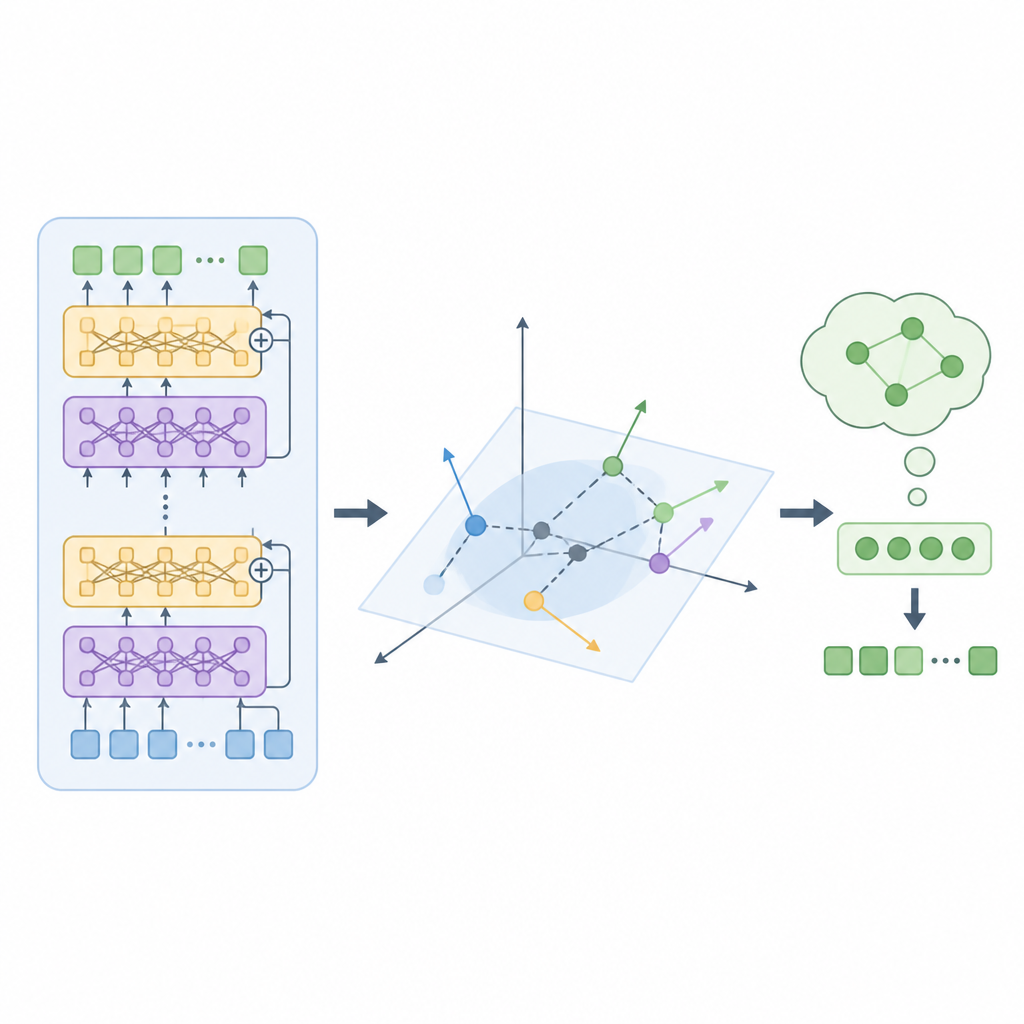
First, the authors prove that the dynamics of attention models on this task family can stay within the invariant manifold. Second, they characterize how data statistics affect the competition between in-context learning and in-weights learning. Third, they study how random initialization influences which circuit wins when multiple solutions are available.
That last point is especially relevant if you care about reproducibility. If different random seeds can push training toward different circuits, then model behavior may depend on initialization in ways that are not obvious from final loss alone. The paper frames that as a dynamical phenomenon, not just a quirk of optimization.
Finally, the authors show that the learned coordinate frame can be used to detect circuits in trained models. That suggests a route to automatic circuit identification, at least in the setting they study. The abstract does not say how robust that detection is across architectures, task families, or real-world data.
Why developers and ML practitioners should care
If you build or study Transformer systems, the main value here is interpretability with math behind it. A low-dimensional dynamical picture gives you a way to reason about training trajectories, not just final outputs.
That can help in several ways. It may make it easier to compare runs that land in different solutions. It may help explain why a model prefers in-context learning in one regime and in-weights learning in another. And it may offer a framework for tooling that inspects learned circuits more automatically.
There is also a broader engineering lesson: if a model family has invariant structure, then some kinds of behavior are not random accidents of scale. They are consequences of the geometry of training. That is useful whether you are trying to debug a model, design a probe, or build a more reliable analysis pipeline.
What this does not prove
As strong as the framework sounds, the abstract is still careful about scope. The paper studies a generalized class of inductive tasks, but it does not claim to explain all Transformer reasoning in the wild. It is about synthetic tasks that unify known examples, not open-ended natural language reasoning.
It also does not provide benchmark numbers in the abstract, so you should not read it as evidence of a new state-of-the-art result. The contribution is explanatory, not performance-driven.
And while the manifold picture is powerful, it is still a theoretical lens. The abstract does not say how easily the method transfers to larger models, different attention variants, or messy real-world datasets. Those are the obvious next questions if you want to turn this into a practical analysis tool.
Bottom line
This paper argues that inductive reasoning in Transformers can be understood as motion on a low-dimensional invariant manifold. That reframes circuit formation as something you can analyze, compare, and potentially detect directly.
For developers, the takeaway is simple: if you care about why a Transformer learned a particular reasoning strategy, this kind of theory could become a useful debugging and interpretability layer. It does not replace empirical evaluation, but it gives you a sharper map of the terrain.
- It unifies multiple synthetic inductive tasks under one theoretical framework.
- It proves attention-model dynamics can stay on an interpretable invariant manifold.
- It offers a coordinate-based way to detect learned circuits in trained models.
// Related Articles
- [RSCH]
Anthropic’s J-space is useful, but not the breakthrough people want
- [RSCH]
Metacognition in LLMs: what the field knows
- [RSCH]
Requential Coding Compresses What Models Actually Learn
- [RSCH]
How VLMs Learned Complex Scene Descriptions
- [RSCH]
Visual Pretraining Beats Text-Only in Language Models
- [RSCH]
PHINN-EEG brings topology to dream-state EEG