MeanFlowNFT brings RL to few-step generators
MeanFlowNFT adapts forward-process RL to MeanFlow generators while keeping few-step sampling fast.

MeanFlowNFT adapts forward-process RL to MeanFlow generators while keeping few-step sampling fast.
- Research org: Unspecified in arXiv abstract
- Core data: 4-step Wan 2.1 reaches VBench 84.33
- Breakthrough: Builds an induced instantaneous-velocity predictor from MeanFlow identity
MeanFlow models are attractive because they can sample in just a few steps by predicting average velocities over time intervals. The problem is that a lot of reinforcement-learning alignment work was designed around instantaneous velocities, which makes it awkward to apply directly to MeanFlow without changing how the model is trained or sampled.
That gap matters if you care about practical generation systems. Fewer sampling steps usually mean lower latency and lower cost, so any alignment method that preserves fast sampling while improving output quality is immediately relevant for image and video pipelines.
What problem this paper is trying to fix
Get the latest AI news in your inbox
Weekly picks of model releases, tools, and deep dives — no spam, unsubscribe anytime.
No spam. Unsubscribe at any time.
The paper focuses on a mismatch between two ideas: MeanFlow sampling and forward-process RL. MeanFlow generators do not predict the same thing as diffusion models that use instantaneous velocities, but DiffusionNFT-style RL is built around optimizing instantaneous velocities without needing reverse-process trajectories or likelihood estimation.

In other words, the RL method is efficient, but it does not naturally fit the way MeanFlow works. The authors say this has been underexplored, and MeanFlowNFT is their attempt to make the two compatible without giving up MeanFlow’s fast few-step generation.
For developers, that is the core engineering problem: how do you add preference or task alignment to a fast generator without turning it back into a slower multi-step system?
How the method works in plain English
The key move is to bridge average velocity and instantaneous velocity using the MeanFlow identity. The paper constructs an induced instantaneous-velocity predictor from the MeanFlow model, then applies the DiffusionNFT objective to that predictor.
This is a clever reframing. Instead of forcing MeanFlow itself to behave like a diffusion model, the method creates a training target that makes reward optimization well-defined for MeanFlow while leaving sampling based on average velocity.
That last part is important: sampling still uses the average-velocity path, so the model keeps the fast few-step behavior that makes MeanFlow appealing in the first place. The paper is not trying to replace MeanFlow with a slower RL pipeline; it is trying to align MeanFlow without changing its runtime advantage.
The authors also prove that MeanFlowNFT inherits DiffusionNFT’s strict policy-improvement guarantee. The abstract does not spell out the full proof, but the claim is that the RL update still has the same formal improvement property once translated through the induced predictor.
What the paper actually shows
The abstract reports experiments on image and video generation, and says MeanFlowNFT consistently improves baselines. It also says the method outperforms prior state-of-the-art RL-tuned few-step generators on most metrics, specifically 6 of 8 metrics on SD3.5-M.
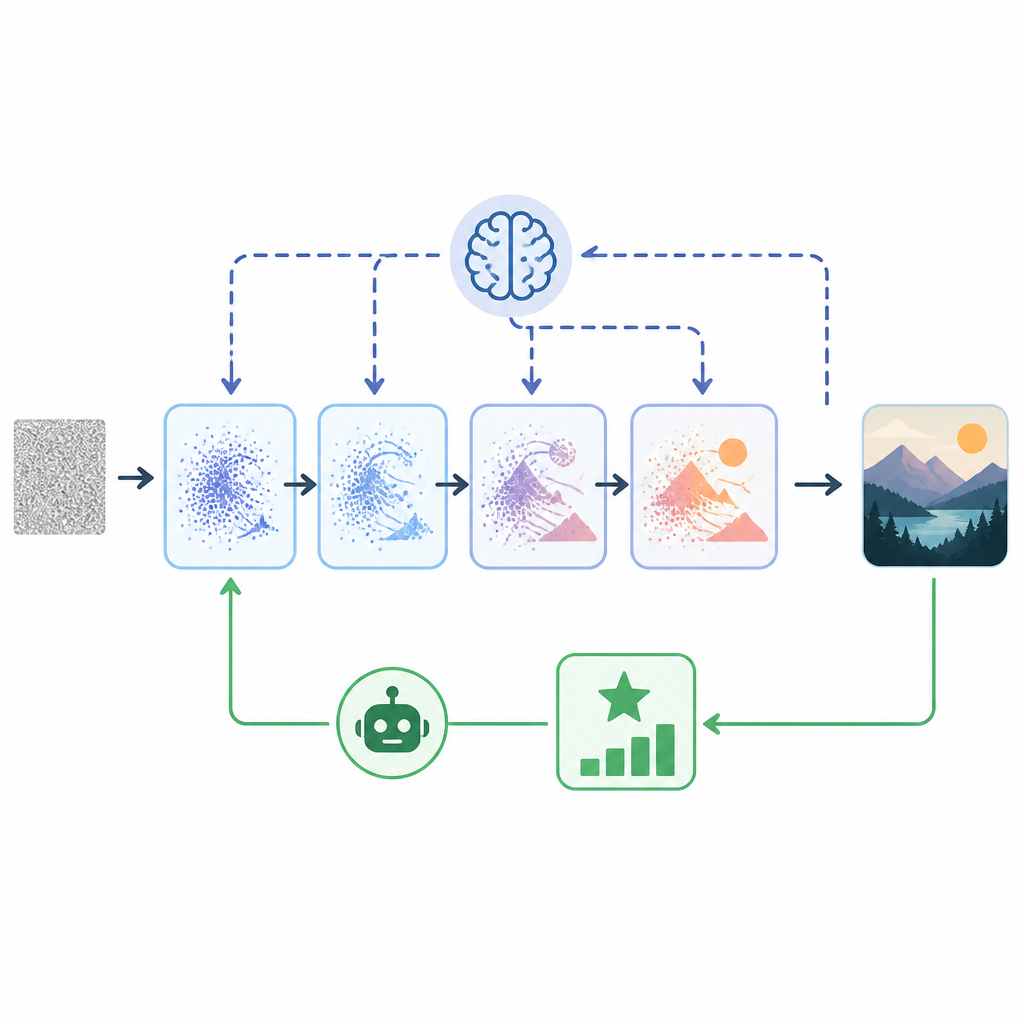
One concrete result stands out: on Wan 2.1, 4-step MeanFlowNFT reaches a VBench score of 84.33, which is higher than 50-step LongCat-Video RL at 82.57. That is the kind of result practitioners notice, because it suggests the method can beat a much more expensive sampling setup while using far fewer steps.
At the same time, the abstract does not give a full benchmark table, training cost, or implementation details. It also does not say whether the gains hold across every metric or every model family, only that the method improves baselines and wins on most metrics in the reported comparison.
- MeanFlowNFT is positioned as a forward-process RL method for average-velocity generators.
- It preserves few-step sampling while aligning outputs with reward objectives.
- Its reported gains include a 4-step result that beats a 50-step RL baseline on VBench.
Why developers should care
If you build generative systems, the practical takeaway is straightforward: alignment does not have to imply slower inference. MeanFlowNFT suggests you can apply RL-style optimization to a fast generator and still keep the sampling path short.
That matters for image and video products where latency, throughput, and compute cost all shape what is actually deployable. A method that improves quality without adding many sampling steps can be more useful than a stronger model that is too slow to ship.
The paper is also a reminder that training objectives are often tied to model parameterization. MeanFlow’s average-velocity setup is not just a different implementation detail; it changes what kind of RL objective makes sense, and this work shows one way to bridge that mismatch.
Limitations and open questions
The abstract is promising, but it leaves a lot unanswered. We do not get training compute, dataset scale, inference latency numbers, or a breakdown of how much the induced predictor adds in practice.
We also do not know from the abstract how robust the gains are outside the reported image and video settings, or whether the same approach transfers cleanly to other few-step generators. The paper claims broad improvement, but the exact boundaries of that improvement are not visible in the summary alone.
Still, the main idea is clear: MeanFlowNFT is trying to make forward-process RL usable for average-velocity generators without sacrificing the speed that makes them attractive. For anyone working on efficient generative models, that is a direction worth watching.
// Related Articles
- [RSCH]
RoboTTT scales robot memory to 8K timesteps
- [RSCH]
Partition, Prompt, Aggregate: Testing LLM Self-Consistency
- [RSCH]
MetaPerch uses metadata to boost bioacoustics models
- [RSCH]
OT-ICA Uses Wasserstein Distance for Linear ICA
- [RSCH]
MOJO adds unlabeled training to neural decoding
- [RSCH]
Claude's J-space is not consciousness, but it matters