Phase noise makes massive MIMO information age
This paper shows that pilot-based channel information can age in massive MIMO when phase noise is present.

This paper shows that pilot-based channel information can age in massive MIMO when phase noise is present.
- Research org: Unspecified in arXiv abstract
- Core data: No benchmark numbers in abstract
- Breakthrough: Iterative EM receiver for phase-noise aging in a 5G uplink
Phase noise is one of those RF-layer problems that looks small on paper and becomes a system-level headache in practice. In massive MIMO, the usual receiver pipeline can lose accuracy because the pilot-based information it relies on gets stale, and this paper focuses on that exact failure mode.
The practical angle matters for anyone building or studying uplink receivers: if your channel knowledge ages between training and detection, then a method that looked solid in a clean model can degrade once oscillator imperfections enter the picture. The authors do not claim to solve every impairment in massive MIMO; they target the specific interaction between phase noise and information aging.
What problem this paper is trying to fix
Get the latest AI news in your inbox
Weekly picks of model releases, tools, and deep dives — no spam, unsubscribe anytime.
No spam. Unsubscribe at any time.
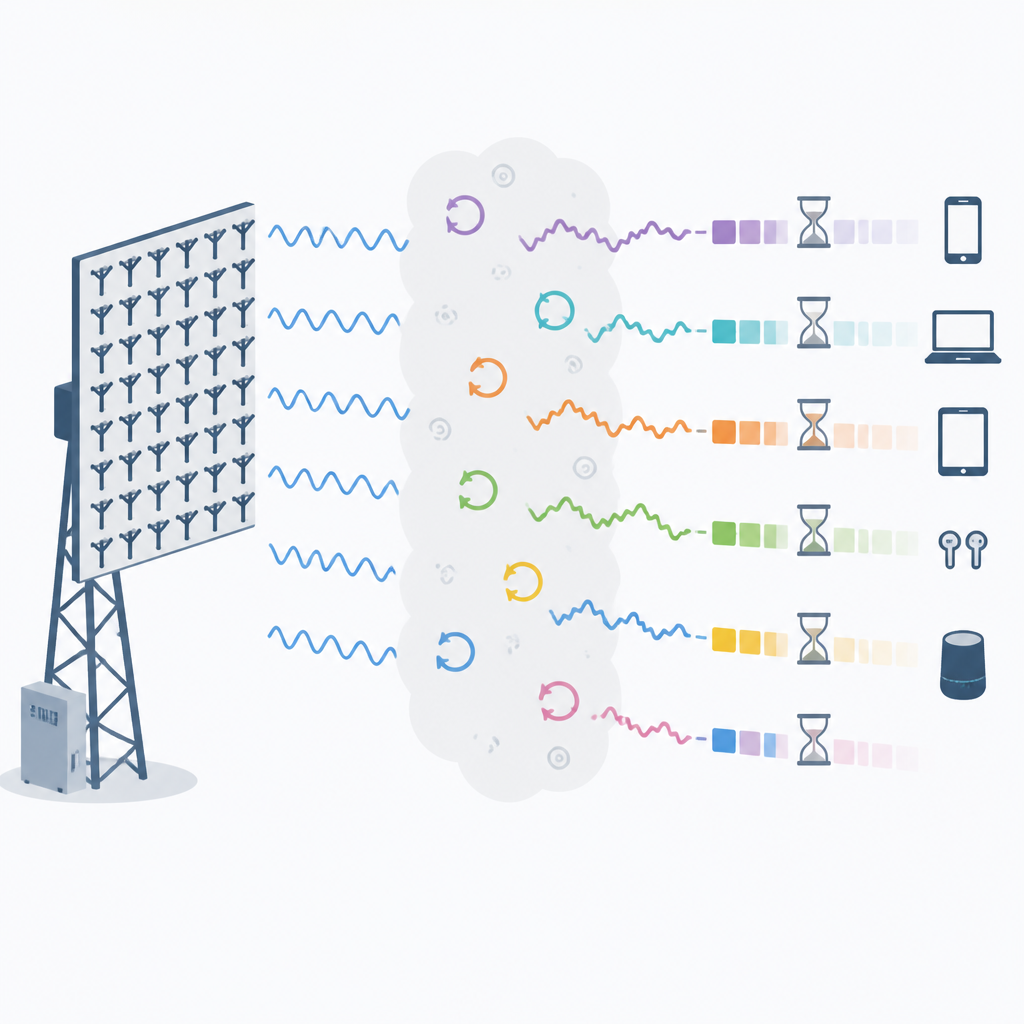
The paper starts from a simple observation: massive MIMO receivers often depend on information extracted from pilots, but phase noise can spoil that information over time. In other words, the receiver is not only dealing with noisy measurements; it is also dealing with knowledge that becomes less reliable as the system runs.

That is what the abstract calls “information aging.” The point is not just that phase noise exists, but that the receiver’s estimate of the channel or signal state becomes outdated because the phase drifts after pilot acquisition. Once that happens, standard receiver techniques can lose effectiveness.
The authors frame this in a realistic 5G uplink scenario, which is useful because it keeps the discussion close to deployment conditions rather than a toy setup. For engineers, that means the paper is about a real operational issue: how to keep detection working when the reference information is no longer fresh.
How the method works in plain English
The proposed fix is an iterative receiver based on expectation-maximization, or EM. At a high level, EM alternates between estimating hidden or uncertain parts of the problem and refining the receiver’s parameters using those estimates. Here, that iterative loop is used to cope with the uncertainty introduced by phase noise and stale pilot information.
Instead of trusting a single pass through the receiver chain, the method revisits the estimate repeatedly. That matters because phase noise makes the signal model less stable, so a one-shot detector can be too brittle. An EM-style receiver is a natural fit when the system has latent variables or incomplete information that need to be inferred jointly with the data.
The abstract does not spell out the full algorithmic details, and this is a short paper, so the implementation specifics are limited in the source material. What is clear is the design intent: make the receiver robust by iteratively correcting for the mismatch between what the pilots suggested earlier and what the current phase-noisy uplink actually looks like.
What the paper actually shows
The concrete result in the abstract is qualitative rather than numeric. The simulation results show that the iterative receiver is robust to information aging related to phase noise.
That is useful, but it also sets the limits of what we can conclude from the abstract alone. There are no benchmark numbers, no comparison table in the source text, and no explicit performance deltas quoted here. So the safe takeaway is not “it improves by X%,” but “the proposed EM receiver maintains robustness under the aging effect the authors study.”
The paper also says it quantifies the impact of information aging in a realistic 5G uplink scenario. That suggests the contribution is twofold: first, characterizing how much phase-noise aging hurts; second, showing that an iterative receiver can tolerate that degradation better than usual techniques. The abstract does not provide the full quantitative breakdown, so any deeper claims would require the paper itself.
- Massive MIMO receivers can be sensitive to stale pilot information.
- Phase noise is treated as a source of receiver-state aging, not just random impairment.
- An EM-based iterative loop is used to recover robustness in uplink detection.
Why developers and system engineers should care
If you work on wireless stacks, SDRs, or receiver algorithms, the lesson is straightforward: training information is not timeless. In systems with oscillator instability, the gap between channel estimation and data detection can matter just as much as the estimator itself.
That makes this paper relevant beyond theory. It points to a design pattern you can reuse: when the state you estimate is likely to drift, consider an iterative inference loop instead of a single-pass receiver. EM is not magic, but it is a practical way to keep re-aligning the receiver with the signal as the underlying phase evolves.
At the same time, the source material is careful not to overclaim. The abstract does not provide implementation cost, convergence behavior, latency impact, or hardware complexity. Those are exactly the questions an engineer would want next, especially if the receiver is meant for real-time use.
What is still open
Because the abstract is short, several useful details are missing. We do not get the exact simulation setup, the magnitude of the phase-noise model, the receiver baseline used for comparison, or the computational overhead of the EM loop. Those omissions do not weaken the paper’s core point, but they do limit how far you can generalize from the abstract alone.
There is also an architectural question left open: how well does this approach scale as the number of antennas grows, or as the uplink scenario becomes more crowded and less ideal? The abstract says “massive MIMO” and “realistic 5G uplink,” but it does not give the scaling story. That makes the paper a focused contribution on robustness, not a complete system blueprint.
For readers building next-gen wireless receivers, the main value is conceptual clarity. The paper isolates a failure mode that is easy to miss in clean channel models, then shows that an iterative EM receiver can handle it better. If your design assumes pilot-derived information stays fresh, this is a reminder to model drift explicitly.
In short, the paper argues that phase noise can age the information a massive MIMO receiver depends on, and that iterative inference is a workable response. It is a narrow result, but a practical one for anyone thinking about robust uplink detection in real 5G-like conditions.
// Related Articles
- [RSCH]
The OpenAI Hugging Face breach proves agents need hard limits now
- [RSCH]
Systema turns AIVC scores into a harder test
- [RSCH]
Stablecoin remittances hit 9% in Bank of Italy test
- [RSCH]
Stablecoins Hit $308B as SVB’s Shock Still Echoes
- [RSCH]
Rust compiler speed wins from July 2026
- [RSCH]
Build a Small Language Model with DeepMind