OpenAI’s Agents SDK gets safer enterprise controls
OpenAI added sandboxing and harness support to its Agents SDK, letting enterprises build longer-running agents with tighter controls.

OpenAI just gave its Agents SDK a more enterprise-friendly shape. The update adds sandboxing and in-distribution harness support, and OpenAI says the new capabilities ship to API customers at standard pricing.
That matters because agentic AI is moving from demos to workflows that touch files, tools, and internal systems. OpenAI’s pitch is simple: let agents do more work, but keep them inside controlled environments so they do not wander into places they should not touch.
What OpenAI changed in the SDK
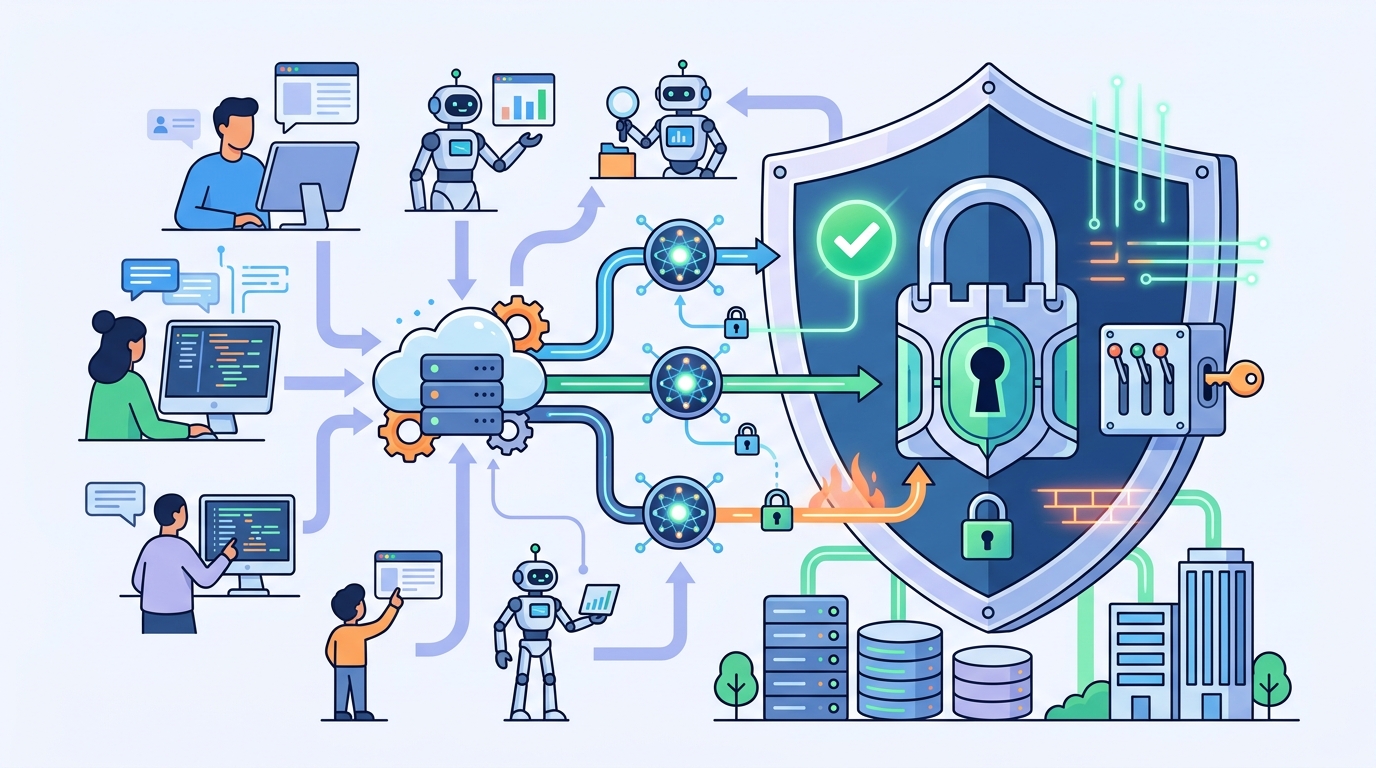
The headline feature is sandboxing. In practice, that means an agent can run inside a controlled computer environment instead of acting directly on a live system. For enterprises, that is less about elegance and more about damage control.

OpenAI also added support for an in-distribution harness for frontier models. In agent development, the harness is the surrounding infrastructure that helps a model interact with files, approved tools, and the rest of the workspace. OpenAI says the goal is to make the SDK work with different sandbox providers, so teams can keep their own infrastructure while still building on OpenAI models.
According to OpenAI product team member Karan Sharma, the update is about compatibility with sandbox providers and about helping teams build longer-running agents. He told TechCrunch that OpenAI wants developers to use the harness with whatever infrastructure they already have.
- Sandboxing keeps agents inside controlled environments.
- Harness support helps agents use files and approved tools inside a workspace.
- OpenAI says the new features are available through the API with standard pricing.
- Python gets the new capabilities first, while TypeScript support comes later.
- OpenAI plans to add code mode and subagents in both Python and TypeScript.
Why enterprises care about containment
Enterprises do not usually fear that an agent will fail in a dramatic movie-style way. They fear smaller failures: a bad file write, a wrong tool call, or an agent that reaches outside its lane. Sandboxing lowers that risk by keeping the agent’s actions bounded.
That is especially relevant for long-horizon tasks, the kind that take many steps and may involve multiple files, APIs, or approvals. OpenAI’s move suggests it knows the market is no longer impressed by chatbots that answer questions. Companies want agents that can do work for hours, not minutes.
“This launch, at its core, is about taking our existing Agents SDK and making it so it’s compatible with all of these sandbox providers,” Karan Sharma told TechCrunch.
The quote is useful because it shows OpenAI is not trying to lock enterprises into one runtime story. It is trying to make the SDK fit into the messy reality of corporate infrastructure, where security teams, platform teams, and application teams all have opinions.
That matters more than a flashy demo. If an enterprise wants to test an agent on internal documents, code, or operational tools, it needs guardrails that security teams can understand. Sandbox support gives those teams a cleaner story: the agent can act, but only inside a controlled box.
How this compares with other agent stacks
OpenAI is not alone here. Anthropic has pushed hard on agentic workflows too, and the broader market is converging on the same idea: the model matters, but the surrounding controls matter just as much. The winner in enterprise AI may be the stack that makes audits and permissions less painful.
The practical difference now is that OpenAI is packaging those controls directly into its SDK rather than leaving teams to assemble everything themselves. That can shorten the path from prototype to deployment, especially for teams that already use OpenAI’s API.
- OpenAI Agents SDK: new sandboxing and harness support, with Python first and TypeScript later.
- Claude: strong agentic workflows, but enterprises often still stitch together more of the runtime themselves.
- OpenAI’s Python SDK repo: the first place the new capabilities land.
- TypeScript: support is coming later, which matters for front-end-heavy and full-stack teams.
There is also a pricing angle. OpenAI says these new SDK capabilities use standard API pricing, which means the company is not asking enterprises to buy into a separate premium product just to get safer agent execution. That lowers friction, at least for teams already spending on model calls.
Still, the rollout order matters. Python first means the earliest adopters will likely be backend-heavy teams and automation groups. TypeScript support coming later leaves a gap for web-first teams that want the same controls in their app stacks.
What this says about OpenAI’s enterprise strategy
OpenAI is clearly treating agents as a product category, not a side feature. The company has been steadily turning model access into developer tooling, and this update pushes further in that direction. The message to enterprises is: you can build something more autonomous, and you do not need to trust it blindly.
That is a smart move, because trust is the bottleneck now. A model that can reason through a task is useful. A model that can do that inside a workspace with file access, tool permissions, and constrained execution is what enterprises will actually buy.
OpenAI also said it plans to add code mode and subagents to both Python and TypeScript. Those additions hint at more complex agent architectures, where one agent can delegate to another or switch into a code-focused workflow. That is where agent products start to feel less like chat interfaces and more like software systems.
My read: OpenAI is trying to make the SDK the default place where enterprise agent projects begin. If the company keeps shipping controls faster than teams can build them internally, it could become the easiest path for companies that want agents without building their own guardrail stack from scratch.
The real test is whether developers adopt the new sandbox and harness features for actual work, not just demos. If they do, the next wave of enterprise AI apps will probably look less like a chatbot and more like a tightly supervised operator inside company systems.
For teams already prototyping agents, the actionable takeaway is straightforward: start by mapping which files, tools, and actions your agent should never touch, then see whether OpenAI’s new SDK controls are enough before you write custom infrastructure. If they are, you save time. If they are not, you at least learn where the gaps are before the agent reaches production.


