Anthropic’s contrarian playbook turns enemies into growth
How Anthropic’s weird choices on safety, hiring, and product focus turned rejection into revenue.

Anthropic turned safety-first choices into a business moat.
I’ve been watching Anthropic for a while, and honestly, it kept annoying me. Every time the rest of the AI crowd sprinted toward bigger demos, louder launches, and whatever would juice the next headline, Anthropic seemed to do the opposite. Less flash. More guardrails. Slower releases. Weird hiring rules. Refusing the easy money. It looked like the kind of strategy that gets mocked in the room until it starts working, and then everyone pretends they saw it coming.
What finally clicked for me was not the model quality by itself. It was the pattern. Anthropic keeps making decisions that offend somebody important: investors, competitors, governments, even parts of its own ecosystem. Yet those same decisions have helped it build a business that is now hard to ignore. That tension is the whole story here, and it’s why I wanted to break down the original piece from 脑极体 on Zhihu into something you can actually use.
1. Stop reading Anthropic as a normal startup
Get the latest AI news in your inbox
Weekly picks of model releases, tools, and deep dives — no spam, unsubscribe anytime.
No spam. Unsubscribe at any time.
“Anthropic’s enemy list covers almost the entire AI map.”
What this actually means is that the company is not optimized for making everyone happy. It is optimized for keeping a narrow set of principles intact, even when that creates friction everywhere else. The original article frames Anthropic as a company that has fought with China’s major AI firms, the U.S. government, investors, its former employer OpenAI, and parts of the market that expected faster, louder growth.

I think that framing matters because most startup advice assumes conflict is a bug. Anthropic treats conflict like a side effect of having a real position. If you refuse military work, tighten usage rules, and prioritize safety over speed, somebody is going to hate you. That’s not a branding accident. That’s the business model.
The source article says Anthropic’s founder Dario Amodei moved from Baidu, then Google Brain, then OpenAI, before leaving with a group of researchers to found Anthropic. That path matters because it explains the company’s reflexes. It was born out of frustration with how AI was being built and shipped. I’ve seen a lot of teams claim they have principles, then drop them the minute the first serious revenue opportunity shows up. Anthropic’s whole identity is basically: no, we’re still doing the annoying thing.
How to apply it: if you’re building a product or team, decide what you will not do before you decide what you will sell. Write down the lines you will not cross. If those lines never create tension, they probably are not real.
- Pick one value that can survive contact with revenue.
- Expect early backlash if that value is meaningful.
- Do not confuse being disliked with being wrong.
2. The founder story is not a biography, it’s a product thesis
The article starts with Dario Amodei’s odd path into AI: biology, Stanford, Baidu, Google, OpenAI, then Anthropic. That isn’t just founder lore. It explains why Anthropic became so obsessed with safety, evaluation, and controlled release. Dario wasn’t the classic “ship fast, ask forgiveness later” founder archetype. He looked like someone who kept running into the limits of the systems he joined.
I found that part useful because founder origin stories usually get flattened into inspiration sludge. Here, the path actually predicts the product. At Baidu, he worked on speech recognition. At OpenAI, he helped build GPT-2, GPT-3, and RLHF. Then he left when the tension between research caution and commercial pressure got too sharp. That’s the real throughline: he kept landing in places where speed wanted to beat judgment, and he kept choosing judgment.
What this actually means is that Anthropic’s product choices are not random. They are the direct output of the founder’s scar tissue. The company built Claude around controlled behavior, cleaner interfaces, and a more conservative release posture. It wasn’t trying to be the toy everyone opens once. It was trying to be the tool people trust every day.
If I were translating this into team advice, I’d say: don’t treat founder background as a pitch-deck paragraph. Treat it like a constraint system. The stuff that frustrated you in your last job usually becomes the thing you design against in your next one.
How to apply it:
- Write down the last three things that made you quit or want to quit a team.
- Turn those frustrations into product or org rules.
- Make sure the rules are visible enough that people can actually test them.
3. Refusing the obvious capital path can be a strategy, not a handicap
“Anthropic faced rejection from 21 top VC firms.”
The article makes a big deal out of this, and I get why. In the usual startup script, the company that exits OpenAI with a core research team should have been an easy funding story. Instead, it got rejected repeatedly because investors wanted speed, scale, and monetization, not restraint. That sounds like a disaster until you realize it also forced Anthropic to define itself without investor cosplay.
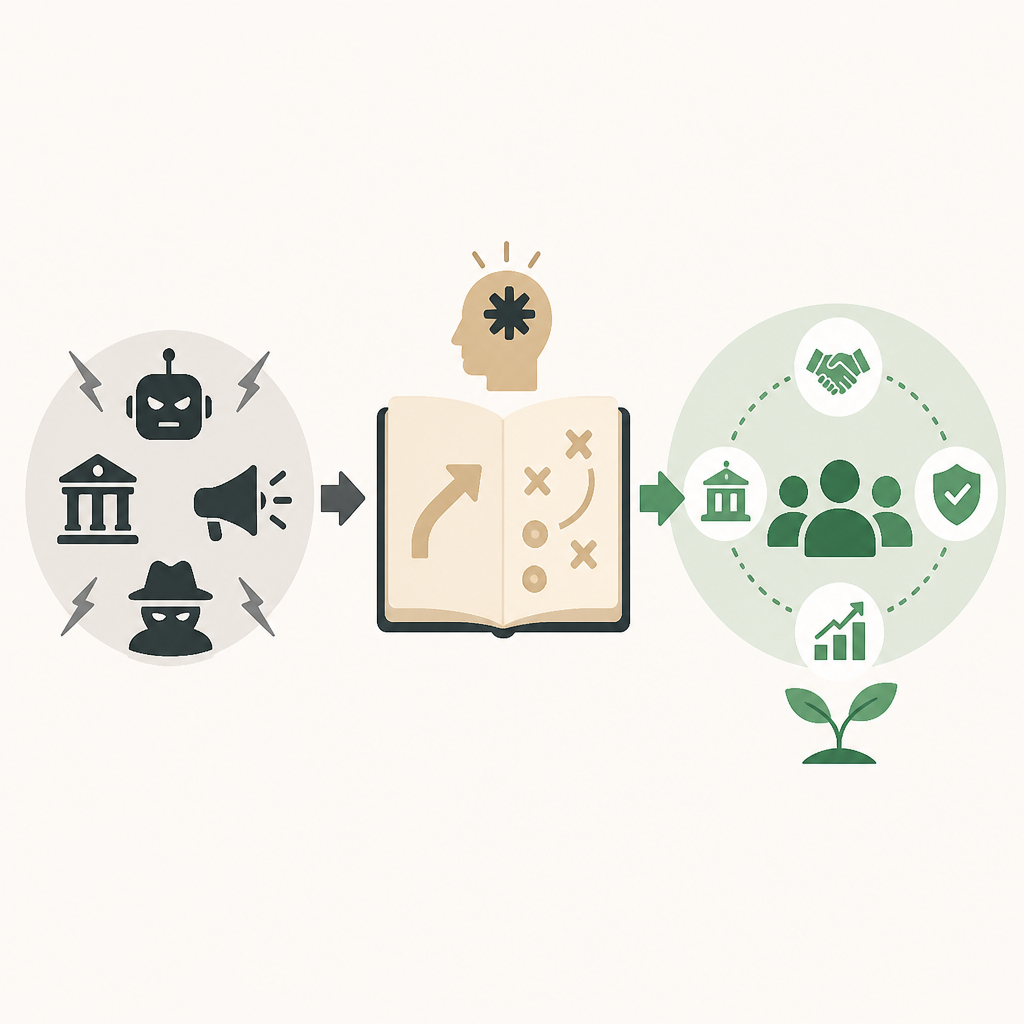
What this actually means is that scarcity can protect a company from becoming a generic clone of its competitors. If everyone who writes you a check wants the same thing, your roadmap gets narrow in a very specific way. Anthropic’s early funding pain seems to have bought it room to stay weird. The article says the first real round came from people like Jaan Tallinn, Dustin Moskovitz, and Eric Schmidt, not the usual growth-at-all-costs crowd.
I’ve seen this pattern before in smaller form. The teams that get funded by people who actually understand the tradeoffs usually end up with more room to make unpopular decisions. The teams that get funded by momentum often become hostage to momentum. Anthropic’s early rejection probably hurt like hell, but it also filtered out the investors who would have pushed it into a faster, dumber version of itself.
How to apply it: if you’re raising money or selling a product, ask what kind of pressure your backers create. Cheap capital that forces bad behavior is expensive. Expensive capital that protects your operating model can be worth it.
- Map the decisions your investors will expect after the check clears.
- Reject money that requires you to betray the product’s core promise.
- Use early rejection to sharpen the company’s edge, not soften it.
4. Anthropic did not win by chasing every shiny AI feature
The article says Anthropic chose an “extreme minimalism” path: cleaner training data, more efficient architecture, fewer flashy features, and a stripped-down Claude experience. That’s boring on purpose. No giant feature pile. No desperate grab for every new interface trend. No pretending that every model needs to do everything.
What this actually means is that Anthropic made a bet on usefulness over spectacle. The market was busy rewarding demos, but Anthropic leaned into reliability and lower inference cost. That mattered because enterprise buyers do not care about your launch video. They care about whether the model behaves predictably, integrates cleanly, and doesn’t turn their workflow into a support ticket factory.
I ran into this exact lesson while building internal AI tools. The flashy version always looks better in a demo. Then the team tries to use it for real work and suddenly the “cool” features become maintenance debt. Anthropic seems to have understood that early. The article points out that Claude’s interface was intentionally plain, and that the company focused on API quality and enterprise stability while everyone else chased consumer chat traffic.
The result, according to the source, is that Anthropic ended up with customers like Netflix, Spotify, KPMG, L’Oréal, and Salesforce. That list is the point. Enterprise adoption is often what happens when the product stops trying to entertain people and starts trying to reduce risk.
How to apply it:
- Cut features that exist mainly to impress investors or social media.
- Optimize for repeat usage, not first-click delight.
- Measure whether your product lowers friction inside a workflow, not just whether it looks smart in a demo.
5. Hiring for belief is not the same as hiring for vibes
“Anthropic interviews candidates on values, boundaries, and long-term commitment.”
This is one of the stranger parts of the article, and also one of the most important. Anthropic apparently screens for alignment on AI safety, long-term work, and usage boundaries before it screens for prestige. It even bans the use of AI in the hiring process. That is not a cute policy. It is a filter.
What this actually means is that Anthropic is not trying to build a team of mercenaries. It wants people who can tolerate a slower, more principled operating mode. The article claims this has helped the company keep a very high retention rate, even while the rest of the AI industry gets shredded by poaching and compensation wars.
I’m skeptical of any company that says culture solves everything, because a lot of culture talk is just HR perfume. But I do think there is something real here. If the work is hard, expensive, and politically loaded, then shared belief matters. Not as a slogan. As a coordination mechanism. You need people who won’t panic when the obvious growth move is also the wrong one.
How to apply it: stop hiring only for raw ability. Hire for the kinds of tradeoffs your company actually faces. If you are building infrastructure, you need patience. If you are building regulated products, you need judgment. If you are building AI systems, you need people who can sit with ambiguity without turning into chaos.
- Ask candidates what they would refuse to build.
- Ask how they handle pressure from revenue goals.
- Use interviews to test operating philosophy, not just technical fluency.
6. Flat org design can remove the usual startup poison
The article says Anthropic uses a very flat internal structure, with technical staff sharing the same title and founders not sitting above everyone else in some exaggerated hierarchy. It also says the founders’ ownership is unusually balanced. That’s not just an org chart quirk. It changes how people behave when they disagree.
What this actually means is that Anthropic is trying to reduce status games. In a lot of startups, hierarchy leaks into every technical conversation. People optimize for who gets credit, who gets promoted, who controls the roadmap. Once that starts, the product becomes a hostage to internal politics. Flat structures are not magic, but they can reduce the amount of energy burned on theater.
I’ve worked in teams where the title ladder mattered more than the code. It is miserable. People stop arguing about the best solution and start arguing about who gets to be seen as the person who found it. A flatter system doesn’t make disagreement disappear, but it can make it easier to keep the conversation on the work.
How to apply it: if you manage a team, inspect the incentives created by your titles, comp, and decision rights. If junior people cannot challenge senior people without social risk, your org is already leaking quality.
Try this instead:
- Use fewer title distinctions inside technical teams.
- Make decision ownership explicit, not ceremonial.
- Reward good disagreement, not just fast agreement.
7. The real trick is that Anthropic chose the market everyone else ignored
The article’s strongest point, in my view, is that Anthropic did not win by out-ChatGPTing ChatGPT. It won by spending time on enterprise users while everyone else chased consumer attention. In 2023, the market was obsessed with chatbots and daily active users. Anthropic was quiet, boring, and focused on APIs. Then the enterprise market turned out to be where the money actually was.
What this actually means is that timing matters, but so does category selection. If you build for the loudest audience, you will probably get the loudest feedback. If you build for the audience with the clearest willingness to pay, you may look late right up until you look smart.
The article claims that by 2026, Anthropic’s annualized revenue had exploded and major companies were using Claude heavily. It also says OpenAI started reacting by considering price cuts to defend enterprise customers. That is the part people miss when they reduce the story to “Anthropic is the safety company.” No. It is also a company that made a very practical business bet and executed it before the market fully understood the value of that bet.
How to apply it: if you’re choosing a market, don’t just ask where the attention is. Ask where the durable budget is. Those are not the same thing.
The template you can copy
# Contrarian AI startup playbook

## Positioning
We do not try to please every AI buyer.
We optimize for trust, predictable behavior, and long-term usefulness.

## What we will not do
- We will not ship features that exist only for hype.
- We will not sell into use cases that violate our safety boundaries.
- We will not hire only for prestige or speed.
- We will not let short-term growth override product trust.

## Product rules
- Keep the first experience simple.
- Prioritize API reliability and workflow fit over flashy demos.
- Reduce model cost by improving data quality and efficiency before adding more scale.
- Treat enterprise adoption as a primary product goal, not a fallback.

## Hiring rules
- Screen for judgment, not just credentials.
- Ask candidates what they would refuse to build.
- Test whether they can work with constraints.
- Prefer people who can sustain a long, boring, important problem.

## Org rules
- Minimize title inflation.
- Make ownership explicit.
- Reduce status games.
- Reward principled disagreement.

## Investor rule
- Only take capital that accepts the company’s boundaries.
- If a backer wants you to become a faster, looser version of yourself, pass.

## Operating question
Before every major decision, ask:
"Does this increase trust, or does it just increase noise?"

## Copy block for your team doc
Our company chooses trust over spectacle.
We will optimize for durable usage, clear boundaries, and products people can rely on.
If a decision improves growth but weakens trust, we do not ship it.
If a decision slows us down but strengthens the product’s integrity, we consider it a win.
The template above is my distilled version of the article’s argument, not a quote. I’m turning the pattern into something you can paste into a strategy doc, team charter, or product brief. If your company is drifting into “ship anything, please everyone” mode, this is the kind of language that can reset the conversation.
Original source: https://zhuanlan.zhihu.com/p/2060013679488374551. My breakdown is derivative of that Zhihu article, but the framing, template, and practical checklist here are mine.
// Related Articles
- [IND]
Anthropic’s eerie new ad sparks backlash
- [IND]
OpenAI hires Google Cloud channel chief Philip Larson
- [IND]
OpenAI’s partner network now has a clear path
- [IND]
GPGPU turned graphics chips into general compute engines
- [IND]
AI Firms Are Filling London Offices Fast
- [IND]
Warner’s AI AGENT Act targets platform AI control