AVA-Encoder turns films into editable knowledge graphs
AVA-Encoder turns video into a knowledge graph so agents can reason about and reconstruct films.
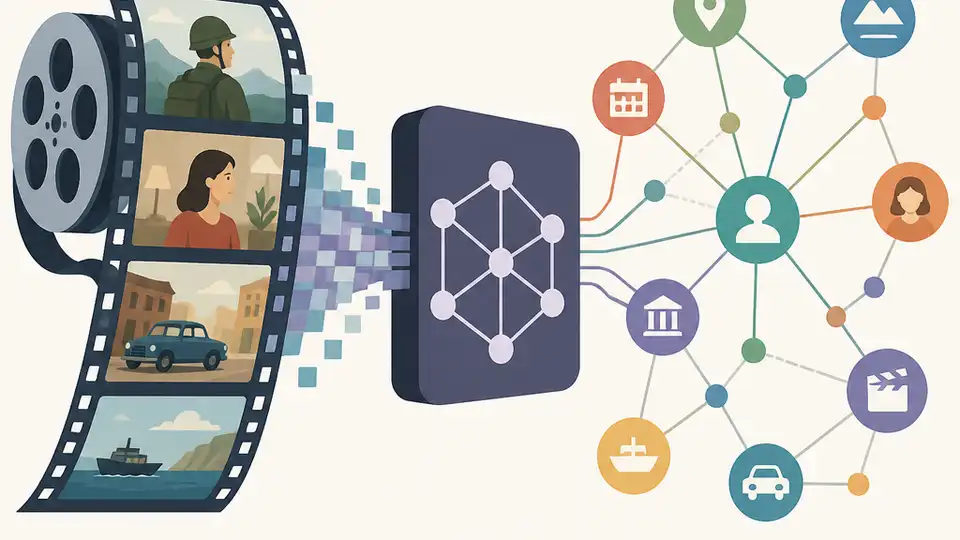
AVA-Encoder turns video into a knowledge graph so agents can reason about and reconstruct films.
- Research org: Unspecified in arXiv abstract
- Core data: 20.7 percentage points over the strongest external baseline
- Breakthrough: Converts video to a typed knowledge graph, then reconstructs it back to video
High-quality film video is hard for creative agents to learn from because raw pixels are not a convenient format for reasoning, editing, or structured memory. This paper argues that the missing piece is not just better encoders, but a representation that keeps film content faithful while making it usable for agentic workflows.
That matters if you are building systems that need to understand scenes, manipulate shots, or generate cinematic video with more control. Instead of treating video as a flat stream of frames, AVA-Encoder tries to make it legible to an agent: inspectable, queryable, and editable.
What problem this paper is trying to fix
Get the latest AI news in your inbox
Weekly picks of model releases, tools, and deep dives — no spam, unsubscribe anytime.
No spam. Unsubscribe at any time.
The paper starts from a simple limitation: creative agents still lack an effective way to learn from high-quality human films. Without a structured video representation, the model may see the visuals, but it does not get a clean way to preserve the relationships that matter for reasoning and manipulation.

In the authors’ framing, the challenge is not only fidelity. A useful representation has to be both faithful to the film content and directly usable for agentic reasoning. That is a harder target than standard video compression or generic embedding learning, because the representation has to support downstream editing and control, not just reconstruction.
AVA-Encoder is the proposed answer. The framework is called an Agentic Video Auto-Encoder, and its goal is to learn agent-native video representations through agentic auto-encoding.
How the method works in plain English
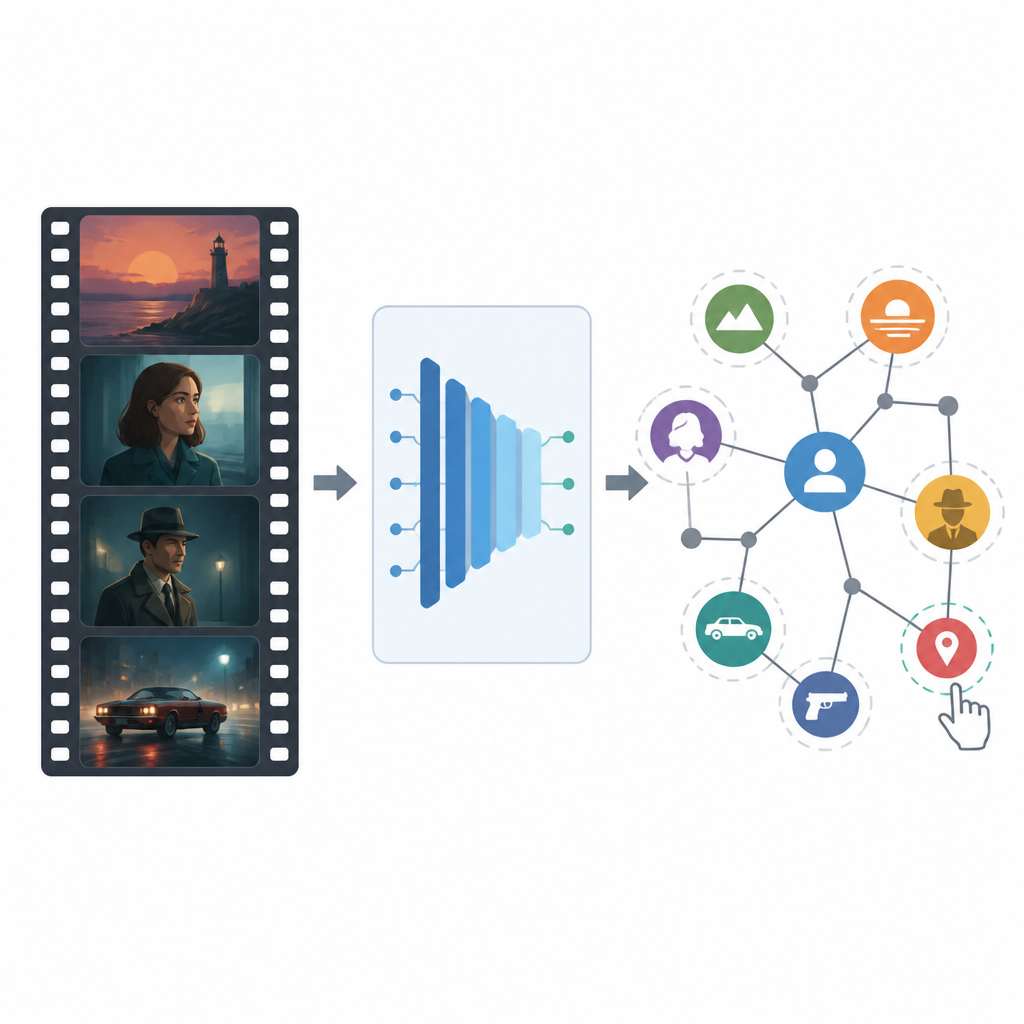
The core idea is to convert a video into a knowledge graph, then reconstruct the video from that graph. The graph is not just a bag of captions. It has a hierarchy and state nodes that store structured text, plus a linked asset layer that contains generated images, audio, and video.
Typed edges connect the text descriptions to the assets. That structure is the key design choice: it preserves relations in a form that agents can understand, query, and edit. In other words, the model is trying to encode not just what is in the scene, but how the pieces relate to each other.
The reconstruction step is also part of the learning signal. Differences between the reconstructed video and the original drive a textual-gradient optimization framework. The paper describes this as expressing evaluation feedback as natural-language update directions.
Those update directions are used in two places. First, they support Data-Independent Encoding Policy Pseudo-Training in the outer loop. Second, the framework can optionally do Data-Dependent KG Representation Refinement in a test-time inner loop. The abstract does not spell out every implementation detail, but the overall pattern is clear: use text-based feedback to improve how the graph representation is built and refined.
What the paper actually shows
The paper reports that AVA-Encoder improves by 20.7 percentage points over the strongest external baseline. The abstract does not name the benchmark in that sentence, so the exact evaluation setting is not visible in the source text provided here.
It also says that, in a controlled policy-only setting, the pseudo-trained shot-level Agentic Video Encoder policy outperforms a carefully human-tuned policy while using 74.3% fewer system-prompt tokens. That is a notable result for developers because it suggests the system can reduce prompt overhead while still beating a manually tuned alternative.
The authors also say they release three things: the complete AVA-Encoder framework, a reliable agentic video reconstruction benchmark, and the first dataset of high-quality film KG representations. The abstract does not include the benchmark’s numeric details, so there are no extra scores to report here.
One thing to keep in mind is that the strongest claims in the abstract are framed around reconstruction, policy quality, and prompt efficiency. The source does not provide a full breakdown of failure modes, so it is not possible to tell from the abstract alone where the method struggles most.
Why developers should care
If you are building video agents, editors, or multimodal systems that need more than frame-level embeddings, this paper points toward a more operational representation. A knowledge-graph view of video could make it easier to ask structured questions, attach edits to specific entities or states, and preserve relationships across long clips.
The practical appeal is not just about better compression. It is about turning video into something a system can reason over. That could matter for tasks like shot-level manipulation, cinematic planning, retrieval over film content, or any pipeline where the model needs to preserve semantics while making changes.
There are still open questions. The abstract does not tell us how expensive graph construction is, how well the method scales beyond high-quality films, or how robust the representation is when the video content is messy, ambiguous, or highly dynamic. It also does not give benchmark numbers in the abstract beyond the reported improvement and token reduction.
Even with those limits, the direction is interesting: instead of asking agents to learn directly from raw video, AVA-Encoder gives them a structured intermediate form. For teams working on controllable video generation or agentic media tools, that is a useful design pattern to watch.
Bottom line
AVA-Encoder proposes a way to represent video as a typed knowledge graph that agents can manipulate, then reconstruct back into video. The paper’s reported gains suggest that this kind of structured representation can improve both quality and efficiency, even though the abstract leaves several evaluation details unspecified.
- Video is treated as a structured knowledge graph, not just a sequence of frames.
- Textual-gradient feedback is used to train and refine the representation.
- The method reports a 20.7-point gain and 74.3% fewer system-prompt tokens in one setting.
// Related Articles
- [RSCH]
Test-Time Harnesses Transfer Skills Without Retraining
- [RSCH]
DreamFly improves aerial VLN with memory and planning
- [RSCH]
Sparse Autoencoders Don’t Behave Like Feature Bags
- [RSCH]
ConVAWG generates controlled VAWG dialogues
- [RSCH]
Surgical WAM uses video to train robot control
- [RSCH]
SWE-bench Verified has stopped being a clean model leaderboard