ConVAWG generates controlled VAWG dialogues
ConVAWG generates 6,000+ synthetic VAWG dialogue events from retrieval-grounded scenarios and controls toxicity at the turn level.

6,000+ synthetic dialogue events show ConVAWG can generate controlled VAWG scenarios with turn-level toxicity steering.
- Research org: Unspecified in arXiv abstract
- Core data: Over 6,000 multi-turn dialogue events
- Breakthrough: Retrieval-grounded scenario building with targeted activation-steered toxicity control
For teams that need to study harmful conversational dynamics without exposing real victims’ data, this paper offers a practical synthetic-data pipeline. The core idea is simple: model violence against women and girls as multi-turn dialogue, not as isolated toxic sentences, so the data better reflects how abuse unfolds over time.
The paper is about a hard engineering problem with real constraints. In sensitive domains, real conversations are often too private, too legally constrained, or too risky to release at scale. That leaves researchers and developers with a gap: they can detect obvious abusive language, but they have less to work with when they want to model escalation, coercion, surveillance, isolation, stalking, or violence as part of a longer interaction.
What problem this paper is trying to fix
Get the latest AI news in your inbox
Weekly picks of model releases, tools, and deep dives — no spam, unsubscribe anytime.
No spam. Unsubscribe at any time.
Most prior work, according to the abstract, has focused on sentence-level toxicity in online abuse. That is useful, but it misses the relational and temporal structure of abuse. A single message can be harmful, yet many real-world abuse patterns are spread across multiple turns, with context building over time.

ConVAWG is designed to fill that gap by generating synthetic dialogues that are aligned with CPS-style scenarios. The paper frames these as Violence Against Women and Girls, or VAWG, and treats the problem as one of controlled scenario generation rather than generic chat synthesis.
That distinction matters for engineers. If you are building moderation tools, safety classifiers, dialogue analysis systems, or evaluation sets for harmful-conversation detection, you need data that looks like an unfolding interaction, not just a list of bad phrases. Synthetic multi-turn data can help when real data cannot be shared.
How the method works in plain English
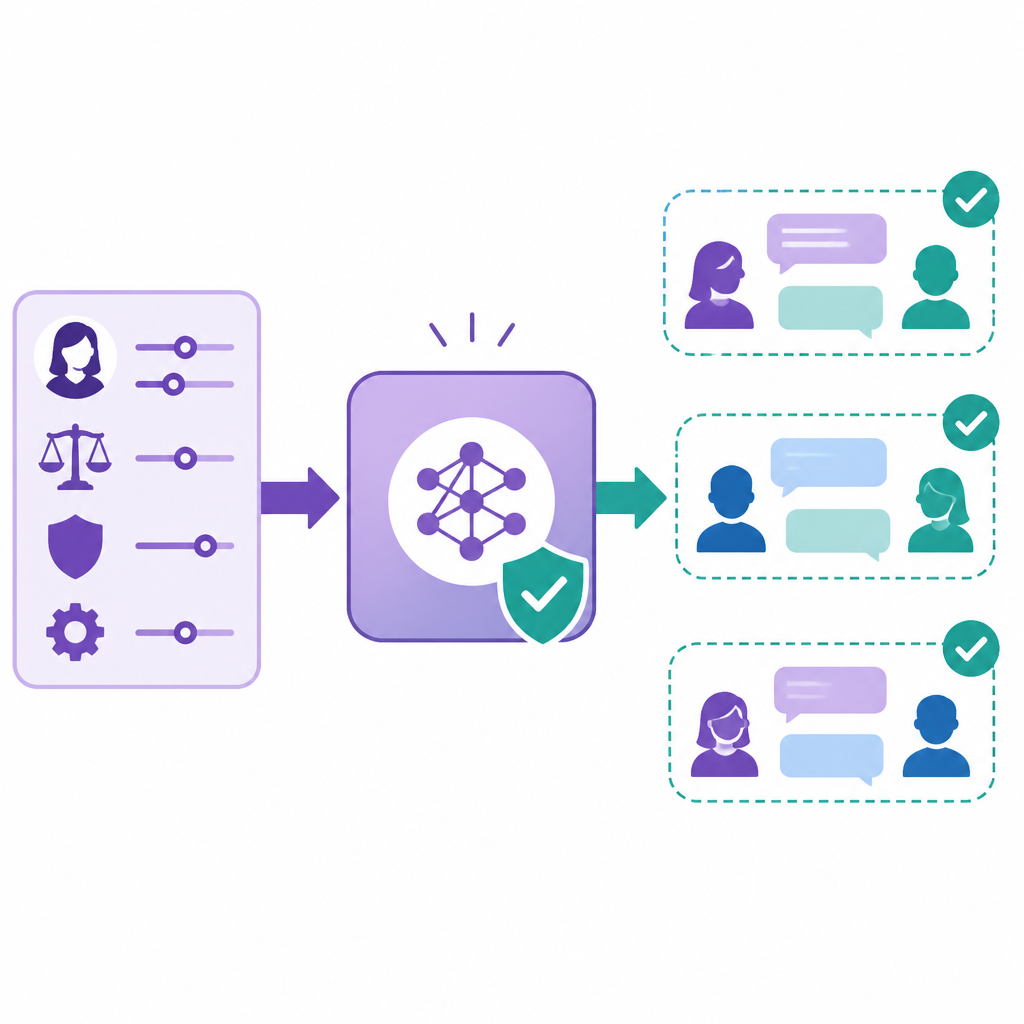
ConVAWG starts from persona seeds and demographic patterns reported by the UK Office for National Statistics. It also uses official crime definitions and retrieved Domestic Homicide Review cases. Those ingredients are turned into hierarchical event timelines, which then drive the generation of multi-scene role-play dialogues.
In other words, the system does not just ask a model to improvise abuse. It first grounds the scenario in retrieved and structured material, then expands that structure into a dialogue sequence. That should make the outputs more coherent and more faithful to the kinds of situations the authors want to represent.
The other key piece is toxicity control. The abstract says the framework applies targeted activation-steered toxicity control to appropriate utterances. The paper does not spell out implementation details in the abstract, but the intent is clear: toxicity is not sprayed across the whole conversation; it is steered where the scenario calls for it.
This is a useful design pattern beyond this specific domain. Retrieval for grounding, structured timelines for consistency, and selective control for safety or realism are all techniques that can transfer to other sensitive synthetic-data workflows.
What the paper actually shows
The release includes over 6,000 multi-turn dialogue events across 200 scenarios, with rich scenario-, event-, and turn-level metadata. That metadata is likely the most practically valuable part for downstream work, because it gives users more than plain text: they can filter, group, and evaluate by structure as well as content.
The abstract says the authors ran extensive human evaluation, LLM-as-Judge assessment, ablations, and downstream tasks, and that these show strong dialogue quality and domain fidelity. However, the abstract does not provide benchmark scores, exact human ratings, or detailed task metrics, so those numbers are not available here.
That means the paper’s strongest publicly visible claim is methodological and dataset-oriented rather than numerical. It presents a controlled generation framework, not a leaderboard result. For many applied teams, that can still be enough if the goal is to build evaluation data or stress-test safety systems.
- Retrieval-grounded scenario construction ties dialogue generation to external case material.
- Hierarchical event timelines help preserve multi-turn narrative structure.
- Activation-steered toxicity control targets harmful content more selectively.
Why developers should care
If you work on moderation, safety evaluation, or abuse-detection pipelines, the main value here is realism under constraint. Synthetic data is only useful if it captures the structure of the thing you are trying to detect. This paper argues that abuse is often a process, not a sentence, and builds a generation system around that idea.
The dataset format also sounds more usable than a flat text dump. Scenario-level, event-level, and turn-level metadata can support curriculum design, targeted evaluation, and error analysis. You can inspect where the model introduces escalation, where it loses coherence, and where toxicity appears relative to the scenario timeline.
There are still limits. The abstract does not tell us how diverse the scenarios are beyond the 200-scenario figure, how faithfully the synthetic dialogues match real-world abuse patterns, or how well the system generalizes outside the VAWG setting. It also does not provide benchmark numbers, so claims about performance should be read as qualitative unless the full paper says more.
There is also a broader caution with any synthetic abuse dataset: controlled generation can help with access and privacy, but it can also encode the assumptions of its source material and its prompting pipeline. Practitioners should treat the output as a tool for analysis and evaluation, not as a substitute for real-world understanding.
Bottom line
ConVAWG is a retrieval-grounded synthetic dialogue framework for a domain where real data is hard to use and abuse unfolds over time. Its main contribution is not a flashy benchmark number; it is a structured way to generate multi-turn VAWG conversations with metadata and controlled toxicity.
For developers, that makes it relevant as a template for safer synthetic-data generation in other sensitive domains. If you need dialogue data that is grounded, controllable, and inspectable, this paper is pointing in the right direction.
// Related Articles
- [RSCH]
Sparse Autoencoders Don’t Behave Like Feature Bags
- [RSCH]
Surgical WAM uses video to train robot control
- [RSCH]
SWE-bench Verified has stopped being a clean model leaderboard
- [RSCH]
Dutch Government LLMs Need More Than Accuracy
- [RSCH]
MMDiff maps and steers multimodal features
- [RSCH]
TTS evaluators miss more than naturalness