A benchmark for scientific lineage reasoning
IG-Bench tests whether LLMs can trace scientific idea lineage and generate new ideas from it.

IG-Bench tests whether LLMs can trace scientific idea lineage and generate new ideas from it.
- Research org: Unspecified in arXiv abstract
- Core data: 27.3% exact accuracy
- Breakthrough: Idea Genome objects plus GenomeDiff lineage alignment
Scientific papers do not usually emerge from nowhere. They borrow mechanisms, patch weak spots, drop outdated pieces, and import ideas from nearby work. This paper argues that current AI benchmarks mostly miss that reality, so it introduces a way to test whether models can reason about scientific inheritance instead of just summarizing isolated papers.
For developers building research assistants, literature tools, or idea-generation systems, that matters a lot. A model that can name papers but cannot track how one idea evolves into another is not very useful when the task is to propose something new that still fits the surrounding lineage.
What problem this paper is trying to fix
Get the latest AI news in your inbox
Weekly picks of model releases, tools, and deep dives — no spam, unsubscribe anytime.
No spam. Unsubscribe at any time.
The core complaint here is simple: existing benchmarks do not say much about whether an AI system can follow the inheritance structure of scientific ideas. In other words, they test surface-level understanding more than lineage-aware reasoning.

The authors frame scientific ideas as something closer to genomes than isolated text snippets. A scientific proposal may inherit some parts from prior work, mutate others, lose pieces that no longer fit, import external components, or insert something genuinely new. That is the behavior the benchmark is trying to capture.
To make that testable, the paper introduces IdeaGene-Bench, or IG-Bench, which is built around the IdeaGene framework. The goal is not just to ask whether a model can read papers, but whether it can reconstruct how ideas are related across a research lineage and then generate a plausible descendant idea grounded in that lineage.
How the method works in plain English
The basic unit in the framework is the Idea Genome object. Each paper or proposal is represented as a set of minimal, typed, evidence-grounded Idea Genome objects. That means the benchmark tries to break a scientific idea into small components that are tied to evidence rather than vague prose.
Then comes GenomeDiff, which aligns those objects across papers to record what changed. The paper says GenomeDiff tracks inheritance, mutation, loss, external import, and novel insertion under six operational evolutionary dynamics. In plain English: it tries to describe how one idea becomes another, not just whether two ideas are similar.
This structure powers two evaluations. IG-Exam is the reasoning side: it contains 42 task types and 1,029 instances, and it tests closed-form lineage reasoning across Idea Genome abstraction, inheritance tracing, evolutionary reasoning, and lineage verification. IG-Arena is the generation side: it checks whether a proposal can be inserted as a coherent descendant of a given lineage population.
IG-Arena uses a lineage-conditioned Population-Evolution Score, or PES. The paper describes PES as checking three things at once: whether the proposal inherits the right Idea Genome objects, varies meaningfully from nearby work, and offers selection value for future research. That is a more demanding target than generic idea generation, because the model has to stay connected to the lineage while still contributing something new.
What the paper actually shows
The benchmark itself is substantial. The paper reports 1,961 golden lineage traces, 1,085 curated Idea Genome objects, and 920 pairwise GenomeDiff records across 10 scientific domains. That gives the evaluation a cross-domain shape rather than limiting it to one narrow field.
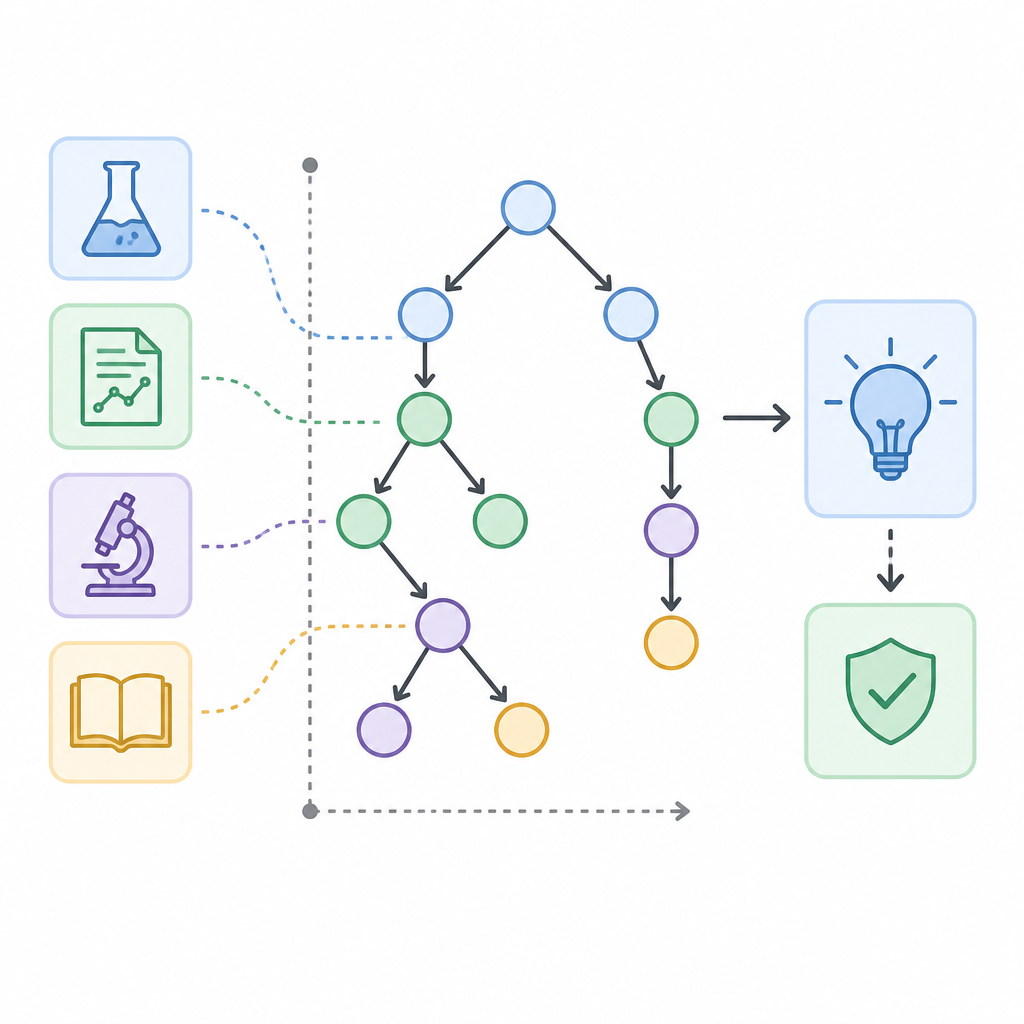
The experiments cover 14 LLM-based scientists. The headline result is not flattering: the strongest system reaches only 27.3% exact accuracy on lineage reasoning. The authors describe this as evidence of a compositional bottleneck, meaning models struggle when they have to combine multiple lineage relations instead of handling each piece in isolation.
Another important result is that structured lineage context does not help every model equally. Instead of producing a simple universal boost, it reshuffles system rankings. That suggests some models can make better use of lineage structure than others, but the benefit is uneven and not automatic.
One thing the abstract does not provide is a broader benchmark table with all per-task scores, latency numbers, or compute costs. So the safe reading is limited to the reported headline metric and the qualitative finding that lineage structure changes relative performance.
Why developers should care
If you are building tools for scientific search, paper understanding, or AI-assisted ideation, this benchmark points to a real failure mode: a model may be good at extracting facts from papers but still poor at reasoning about how a research idea evolves over time.
That matters for systems that try to do more than retrieval. A literature agent that proposes new hypotheses, drafts related-work-aware suggestions, or maps research directions needs lineage awareness. Without it, you can get outputs that sound plausible but ignore what was inherited, what was changed, and what was genuinely new.
IG-Bench also gives developers a more concrete target for evaluation. Instead of asking whether a model can generate “interesting” ideas, it asks whether the idea is a coherent descendant of a known lineage population. That is a harder, but much more operational, standard.
Limitations and open questions
There are still obvious limits. The abstract does not say how the golden lineage traces were constructed in detail, how hard the annotation process was, or how much subjectivity is involved in deciding what counts as inheritance versus novelty. Those details matter if you want to trust the benchmark at scale.
The paper also focuses on structured lineage reasoning and lineage-grounded generation, which is useful, but it is not the same as real-world scientific discovery. Actual research involves messy evidence, conflicting interpretations, and incomplete records. A benchmark can approximate that complexity, but it cannot fully replace it.
Even so, the idea is practical: if AI systems are going to help with science, they should be evaluated on whether they can follow the genealogy of ideas, not just summarize the latest paper. IG-Bench is a step toward measuring that capability in a way engineers can actually build against.
- Scientific ideas are treated as inherited, mutated, and recombined structures.
- IG-Bench evaluates both lineage reasoning and lineage-grounded idea generation.
- The strongest tested model reached only 27.3% exact accuracy on reasoning.
// Related Articles
- [RSCH]
OpenCoF teaches video models to reason frame by frame
- [RSCH]
UniClawBench tests proactive agents in live tasks
- [RSCH]
WebAssembly-to-C still rivals native runtimes in 2026
- [RSCH]
How to Linearize Transformers Without Losing Quality
- [RSCH]
Co-LMLM lets LMs query knowledge continuously
- [RSCH]
SciReasoner makes structure readable to AI