UniClawBench tests proactive agents in live tasks
UniClawBench evaluates proactive agents in live Docker tasks with five capability axes and 400 bilingual scenarios.

400 bilingual tasks show proactive agents need live, capability-driven evaluation.
- Research org: HKU-MMLab
- Core data: 400 bilingual real-world tasks
- Breakthrough: Live Docker evaluation with step-by-step checkpoints
Proactive agents are moving beyond toy demos and into workflows where they have to use everyday tools, handle feedback, and keep going across multiple turns. That creates a problem for evaluation: if the benchmark is too static, too sandboxed, or too tied to one scenario type, it can hide the real reason an agent succeeds or fails.
UniClawBench: A Universal Benchmark for Proactive Agents on Real-World Tasks is meant to fix that gap. The paper argues that current benchmarks do not cleanly separate base model ability from agent-framework design, and that makes it hard for developers to know whether a failure comes from the model, the orchestration layer, or the task setup itself.
What problem the paper is trying to fix
Get the latest AI news in your inbox
Weekly picks of model releases, tools, and deep dives — no spam, unsubscribe anytime.
No spam. Unsubscribe at any time.
The core complaint here is straightforward: many existing benchmarks for agents are built around sandboxed environments and single-turn evaluation. That works for narrow testing, but it does not reflect how proactive agents behave in real environments where they need to explore, reason over long context, understand multimodal inputs, and coordinate across platforms.

The authors also point out that scenario-based taxonomies often bundle several capabilities into one bucket. If an agent fails, you still do not know whether the issue was poor tool use, weak exploration, bad long-context reasoning, or something else entirely. For engineers building agent systems, that kind of ambiguity is a real problem because it makes debugging and iteration slower.
UniClawBench is positioned as a capability-driven benchmark instead of a scenario-driven one. In other words, it tries to evaluate the underlying skills that proactive agents need, rather than just the surface form of the task.
How the benchmark works
The benchmark is organized around five foundational model capabilities: Skill Usage, Exploration, Long-Context Reasoning, Multimodal Understanding, and Cross-Platform Coordination. Those categories are the paper’s main design choice, because they let the benchmark map failures back to a more specific class of weakness.
Based on those five capabilities, the authors build 400 bilingual real-world tasks. The abstract does not break down the language pairs, task distribution, or difficulty mix, so those details are not available here. What is clear is that the benchmark is not just a static question set; it is meant to reflect real-world, dynamic agent behavior.
Another important design choice is the evaluation environment. Instead of relying on pre-recorded answers, UniClawBench evaluates agents in live Docker containers. The paper says completion is tracked with fine-grained, step-by-step checkpoints, which is a useful detail for developers because it suggests the benchmark can measure partial progress rather than only final success.
The evaluation is also closed loop. The system uses an executor agent, a hidden supervisor agent, and a user agent to simulate realistic multi-turn human feedback without leaking grading criteria. That matters because agent benchmarks often get distorted when the grading logic is too visible or when the task setup does not force the system to respond to feedback the way a real user would.
What the paper actually shows
The abstract does not provide benchmark scores, win rates, or any other numeric performance results beyond the benchmark size itself. So there are no accuracy numbers, no throughput figures, and no leaderboard-style comparisons in the source text we have.
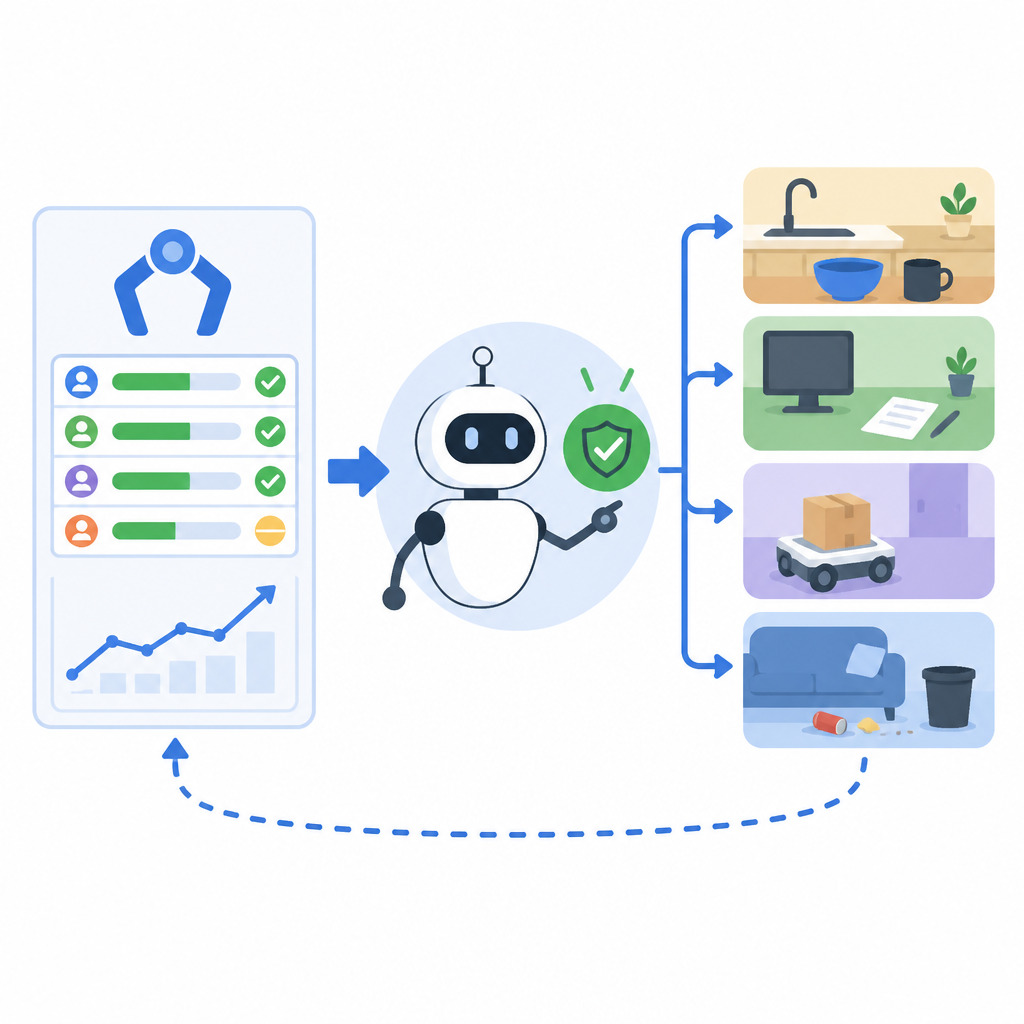
What the paper does claim is more structural than numerical: it evaluates state-of-the-art models under multiple agent frameworks to separate model capability from framework design. The result, according to the abstract, is that both base model capabilities and agent-framework choices jointly shape performance in real-world environments.
That is an important point for anyone building agents. It means a bad outcome may not be fixed by swapping in a stronger model alone. The orchestration layer, the feedback loop, and the framework’s handling of context and tools can also be decisive.
The paper also says the benchmark and code are publicly available, which should make it easier for others to reproduce the setup and compare future systems against the same tasks and evaluation flow.
Why developers should care
If you build agents that touch real tools, real files, or multi-step workflows, this benchmark is aimed at the kinds of failures you actually see in practice. A model that looks good in a single-turn test may still break when it has to explore a system, hold state across turns, or coordinate actions across platforms.
UniClawBench is also a reminder that agent evaluation is not just a model problem. Framework design matters. For teams shipping agentic products, that means you should test the full stack: the model, the planner, the tool layer, the feedback loop, and the way progress is measured.
There are also clear limitations in what the abstract tells us. We do not get benchmark results, ablation details, task examples, or evidence about how hard the 400 tasks are relative to each other. We also do not know from the abstract how the bilingual setup affects performance analysis, or whether the live Docker environment introduces any reproducibility constraints.
Still, the benchmark direction is useful. It shifts attention away from static agent demos and toward evaluation setups that better resemble operational reality. For engineers, that is the difference between a system that only looks capable and one that can actually be debugged, measured, and improved in the wild.
Bottom line
UniClawBench proposes a more practical way to test proactive agents by combining capability-based task design, live execution, and closed-loop feedback. The abstract does not give performance numbers, but it does make a strong case that both model quality and framework design need to be evaluated together.
- It targets proactive agents in dynamic, real-world settings rather than static sandbox tests.
- It evaluates five core capabilities and uses live Docker checkpoints to track progress.
- It highlights that model strength and agent framework design both affect real-world performance.
// Related Articles
- [RSCH]
A benchmark for scientific lineage reasoning
- [RSCH]
OpenCoF teaches video models to reason frame by frame
- [RSCH]
WebAssembly-to-C still rivals native runtimes in 2026
- [RSCH]
How to Linearize Transformers Without Losing Quality
- [RSCH]
Co-LMLM lets LMs query knowledge continuously
- [RSCH]
SciReasoner makes structure readable to AI