Bitcoin DeFi will grow, but not by copying Ethereum
Bitcoin DeFi is real in 2026, but its future depends on narrow use cases, not Ethereum-style composability.

Bitcoin DeFi is real in 2026, but its future depends on narrow use cases, not Ethereum-style composability.
Bitcoin DeFi will matter in 2026, but only if it stays narrow, security-first, and unapologetically different from Ethereum.
Lightning finally proved Bitcoin can do payments at scale
Get the latest AI news in your inbox
Weekly picks of model releases, tools, and deep dives — no spam, unsubscribe anytime.
No spam. Unsubscribe at any time.
For years, Lightning was the answer Bitcoin maximalists gave before the product was ready. That is no longer true. By 2026, custodial wallets and payment apps have reduced the friction enough that Lightning works for real users, not just protocol enthusiasts. Strike, Cash App, Wallet of Satoshi, and Phoenix have turned channel management and liquidity headaches into something ordinary people can ignore, which is exactly what a payment layer must do.

The evidence is in the use cases, not the slogans. Lightning has found product-market fit in remittances, tipping, micropayments, and in-app transfers, especially in markets where banking rails are slow or expensive. That is a meaningful win for Bitcoin. It is not a general retail revolution, and it does not need to be. A payment network that solves cross-border transfers and small-value commerce is already a serious business.
Bitcoin Layer 2s are useful because they are not one thing
The strongest argument for Bitcoin DeFi is that the ecosystem is no longer pretending one architecture can do everything. Stacks, Rootstock, Babylon, and newer entrants each solve a different problem. Stacks gives developers a smart-contract environment tied to Bitcoin. Rootstock brings EVM compatibility for teams that want to port Ethereum apps. Babylon turns Bitcoin into an economic security asset for proof-of-stake systems. That fragmentation looks messy, but it is also honest.
The market has already shown that this diversity is not theoretical. Rootstock has survived since 2018 because Ethereum developers want a familiar toolchain with Bitcoin exposure. Stacks has kept building because some teams value Bitcoin alignment over raw throughput. Babylon matters because Bitcoin holders want yield without fully leaving the asset. None of these projects need to become a universal execution layer to justify themselves. They need to serve one job well.
BitVM is the real breakthrough, even if it is not ready for prime time
BitVM matters because it attacks the hardest problem in Bitcoin DeFi: trust. Most Bitcoin bridges still rely on custodians, federations, or multi-signature setups that reintroduce the very counterparty risk DeFi was supposed to remove. BitVM changes the conversation by enabling fraud-proof style verification of complex computation without changing Bitcoin’s consensus rules. That is a genuine technical advance, not a marketing label.
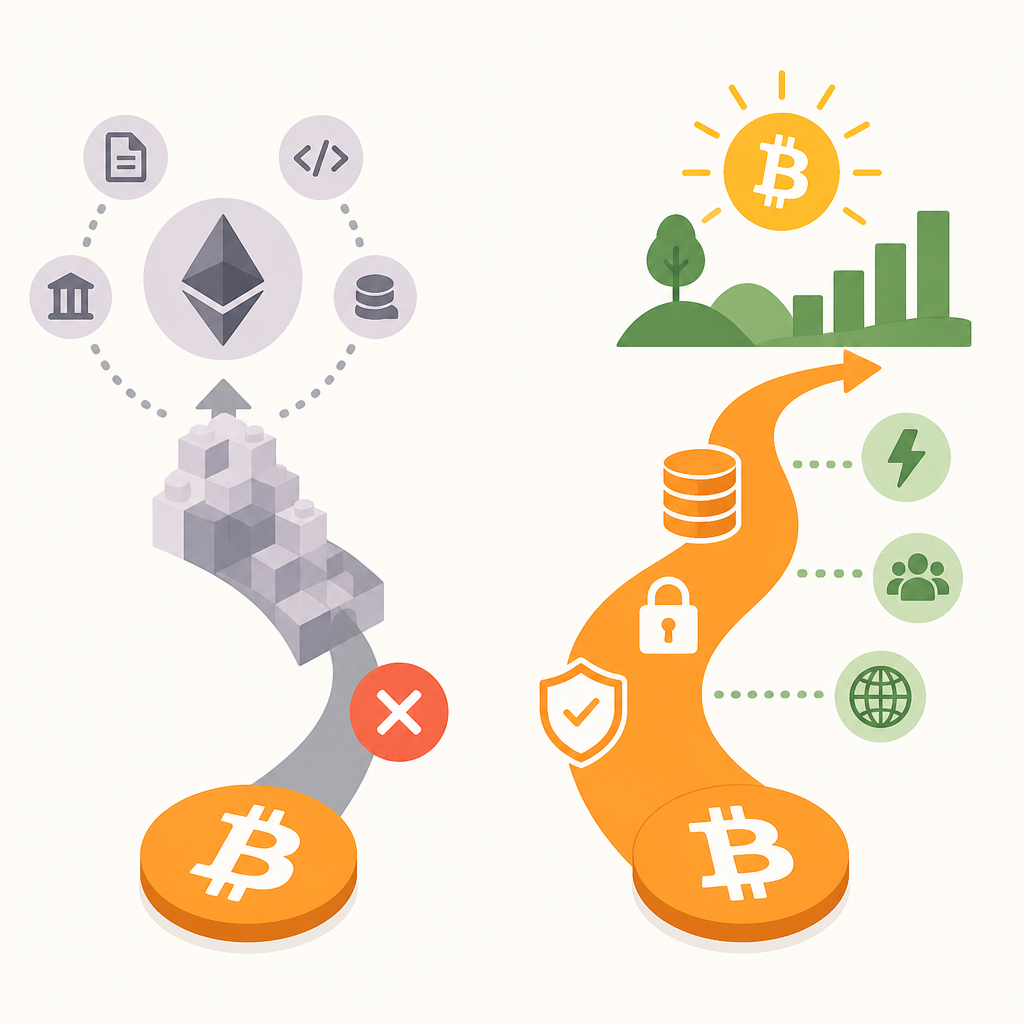
But the gap between technical promise and production reality is still wide. BitVM-based systems are complex, the user experience is rough, and scaled deployments are still early. That limitation does not weaken the case for BitVM. It clarifies it. If Bitcoin DeFi is going to earn serious capital, it must reduce trust assumptions, not just wrap Bitcoin in new interfaces. BitVM is the clearest path to that outcome.
The counter-argument
The best critique is simple: Bitcoin DeFi is a distraction. Ethereum already has the liquidity, the composability, the developer base, and the application depth. Bitcoin should remain a settlement asset and a payment network, while DeFi activity stays where the tooling is mature. From that view, every Bitcoin L2 adds complexity, weakens the user experience, and risks confusing users about what security they actually have.
That argument is strong because it is grounded in reality. Ethereum DeFi is still far ahead on every conventional metric: TVL, transaction volume, app variety, and institutional familiarity. Bitcoin cannot pretend otherwise. But the critique fails on one decisive point: it assumes users only want general-purpose DeFi. They do not. Bitcoin holders want yield, lending, and payments without abandoning the asset they already trust. That demand is specific, persistent, and large enough to support an ecosystem even if it never looks like Ethereum.
What to do with this
If you are an engineer, build for one Bitcoin-native job and do it with extreme clarity: payments, bridge security, or Bitcoin-collateralized yield. If you are a PM, stop pitching “Ethereum on Bitcoin” and define the trust model, custody model, and user promise in one sentence. If you are a founder, aim for the user who wants Bitcoin exposure first and DeFi second. The winners in Bitcoin DeFi will not be the broadest platforms. They will be the most credible ones.
// Related Articles
- [CHAIN]
Bitcoin’s price page explains the market in one view
- [CHAIN]
Web3 Banking Guide for Fintech Teams
- [CHAIN]
10 prediction market builders that can ship Polymarket-style apps
- [CHAIN]
Solana’s July 10 updates point to real adoption
- [CHAIN]
BYDFi Brings Crypto Trading Pitch to Lima
- [CHAIN]
Crypto exchanges should show up in LATAM, not just advertise there