CCCL Runtime makes CUDA safer by making state explicit
NVIDIA’s CCCL Runtime replaces implicit CUDA habits with explicit, typed C++ APIs for streams, memory, and launches.

NVIDIA’s CCCL Runtime replaces implicit CUDA habits with explicit, typed C++ APIs for streams, memory, and launches.
CCCL Runtime is the right direction for CUDA, because the old model makes correctness depend on hidden state while modern C++ can make those dependencies visible, composable, and harder to misuse.
CUDA has outgrown opaque handles and ambient state
Get the latest AI news in your inbox
Weekly picks of model releases, tools, and deep dives — no spam, unsubscribe anytime.
No spam. Unsubscribe at any time.
The strongest case for CCCL Runtime is that CUDA programs no longer live in simple, single-library worlds. A stream created with the legacy runtime is tied to whichever device happens to be current at that moment, which means the meaning of the handle is partly stored in global state rather than in the code itself. That is a brittle way to build systems that mix kernels, memory pools, and third-party libraries.

NVIDIA’s new API answers that with explicit construction: a stream is created from a device reference, not a hidden device context. That sounds small, but it changes the debugging model completely. When the device is an argument, the dependency is visible in the call site and preserved in the type system. The same logic applies to owning and non-owning forms such as cuda::stream and cuda::stream_ref, which mirror the clarity of std::string and std::string_view. CUDA has needed that split for years.
Asynchronous by default is the only sane default for modern GPU code
CCCL Runtime also gets the performance story right by treating stream-ordered behavior as the norm rather than the exception. The blog points out that memory pools and stream-ordered allocation have been available since CUDA 11.2, and that CUDA 13.0 extended the model to managed and host memory. In practice, that matters because fewer synchronization points usually mean better throughput and less accidental serialization.
The API design follows through on that reality. If a function takes a stream as its first argument, it runs in stream order. If you allocate with cuda::make_buffer, the allocation, initialization, and eventual deallocation all become part of the stream’s timeline. That is a better contract than a pair of synchronous and asynchronous variants that force developers to memorize naming conventions. It also makes unsafe behavior harder to slip in: uninitialized memory requires an explicit opt-out with cuda::no_init, instead of being the silent default. For GPU code, that is not ceremony. That is damage prevention.
Compatibility is the feature that makes this practical
The best part of CCCL Runtime is not that it is new. It is that NVIDIA is not asking developers to throw away the CUDA runtime overnight. The blog is explicit that compatibility helpers let teams adopt the new APIs incrementally, which is the only realistic path in production codebases with years of accumulated kernels, wrappers, and vendor dependencies. A clean redesign that requires a rewrite is not a runtime. It is a whiteboard exercise.
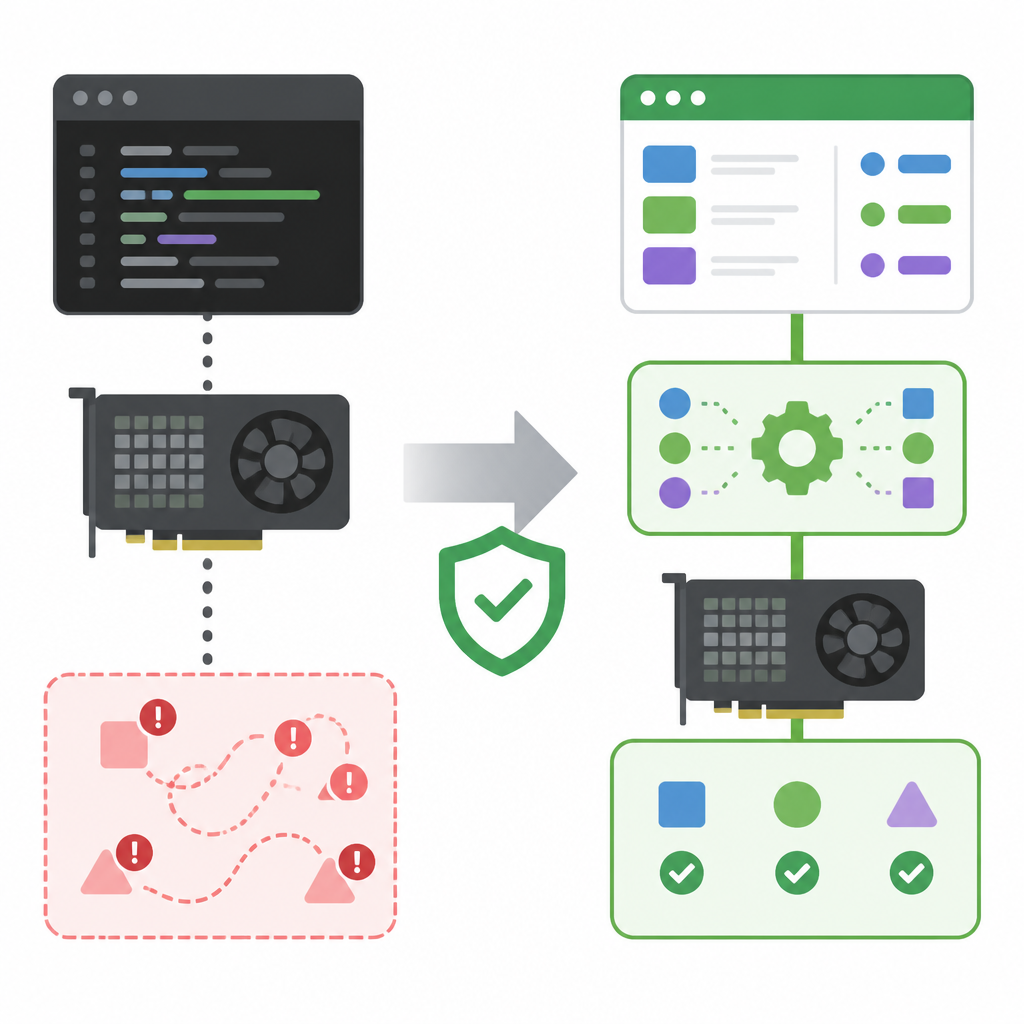
This matters because CUDA adoption happens inside large, messy systems where one library may still expose raw cudaStream_t while another wants stronger types and explicit ownership. CCCL Runtime’s _ref types and native-handle bridges are a pragmatic answer to that reality. They let new code be safer without breaking old code, and they let teams modernize one boundary at a time. That is exactly how infrastructure libraries should evolve: not by demanding purity, but by making the better path easy to take repeatedly.
The counter-argument
The strongest objection is that CUDA’s existing runtime works, is widely understood, and already has enormous ecosystem support. A new abstraction layer can look like extra ceremony, especially for small projects or teams that know the old API well. There is also a legitimate fear of fragmentation: if developers must learn both the traditional runtime and CCCL Runtime, the cognitive load rises before the benefits are obvious.
There is also a portability concern. Modern C++ abstractions are only valuable if they remain stable across toolchain versions and do not hide too much of the underlying GPU behavior. Some engineers will prefer direct control over raw handles, especially when chasing edge-case performance or integrating with code that was built around the legacy runtime’s assumptions.
That objection stops short of a real case against CCCL Runtime. The old API remains available, and the new one does not erase it. More important, the problem CCCL Runtime targets is not stylistic preference; it is the cost of implicit state in large systems. When a stream’s device association depends on what is current, when memory lifetime is easy to separate from execution order, and when uninitialized buffers are one typo away, the API is doing too little to help the programmer. CCCL Runtime is not extra abstraction for its own sake. It is a correction to a model that has aged past its convenience.
What to do with this
If you are an engineer building CUDA code today, start by using CCCL Runtime at the edges where bugs are most expensive: stream creation, memory allocation, and kernel launch setup. Keep the legacy runtime where you must, but prefer explicit device references, owning and non-owning types, and stream-ordered allocation for new code. If you are a PM or founder, treat this as a signal that CUDA development is moving toward safer composition and cleaner library boundaries, so plan migrations and internal abstractions around that shift instead of around raw handles and implicit state.
// Related Articles
- [TOOLS]
Baidu Wenxin turns search into a free agent
- [TOOLS]
OpenCode now supports DeepSeek, GLM, Qwen, GPT
- [TOOLS]
DeepSeek in Codex Will Cut AI Coding Costs Hard
- [TOOLS]
Token vs. word: why Chinese tokenization still matters
- [TOOLS]
OpenAI API Pricing Hits $0.05 to $180/M Tokens
- [TOOLS]
Usage limits belong in ChatGPT Enterprise and Edu controls