DeepSeek in Codex Will Cut AI Coding Costs Hard
DeepSeek’s Codex integration will push AI coding costs down and make agentic development cheaper.
DeepSeek’s Codex integration pushes AI coding costs down sharply.
10x lower inference cost changes the economics of AI coding tools, and DeepSeek’s official Codex integration makes that pressure real.
Cost, not capability, is now the bottleneck
Get the latest AI news in your inbox
Weekly picks of model releases, tools, and deep dives — no spam, unsubscribe anytime.
No spam. Unsubscribe at any time.
Codex already works well on OpenAI models for writing code, editing files, troubleshooting local issues, and automating small tasks. That is exactly why the cost question matters: once a tool becomes part of daily workflow, price stops being a line item and becomes a product constraint. If every prompt is cheap enough, teams use the agent more often; if it is not, they ration it.
DeepSeek’s move matters because it attacks the part of the stack that most directly limits usage. A developer does not need a model that is 5 percent better at a narrow benchmark if the current model is 10 times cheaper for the same job. In practical terms, cheaper inference means more iterations, more background tasks, and more willingness to let the agent handle repetitive work.
Official integration lowers friction more than a model swap
The important detail is not that DeepSeek exists as another model option. The important detail is that DeepSeek published a script for connecting it to Codex, which turns a theoretical alternative into something developers can actually adopt without redesigning their workflow. That reduces the switching cost from “rebuild the stack” to “change the endpoint.”
This is how platform shifts start: not with a grand migration, but with a small compatibility layer. When the toolchain stays familiar, adoption spreads faster inside teams. Engineers keep their editor habits, their prompts, and their review patterns, while the underlying model changes underneath them. That is a stronger wedge than a standalone chatbot.
Cheaper agents will change product decisions
Once the cost of agentic coding drops, teams will stop treating AI assistance as a premium feature and start treating it as default infrastructure. That changes what founders build. Instead of charging for a few high-value interactions, they can design products around continuous assistance: refactors, test generation, bug triage, and codebase navigation.
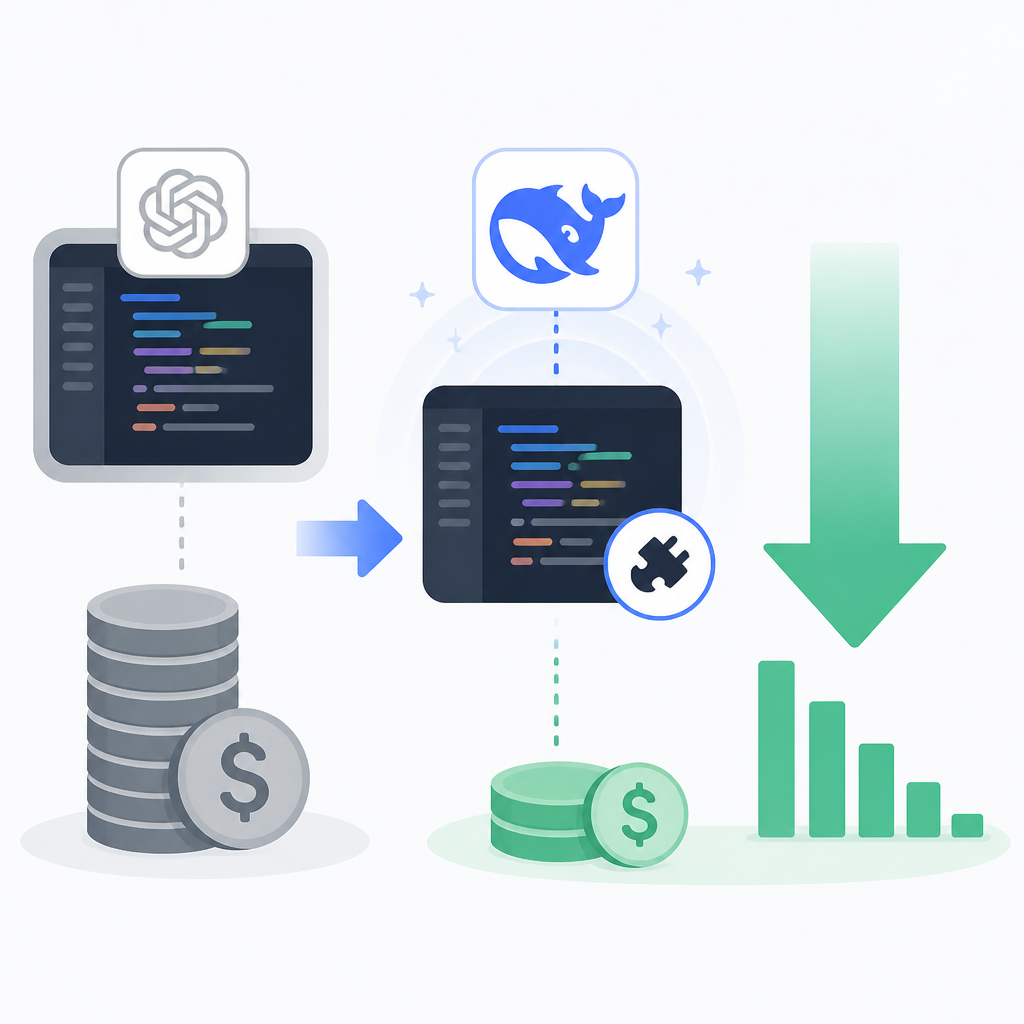
It also changes how PMs define value. A tool that saves one engineer an hour a week is useful; a tool that can be run across an entire team at low cost becomes operational leverage. The difference is scale. If a company can afford to let an agent inspect more files, run more checks, and propose more edits, then the product can move from “assistant” to “workflow layer.”
The counter-argument
The strongest objection is that coding quality matters more than cost. A cheaper model that produces weaker code, hallucinates more often, or needs more supervision can erase the savings. Teams also care about reliability, security, and vendor trust. If an integration adds operational risk, the lower price is not a real win.
That objection is valid, but it misses the point of cost competition in AI infrastructure. For many coding tasks, the job is not to produce final production code from scratch. The job is to draft, compare, explain, and accelerate. In those cases, a model that is good enough and much cheaper wins because the human stays in the loop. The limit is clear: mission-critical changes still need review. But for the bulk of routine coding work, cheaper access changes behavior faster than marginal model quality does.
What to do with this
Engineers should test cheaper model routing on low-risk workflows first: file edits, test scaffolding, doc generation, and code search. PMs should measure cost per accepted change, not just raw usage. Founders should treat model choice as a margin lever, not a branding decision. The right move is to build systems that can swap models easily, because the price curve is now part of the product strategy.
// Related Articles
- [TOOLS]
Token vs. word: why Chinese tokenization still matters
- [TOOLS]
OpenAI API Pricing Hits $0.05 to $180/M Tokens
- [TOOLS]
Usage limits belong in ChatGPT Enterprise and Edu controls
- [TOOLS]
Prepare for Gemini 3.5 Pro on launch day
- [TOOLS]
Kitesurf turns Workers into an agent browser
- [TOOLS]
CUDA warps turn GPU threads into one machine