CLARITY Act floor vote prep for crypto teams
A practical guide for crypto teams to prepare for the CLARITY Act moving to a House floor vote.

The CLARITY Act is moving toward a House floor vote and crypto teams should prepare now.
This guide is for founders, compliance leads, product managers, and counsel at blockchain, DeFi, and digital asset companies that need to track U.S. market structure changes. After you follow the steps, you will have a clear read on the bill’s likely impact, a simple internal review plan, and a checklist for exchanges, token issuers, custodians, and protocol teams.
The source material cites the CLARITY Act, the SEC, the CFTC, and the bill’s path from committee to the House floor. It also discusses registration, disclosure, staking, mining, and self-custody questions, so the steps below focus on turning that policy shift into an actionable response plan.
Before you start
Get the latest AI news in your inbox
Weekly picks of model releases, tools, and deep dives — no spam, unsubscribe anytime.
No spam. Unsubscribe at any time.
- Access to the CLARITY Act text or a tracked summary from Congress.
- Current U.S. legal counsel or an in-house compliance lead.
- A working inventory of products, tokens, custody flows, and counterparties.
- One owner for regulatory tracking, one for product review, and one for communications.
- Browser access to the U.S. Congress site and the GitHub repos used by your team for policy notes or internal tooling.
- If you plan to automate monitoring, Node 20+ and Python 3.11+.
Step 1: Map the bill’s jurisdiction split
Your first goal is to understand which parts of the CLARITY Act affect SEC oversight, CFTC oversight, or both. This creates the baseline for every later decision, from token classification to exchange registration and disclosure duties.

Read the bill summary and mark the sections that define whether a digital asset is treated as a security or a commodity, plus the parts covering exchanges, brokers, custodians, and token issuer disclosures. If you maintain an internal memo, add one line for each business line: spot trading, custody, token issuance, staking, and protocol governance.
Checklist output example:
- Token classification: pending review
- Exchange activity: likely registration impact
- Custody: likely disclosure and control impact
- DeFi protocol: governance and enforcement questions
- Self-custody: treatment unclear
You should see a one-page jurisdiction map that names the likely regulator for each product area. If you cannot assign a regulator to a business line, that is the signal to escalate the issue to counsel.
Step 2: Inventory products and counterparties
The goal here is to connect the bill’s language to your actual operating model. A policy change only matters if it touches a live product, a customer flow, or a vendor relationship.
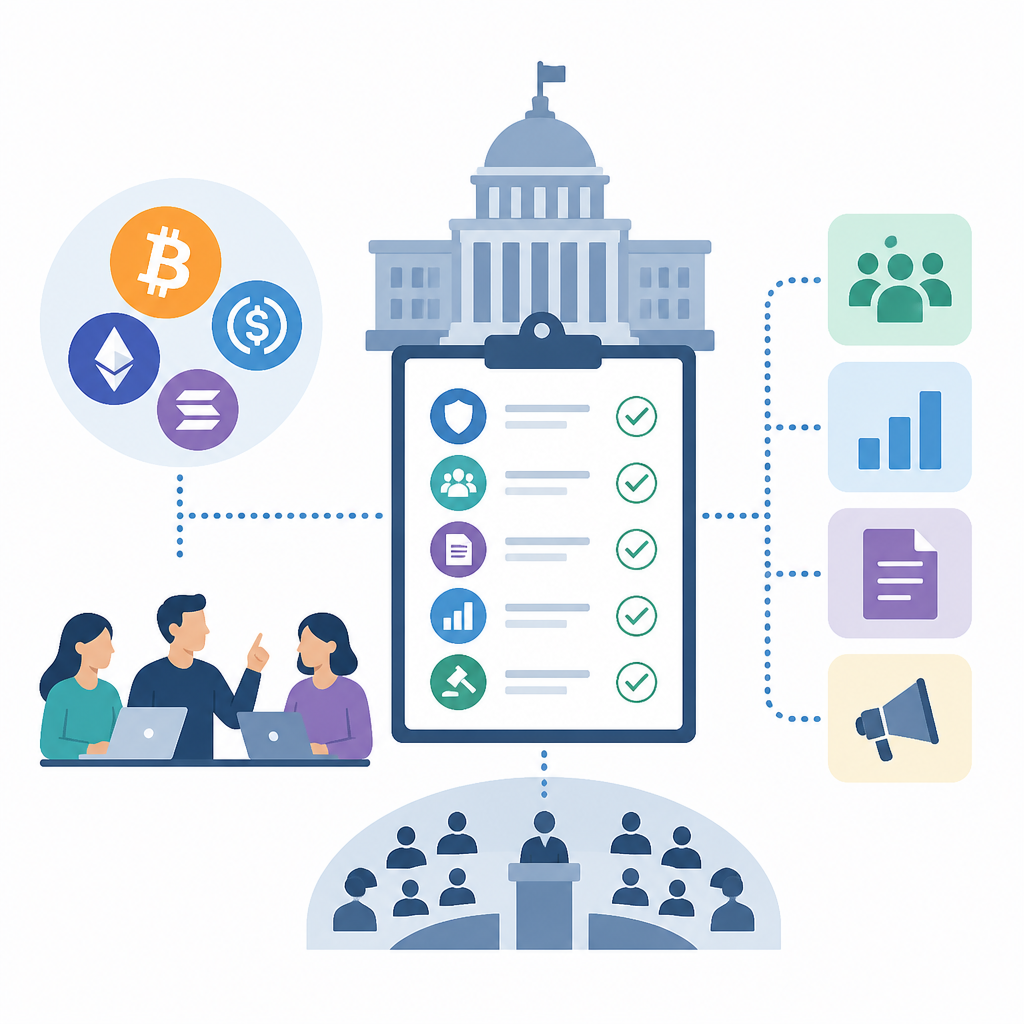
Build a table of every asset, protocol, wallet, and service you offer, then tag each item by function: issuance, exchange, brokerage, custody, staking, mining, or software infrastructure. Include counterparties such as market makers, custodians, auditors, and liquidity providers.
For each item, note whether users can transfer assets, whether you control private keys, whether fees are charged, and whether the product depends on a centralized team. Those details will help you decide where the CLARITY Act may create new registration or disclosure work.
You should end with a complete inventory that your legal and product teams can review in one meeting. If any product is missing from the list, assume the review is incomplete.
Step 3: Classify token and protocol risk
Now you want a working view of which assets and protocols look most exposed to reclassification or new compliance obligations. This step helps you prioritize the highest-risk items before the bill reaches a vote.
Use a simple three-tier rating: low, medium, or high. Give higher risk to products with issuer control, revenue sharing, custodial features, or governance structures that resemble a managed enterprise. Give lower risk to open-source software with no custody or direct customer relationship, but still flag it for counsel review.
Document open questions on staking, mining, and self-custody, because the source notes those areas remain debated. If your protocol is decentralized, also note where the team still exercises operational control, since that can matter under any market-structure regime.
You should now have a prioritized risk register that identifies the assets most likely to need legal analysis first. The output should make it obvious which items are safe to leave for later and which need immediate attention.
Step 4: Draft the compliance response plan
The goal of this step is to turn policy uncertainty into a short action plan your team can execute. That plan should cover registration, disclosures, internal controls, and external messaging.
Write down the exact actions you would take if the bill becomes law in its current form: update disclosures, review custody arrangements, assess exchange or broker registrations, and prepare new customer notices. If you operate in multiple jurisdictions, add a line for cross-border harmonization so your U.S. and non-U.S. teams stay aligned.
Keep the plan narrow and practical. A good first version is one page, with owners, due dates, and decision points tied to the House vote and any later Senate action.
You should finish with a response plan that can be used in a leadership briefing. If the plan is too broad to assign, it is not ready.
Step 5: Monitor legislative movement and public signals
Your last goal is to keep the plan current as the bill moves from committee to the House floor and beyond. The source frames this as a major test of U.S. crypto market reform, so timing matters.
Track committee updates, floor scheduling, sponsor statements, and industry reactions. Set alerts for the bill title, key sponsors, and related terms such as SEC, CFTC, token issuer, staking, and self-custody. If you use internal tooling, log each update with the date, source, and expected business impact.
Review the watchlist weekly, or daily during active legislative windows. That rhythm keeps legal, product, and communications teams from reacting too late.
You should now have a live monitoring process that tells you when the bill changes and what to do next. The outcome is not just awareness, but a repeatable response loop.
| Metric | Before/Baseline | After/Result |
|---|---|---|
| Regulatory clarity | Mixed SEC/CFTC overlap | Defined jurisdiction framework |
| Product review speed | Ad hoc legal checks | Structured risk register and owners |
| Compliance planning | Reactive to headlines | One-page response plan tied to milestones |
| Monitoring cadence | Irregular manual checks | Weekly or daily legislative watch |
Common mistakes
- Assuming the bill only affects exchanges. Fix: review token issuance, custody, staking, and protocol governance too.
- Waiting for final passage before preparing. Fix: draft your response plan now, then update it as the text changes.
- Ignoring self-custody and decentralized operations. Fix: document where control exists, even if the product is marketed as decentralized.
What's next
After this, build a short memo for leadership and legal counsel, then compare the CLARITY Act against your current policies for listings, custody, disclosures, and token launches. If you need a deeper follow-up, turn the risk register into a line-by-line gap analysis for each product and jurisdiction.
// Related Articles
- [CHAIN]
Layer 2 Is Ethereum’s Real Product, Not a Detour
- [CHAIN]
Ethereum’s price should be read as network demand, not just speculati…
- [CHAIN]
Ethereum’s shake-up turns ETH into a cleaner bet
- [CHAIN]
Bitcoin’s price page explains the market in one view
- [CHAIN]
Web3 Banking Guide for Fintech Teams
- [CHAIN]
10 prediction market builders that can ship Polymarket-style apps