MMDiff maps and steers multimodal features
MMDiff turns multimodal SAEs into feature-level controls for finding, auditing, and steering MLLM behavior.

What does Multimodal Model Diffing for Feature Discovery and Control show?
MMDiff turns multimodal SAEs into feature-level controls for finding, auditing, and steering MLLM behavior.
- Research org: Unspecified in arXiv abstract
- Core data: 24% lower attack success rate on multimodal safety attacks
- Breakthrough: Diff base and multimodal SAEs to isolate changed causal features
For engineers working with multimodal large language models, the practical problem is not just that these systems are hard to interpret. It is that the internal features behind visual understanding, OCR, and safety behavior are difficult to isolate well enough to audit or control. This paper argues that sparse autoencoders can do more than post-hoc inspection if you compare a base model against its multimodal-adapted version and then use the resulting feature directions as an interface.
The result is MMDiff, a framework that treats multimodal SAEs as a way to discover which features changed during multimodal training, identify which ones matter for a specific task, and then remove or steer them. That makes the work relevant to anyone trying to build more controllable MLLMs, especially when the goal is not only to explain behavior but to change it in a targeted way.
What problem this paper is trying to fix
Get the latest AI news in your inbox
Weekly picks of model releases, tools, and deep dives — no spam, unsubscribe anytime.
No spam. Unsubscribe at any time.
Multimodal LLMs can be strong at visual understanding, but their internal mechanics are still opaque. The abstract is explicit about the gap: hidden states can be decomposed into interpretable feature directions with sparse autoencoders, yet those directions do not naturally tell you which features were introduced or altered by multimodal training. They also are not directly useful when you want to intervene on a specific behavior.

That matters because interpretability tools are only half the job in real systems. If you can see a feature but cannot connect it to a behavior, or cannot reliably change that behavior, you still do not have much operational control. MMDiff is positioned as a bridge between inspection and intervention.
How MMDiff works in plain English
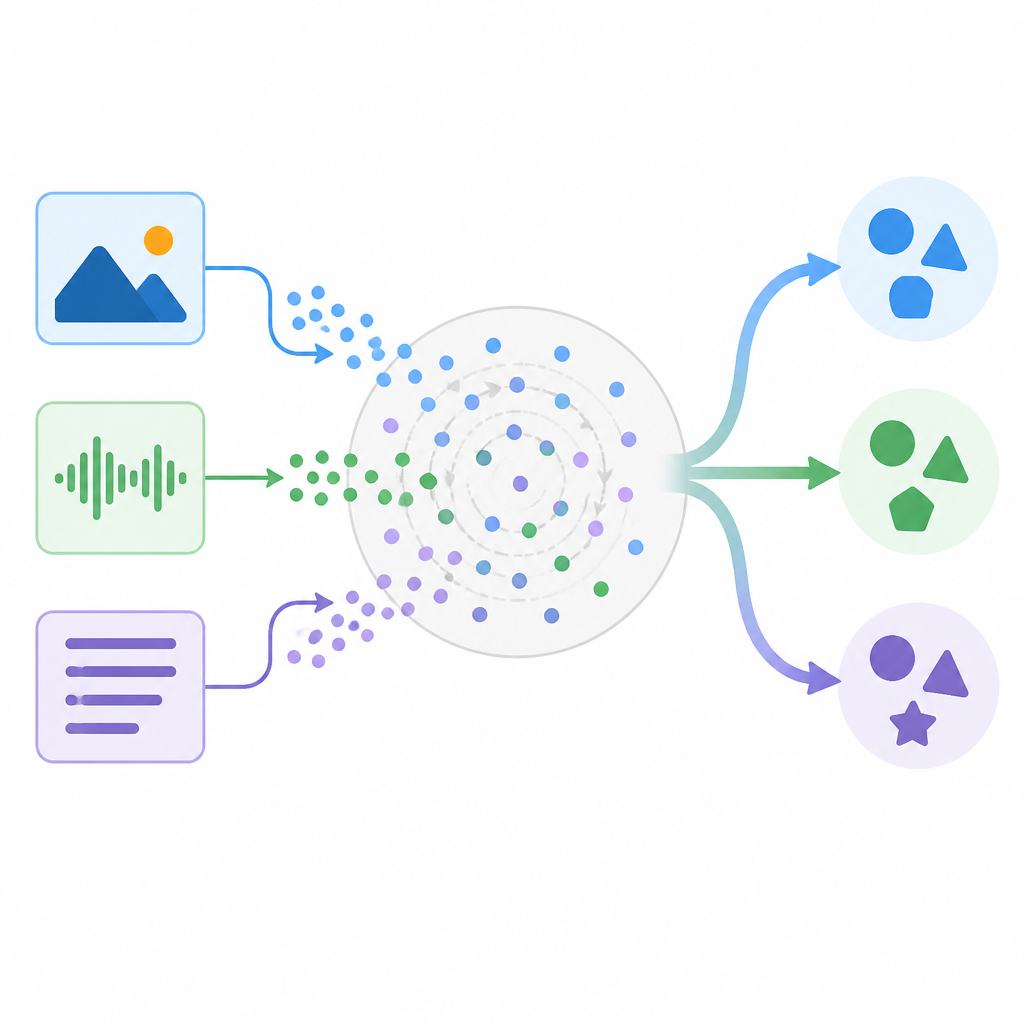
MMDiff is described as a multimodal model-diffing framework. The key move is to train multimodal sparse autoencoders and compare a base language model SAE with its multimodal-adapted counterpart. That diffing step is used to isolate which features were changed by multimodal training.
From there, the paper says MMDiff supports three uses. First is feature isolation: compare the base and multimodal SAEs to find altered features. Second is task-specific feature detection: use per-token contrastive firing analysis to isolate causal features for a given task. Third is feature-level control: remove or steer the discovered feature directions causally.
In other words, the paper is not just saying “here is a better interpreter.” It is proposing a workflow where the same learned feature directions can be used to inspect a model and then directly intervene on its behavior. That is the part developers will care about most, because it turns interpretability into an operational tool.
What the paper actually shows
The authors train multimodal SAEs for three MLLM families: LLaVA-MORE, PaliGemma 2, and InternVL3.5. They evaluate the method on visual-spatial understanding, multimodal safety, and OCR. The abstract does not provide full benchmark tables, so there is no detailed per-dataset breakdown here beyond the summary numbers reported by the authors.
Still, the reported effects are concrete. MMDiff discovers sparse, causally specific features whose removal selectively degrades target behaviors by an average of 12% on spatial tasks and 17% on OCR. On multimodal safety attacks, removing the discovered features reduces attack success rate by 24%, and the abstract says this happens with no impact on VQA performance.
The steering results are also notable. When the discovered features are steered rather than removed, spatial and OCR accuracy improve by +3.6% and +1.8% on average over a standard single-layer steering baseline. That comparison matters because it suggests the method is not only good at suppressing behavior, but can also nudge models toward better performance on selected tasks.
- Model families tested: LLaVA-MORE, PaliGemma 2, InternVL3.5
- Evaluation areas: visual-spatial understanding, multimodal safety, OCR
- Reported intervention effects: 12% spatial degradation, 17% OCR degradation, 24% safety ASR reduction
Why developers should care
If you are building or shipping multimodal systems, the main appeal is control. A feature-level interface can help you understand which internal directions are tied to brittle OCR behavior, unsafe responses, or spatial reasoning, and then intervene more precisely than with broad prompt or layer-level hacks.
The safety angle is especially practical. The abstract says feature removal reduces attack success rate on multimodal safety attacks without affecting VQA performance, which suggests the intervention can be selective rather than globally destructive. That is the kind of property teams want if they are trying to harden a model without flattening useful capability.
The steering result also points to a broader possibility: interpretability methods that are useful for optimization, not only diagnosis. If discovered features can improve task accuracy relative to a standard single-layer steering baseline, then the same tooling may become part of a tuning workflow, not just a debugging workflow.
What this does not prove yet
The abstract gives useful signal, but it also leaves important questions open. It does not include full benchmark details, training costs, dataset sizes, or latency overhead. It also does not tell us how stable the discovered features are across different prompts, domains, or model scales beyond the three families named in the paper.
And while the results are promising, they are still scoped to the tasks and models the authors evaluated. The paper shows that multimodal SAEs can be used for auditing, steering, and control in these settings, but it does not establish that the same approach will generalize cleanly to every multimodal model or every kind of behavior.
That said, the core idea is strong: if you can diff a base model against its multimodal version and recover causal feature directions, you get a practical handle on behavior that is usually buried inside hidden states. For developers, that is a meaningful step toward making multimodal systems more inspectable and more governable.
In short, MMDiff reframes multimodal interpretability as a control problem. Instead of stopping at “what feature is this?”, it asks “what changed, what causes the behavior, and can we steer it?” That is the right question if the end goal is safer and more capable MLLMs.
// Related Articles
- [RSCH]
Dutch Government LLMs Need More Than Accuracy
- [RSCH]
TTS evaluators miss more than naturalness
- [RSCH]
Rust should be a serious GPU programming language, not a side project
- [RSCH]
CoinRAG Reuses Fine-Grained KV Caches for RAG
- [RSCH]
CreativeInstruct teaches LLMs to stay creative
- [RSCH]
MirrorWorld makes mirror reflections consistent in video