Google Gemini’s latest update centers on Maps
Google’s latest Gemini update puts Ask Maps and Immersive Navigation into a major Maps upgrade.
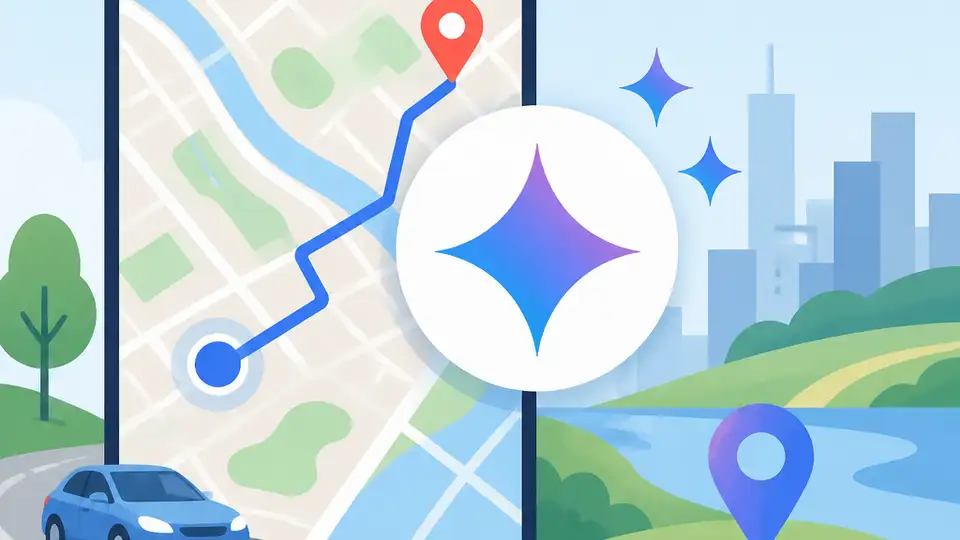
Google’s latest Gemini update puts Ask Maps and Immersive Navigation into Google Maps.
Google has turned its Gemini news feed into a product showcase, and the biggest item is about Google Maps. In the latest episode of The Podcast, Miriam Daniel and David Cronin joined host Logan Kilpatrick to talk about the biggest Maps update in 10 years.
The headline features are Gemini-powered Ask Maps and Immersive Navigation. Google is pitching both as a way to make directions feel more conversational, more visual, and less stressful when you are trying to get somewhere in a hurry.
| Item | Detail | Why it matters |
|---|---|---|
| Maps update | Biggest in 10 years | Signals a major product reset |
| Ask Maps | Conversational experience powered by Gemini 3.0 Pro | Turns Maps into a question-and-answer tool |
| Immersive Navigation | High-fidelity 3D driving experience | Gives drivers more visual context |
| Music feature | Create custom 30-second tracks from a prompt or photo | Shows Gemini expanding beyond text |
Google is pushing Gemini deeper into everyday tasks
Get the latest AI news in your inbox
Weekly picks of model releases, tools, and deep dives — no spam, unsubscribe anytime.
No spam. Unsubscribe at any time.
This update matters because it pushes Gemini beyond chat and into software people already use every day. Maps is one of Google’s most practical products, and a conversational layer on top of it is a much easier sell than another generic assistant demo.

Google also used the same news feed to highlight other Gemini features. One post on Instagram says Gemini 3.1 Pro is built for complex tasks, from ambitious projects to tracking the Space Station. Another post shows a music feature that can create 30-second tracks from a prompt or image.
- Ask Maps uses natural language instead of menu-heavy search.
- Immersive Navigation adds a 3D driving view.
- Gemini 3.1 Pro is being framed as the model for harder tasks.
- Music generation is now part of the same consumer-facing product story.
The Maps podcast makes the strategy clearer
The podcast format matters here because Google is not just announcing a feature list. It is trying to explain why Gemini belongs inside Maps in the first place, and the answer is simple: drivers and travelers want less friction.
In the episode, Daniel and Cronin describe how Ask Maps and Immersive Navigation are meant to make navigation more intuitive, more personalized, and less stressful. That is a practical pitch, and it fits the kind of product Google can improve with its own models better than most rivals can.
"The biggest update in Google Maps history" — Miriam Daniel and David Cronin, in Google’s latest Gemini podcast episode.
The quote is doing a lot of work. Google wants users to hear that Maps is changing at the same scale as a major platform refresh, not a minor feature add-on. That framing also gives the company room to keep shipping more AI layers into the product without treating each one like a separate launch.
How this compares with Google’s other Gemini moves
The Maps update is part of a wider pattern. Google has been using Gemini to branch into productivity, media creation, and developer tools, and the company is making the product feel less like a single chatbot and more like a family of interfaces.
Here is the clearest comparison from the latest news items Google highlighted:
- Gemini 3.1 Pro is framed around complex tasks and long-running work.
- Ask Maps is built for location questions and trip planning.
- The music feature is about short creative output from text or images.
- Gemma and Gemini developer updates point to faster generation and broader app integration.
That mix tells you where Google is headed. It is not treating Gemini as one product with one audience. It is turning the same model family into a layer that can sit inside navigation, creativity tools, and developer workflows.
For developers, the interesting part is not the marketing copy. It is the pattern: model upgrades are getting tied to specific user jobs, and Google is packaging those jobs into familiar surfaces instead of asking users to learn a new app.
What to watch next in Gemini and Maps
The big question is how quickly Google can move Ask Maps and Immersive Navigation from demo language into daily use. If the company gets the rollout right, Maps could become one of the strongest real-world examples of conversational AI doing something useful without getting in the way.
For now, the safest read is that Google is testing how far Gemini can go when it is attached to a product with billions of users and a clear purpose. If Ask Maps lands well, expect more Google apps to get the same treatment, with AI features built around specific tasks rather than broad promises.
The next thing worth watching is whether Google exposes enough of this stack to developers through Google for Developers and related APIs. If it does, the Maps update may end up mattering less as a consumer feature and more as a template for how Google wants Gemini to show up across its products.
// Related Articles
- [MODEL]
Google ships Gemini 3.6 Flash and 3.5 Lite
- [MODEL]
Kimi K3 Is Forcing Silicon Valley to Pick Sides
- [MODEL]
Opus 5 lets you ship with fewer refusals
- [MODEL]
Claude Opus 5 undercuts Fable 5 on price
- [MODEL]
OpenAI model catalog adds GPT-5.6 pricing tiers
- [MODEL]
Gemini 3.6 Flash proves Google is betting on efficiency over hype