Navigating the AI Model Release Wave of March 2026
Discover the latest developments in AI model releases, including Anthropic's Claude Code and OpenAI's strategic shifts, shaping the AI landscape.

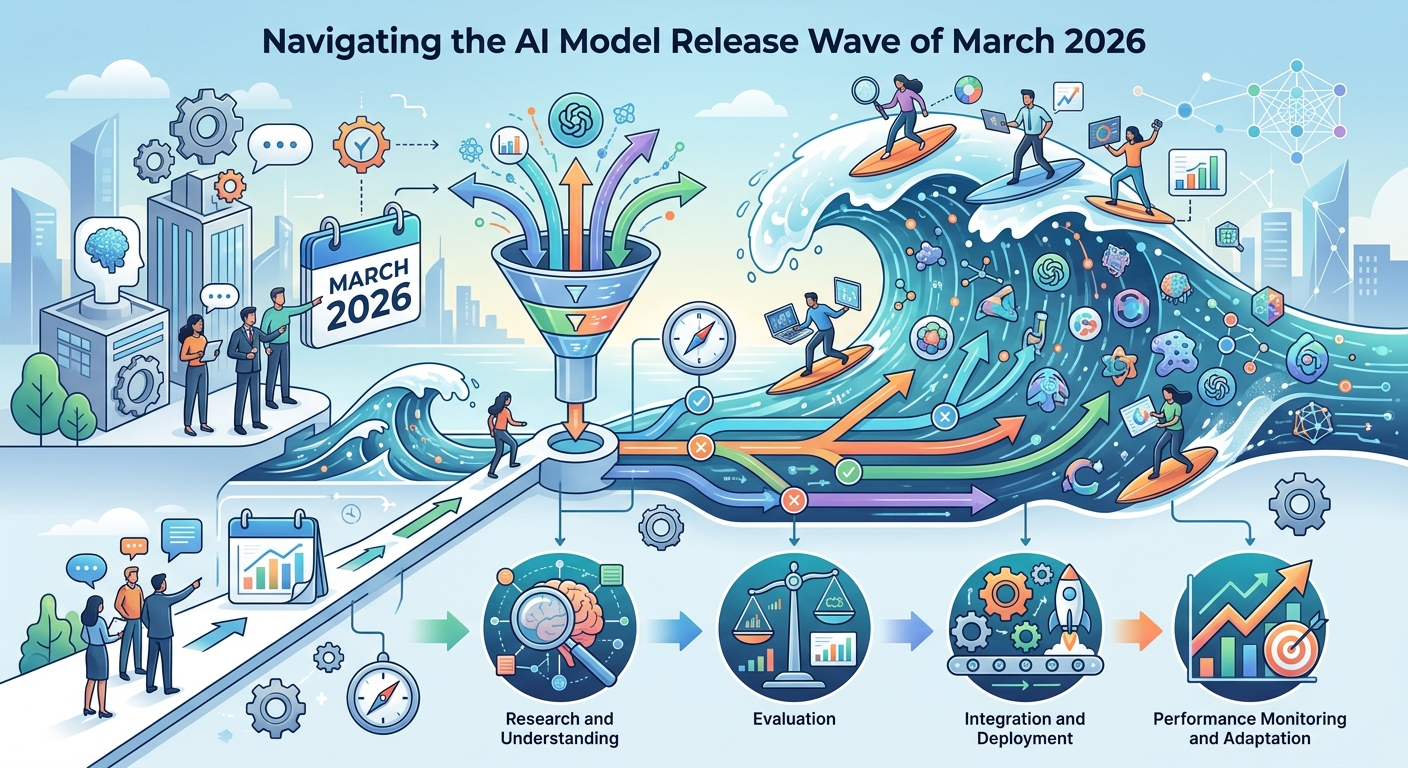
The AI landscape is buzzing with activity this March 2026, as several key players in the industry unveil significant updates to their model offerings. With over 500 models now available, the variety of options for developers and businesses is vast, signifying a lively competitive environment.
Anthropic's Claude Code: A Step Towards Balancing Safety and Efficiency
Get the latest AI news in your inbox
Weekly picks of model releases, tools, and deep dives — no spam, unsubscribe anytime.
No spam. Unsubscribe at any time.
Anthropic has introduced a new "Auto Mode" for its Claude Code, aiming to strike a balance between safety and operational speed. Traditionally, users faced the dilemma of either manually approving every action or completely disabling safety checks. This new mode offers a middle ground, enhancing usability without compromising security.

- The new Auto Mode provides an automated approval feature, minimizing manual intervention.
- It maintains critical safety checks, reducing the risk associated with AI-driven tasks.
- Claude Code is positioned as a solution for developers seeking both efficiency and safety in AI implementations.
OpenAI's Strategic Movements
OpenAI has been making headlines with strategic personnel changes and model updates. Kiran Mani, former CEO of JioStar, joins OpenAI to spearhead its Asia-Pacific operations, indicating a focus on expanding influence in the region.
"OpenAI’s decision to bring in Kiran Mani showcases their intention to strengthen ties and expand their outreach in the Asia-Pacific market," stated Jason Kwon, CSO at OpenAI.
Additionally, OpenAI has retired its Sora app and API amidst concerns over deepfake content, redirecting focus towards integrating video capabilities into ChatGPT.
Comparing the Competitors: Google, NVIDIA, and More
As OpenAI and Anthropic make headlines, other tech giants are not far behind in the race to enhance AI capabilities. Google has introduced TurboQuant, a compression algorithm that promises significant improvements in memory efficiency and processing speed.
- TurboQuant reduces Key-Value cache memory by sixfold, with an eightfold speed increase.
- NVIDIA's new framework, PivotRL, achieves high accuracy in agentic tasks with 4x fewer rollout turns.
- These advancements are crucial for applications in software engineering and complex tool use.
What Does This Mean for Developers?
With these rapid advancements, developers are presented with both challenges and opportunities. The increasing number of available models and benchmarks encourages them to carefully consider their specific needs and the unique features each model offers. As the landscape evolves, it will be essential for developers to stay informed and strategically select models that align with their project goals.
// Related Articles
- [MODEL]
August 2026 model rankings: Claude leads text, Kimi coding
- [MODEL]
Qwen3.8-Max pushes Alibaba into the top tier
- [MODEL]
Qwen3.8-Max proves that agentic work is the real frontier
- [MODEL]
Google Earth Should Not Ship AI Image Generation
- [MODEL]
Try Claude Opus 4.7 and read its benchmarks
- [MODEL]
Opus 5 lets you cut cost without losing quality