Institutional DeFi Works Once the Middle Layer Exists
4 pillars show how DeFi can fit corporate treasury, custody, approvals, and compliance without changing the protocols.

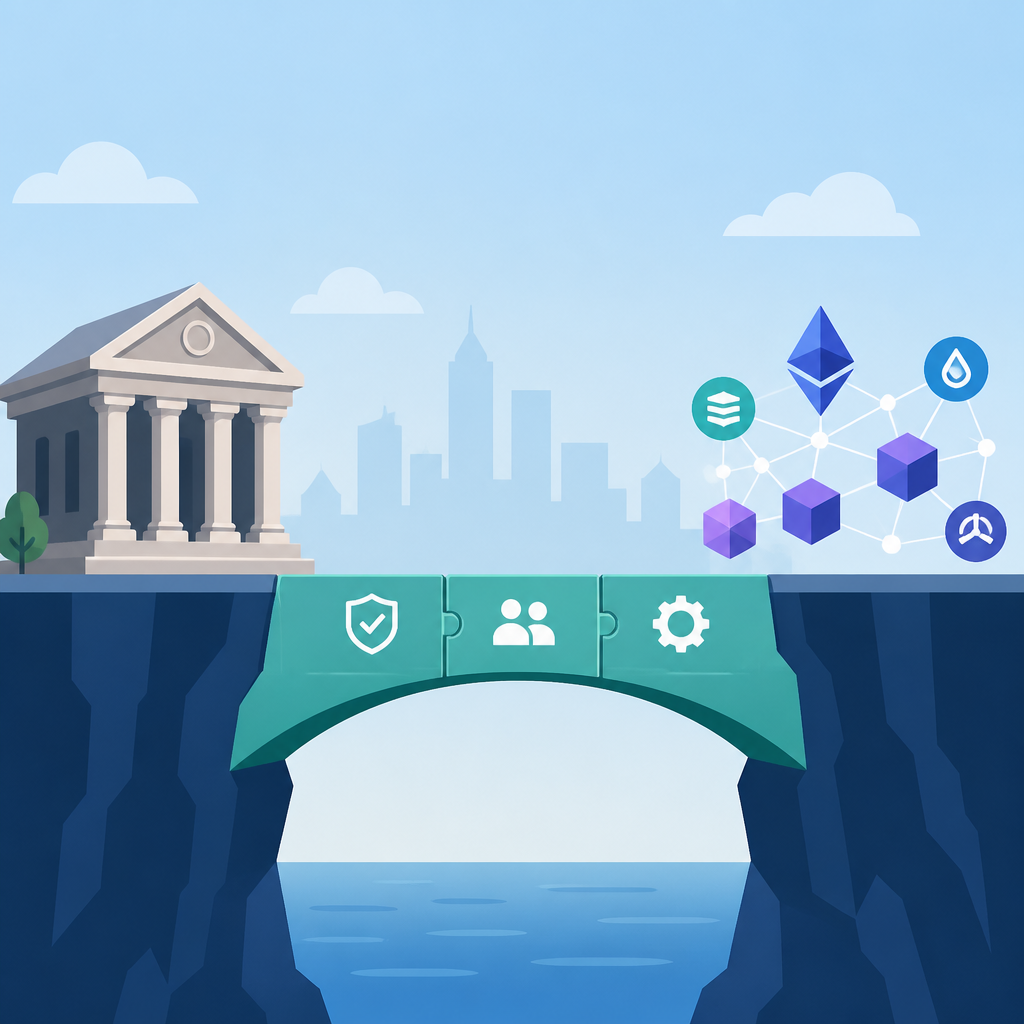
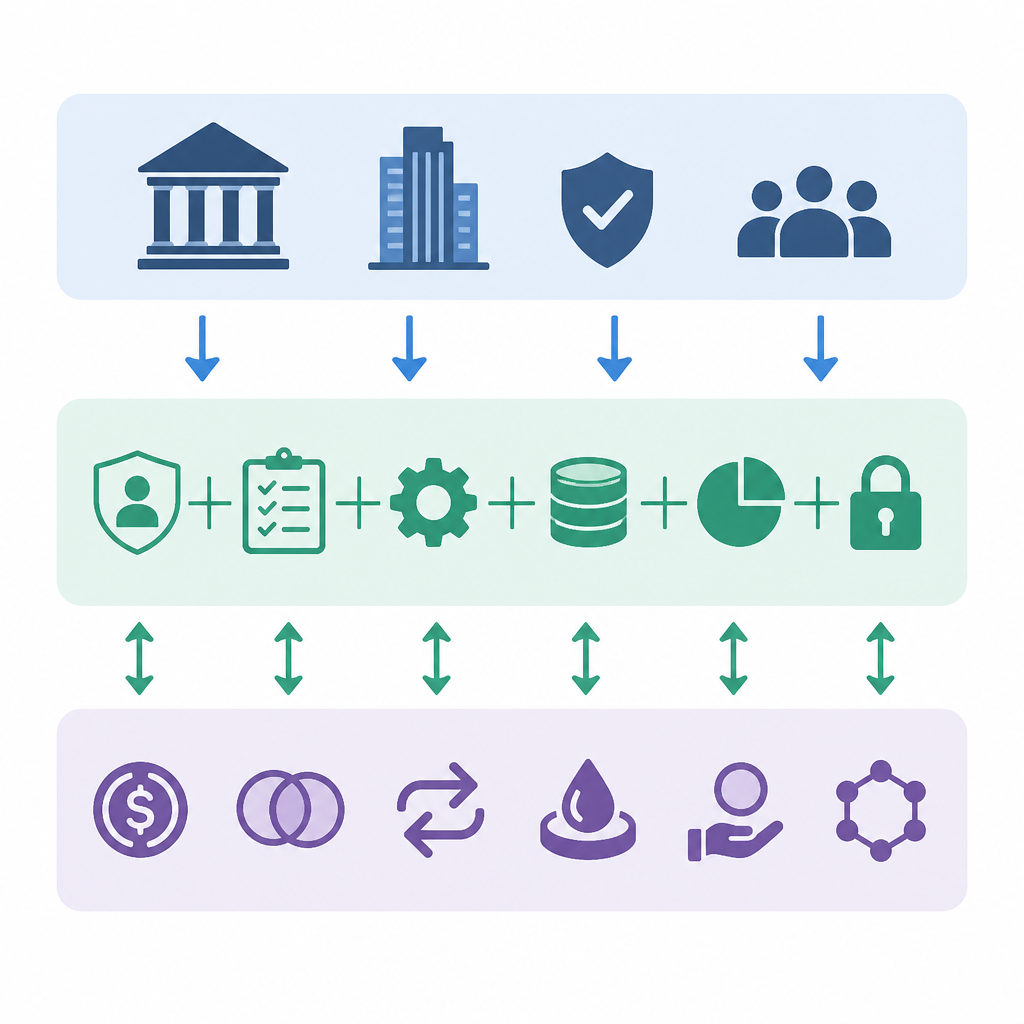
Institutional DeFi becomes workable when custody, approvals, identity, and reporting sit above the protocol.
DeFi is already moving real money: total value locked exceeded $200 billion in 2026, while stablecoin transfers topped $27 trillion a year. This list breaks down the four institutional layers that turn that activity into something a treasury team, compliance group, and board can actually use.
| Item | What it solves | Key examples |
|---|---|---|
| 1. Institutional-grade custody | Key control and signing | MPC, HSM, insurance, SOC 2 |
| 2. Identity and access management | Role-based permissions | SSO, segregation of duties, granular limits |
| 3. Corporate approval workflows | Multi-step transaction review | Analyst, desk head, CFO, treasury |
| 4. Compliance traceability and reporting | Audit trails and screening | Chainalysis, TRM, Elliptic, MiCA |
| 5. New infrastructure primitives | Enterprise-friendly execution | Virtual blockchains, gasless tx, decentralized identity |
1. Institutional-grade custody
Get the latest AI news in your inbox
Weekly picks of model releases, tools, and deep dives — no spam, unsubscribe anytime.
No spam. Unsubscribe at any time.
For banks and corporates, custody is the first gate. In native DeFi, a private key can control everything, but that model does not fit a treasury desk with approvals, controls, and audit duties. The article points to MPC and HSM-based custody as the way to keep keys from ever living in one place while still allowing controlled signing.
That matters because the institution needs more than storage. It needs insurance, role segregation, and audit evidence that a transaction was signed by the right people under the right policy.
- MPC splits signing authority across multiple parties.
- HSMs keep cryptographic material in tamper-resistant hardware.
- Providers named in the source include Fireblocks, BitGo, and Coinbase Custody.
2. Identity and access management
The second layer is about who can do what. A company cannot let any employee move funds with a single click, so institutional DeFi needs the same separation of duties used in banking. That means the person who creates a transaction should not be the person who approves or executes it.
In practice, this layer ties corporate identity systems to blockchain wallets. It turns wallet access into a governed permission model, with controls by role, amount, and transaction type.
- Connects corporate directories and SSO to wallet access.
- Supports granular permissions by role and transaction size.
- Preserves segregation of duties across treasury, risk, and compliance.
3. Corporate approval workflows
Native DeFi is built for immediate execution. Institutional finance is not. The article’s answer is multi-step approval logic, where a trade can move from analyst to desk head to CFO to treasury before it is signed on-chain. That gives companies a familiar control process without giving up decentralized execution.
Smart contracts can encode these approvals as cryptographic signatures, which makes them verifiable and immutable. The result is a transaction path that can be reviewed later without relying on spreadsheets or email threads.
Analyst creates request → Desk head reviews → CFO approves → Treasury executes
4. Compliance traceability and reporting
This is the layer regulators care about most. They are not asking only about returns; they want to know who transacted, when, how, and why. The compliance stack described in the source uses on-chain analytics to screen counterparties in real time and produce an audit trail for every action.
That makes DeFi easier to fit into regulated environments, since the institution can generate reports aligned with frameworks such as MiCA in Europe or the GENIUS Act in the United States.
- Counterparty screening with Chainalysis, TRM, or Elliptic.
- Automatic logs for each authorization, policy, and outcome.
- Reports that map to current regulatory requirements.
5. Virtual blockchains, gasless transactions, and decentralized identity
The last item is not a governance layer, but it matters for adoption. Virtual blockchains let teams deploy a customized chain in minutes while inheriting security and liquidity from the base network. Gasless transaction models remove the need for treasury teams to hold native tokens just to move assets. Decentralized identity systems replace unreadable wallet strings with human-friendly names and verifiable credentials.
Taken together, these tools lower the technical friction that has kept many institutions on the sidelines. They make blockchain activity feel less like operating a crypto-native stack and more like using enterprise software.
- Virtual blockchains reduce setup time and infrastructure overhead.
- Gasless flows let users sign off-chain while operators cover fees.
- Decentralized identity supports readable names and credential-based verification.
How to decide
If you are a treasury or finance team, start with custody and approval workflows, because those are the controls that make the rest usable. If you are in compliance or risk, focus first on screening, audit trails, and reporting. If you are building the platform itself, the infrastructure layer matters most, because virtual chains, gasless execution, and decentralized identity reduce the day-to-day friction for users.
The article’s core point is simple: DeFi protocols already work, but institutions need a middle layer that translates them into governance, custody, and compliance. Once that layer exists, the technology becomes much easier to adopt without forcing companies to abandon their operating rules.
// Related Articles
- [CHAIN]
Layer 2 Is Ethereum’s Real Product, Not a Detour
- [CHAIN]
Ethereum’s price should be read as network demand, not just speculati…
- [CHAIN]
Ethereum’s shake-up turns ETH into a cleaner bet
- [CHAIN]
Bitcoin’s price page explains the market in one view
- [CHAIN]
Web3 Banking Guide for Fintech Teams
- [CHAIN]
10 prediction market builders that can ship Polymarket-style apps