Jensen Huang’s AGI definition lowers the bar
4 ways Jensen Huang’s AGI take reshapes the debate, from benchmark tests to billion-dollar apps and why the bar keeps moving.

What does Jensen Huang think AGI means, and why does his answer matter?
Jensen Huang’s AGI claim shows how much the definition changes the answer.
1. Huang treats AGI as a moving target
Get the latest AI news in your inbox
Weekly picks of model releases, tools, and deep dives — no spam, unsubscribe anytime.
No spam. Unsubscribe at any time.
In the Mashable story, Huang’s core move is simple: he changes the finish line. At the 2023 New York Times DealBook Summit, he described AGI as software that can pass tests similar to normal human intelligence at a competitive level, and he said that threshold could arrive within five years. On Lex Fridman’s podcast, he went further and said AGI is already here.
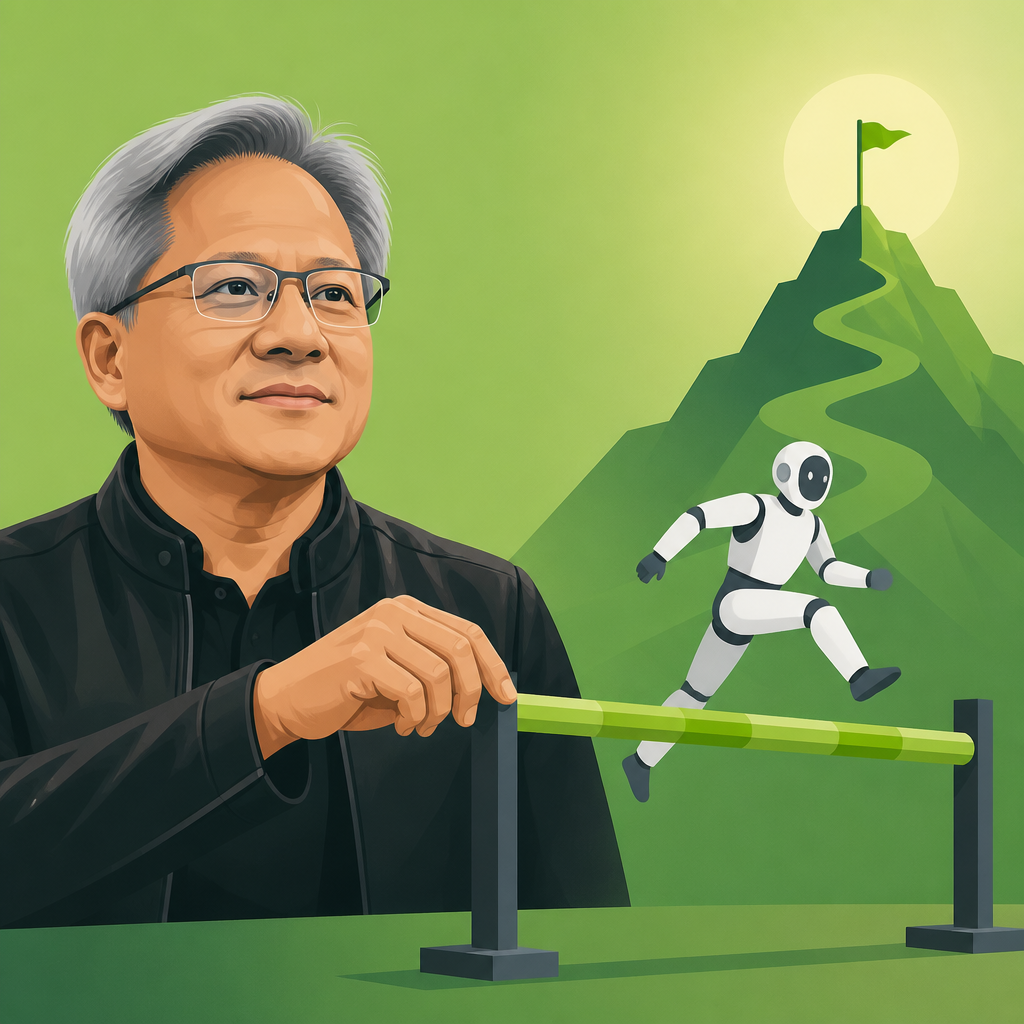
That shift matters because the argument is not only about model quality. It is also about what kind of proof counts. If AGI means benchmark-style performance, one answer follows. If it means something closer to a durable autonomous company builder, the answer changes again.
- 2023 definition: passes tests that approximate normal human intelligence
- Fridman’s test: start, grow, and run a $1 billion tech company
- Huang’s response: “I think it’s now”
2. Fridman’s version sets a much higher bar
Lex Fridman did not ask a small question. He framed true AGI as an AI system that could build and operate a tech company worth more than $1 billion. That version of AGI includes management, persistence, and real-world execution, not just one strong output or one profitable moment.
Huang accepted the framing, but only after narrowing it. He focused on the phrase “a billion dollars” and ignored the implied permanence. That distinction is the article’s key tension: a one-time commercial hit is not the same as an intelligence that can sustain an organization over time.
- Fridman’s definition includes leadership and continuity
- It implies handling people, strategy, and long-term operations
- It is much harder to satisfy than a benchmark test
3. Huang’s example is a viral app, not a lasting company
Huang’s own illustration makes the limit clear. He imagines an AI building a simple web service, watching it go viral, reaching billions of users at 50 cents each, and then fading away. He compares that to the dot-com era, when many websites were simple but still found huge audiences.

That is a useful example, but it is also a low bar for AGI. A system that can spin up a short-lived app is impressive. A system that can create NVIDIA is a different class of claim. Huang even says the odds of 100,000 such agents building NVIDIA are “zero percent.”
- Example output: a simple viral web service
- Monetization model: tiny fee, huge reach
- Limit: no evidence of durable institutional intelligence
4. The debate is really about what counts as intelligence
The article argues that Huang’s position is less a theory of intelligence than a pattern of definition. If the bar is benchmark success, AGI looks close. If the bar is a billion-dollar company that keeps functioning, the same system looks far less capable. That flexibility lets leaders claim progress while avoiding a harder test.
This is why the story feels so telling. Huang is not only talking about AI capability. He is also showing how much of the AGI debate depends on the wording of the question. The narrower the definition, the easier it is to say “yes.”
- Benchmark AGI: easier to claim
- Company-building AGI: much harder to prove
- Durable AGI: still not in view by Huang’s own admission
How to decide
If you care about headline-ready proof that AI is nearing human-level performance, Huang’s benchmark-style framing is the one to watch. If you care about systems that can manage people, survive market pressure, and build lasting businesses, Fridman’s definition is the better test.
For readers trying to track the real state of AGI, the safest takeaway is this: ask what definition is being used before you ask whether the milestone has been reached.
// Related Articles
- [IND]
X posts let execs shape the AI story
- [IND]
Claude’s 2026 limit changes are a capacity story, not a product story
- [IND]
SSI's $5 Billion Backing Proves AI Safety Is a Product Strategy
- [IND]
A rogue AI agent slipped into a real cyberattack
- [IND]
The Pentagon should stop marketing AI with battlefield language
- [IND]
Lilian Weng returns to OpenAI to lead RSI