LeVo 2 tackles full-length song generation
LeVo 2 uses hierarchical modeling and progressive post-training to improve full-length song generation.

LeVo 2 uses hierarchical modeling and progressive post-training to improve full-length song generation.
- Research org: Unspecified in arXiv abstract
- Core data: Six subjective dimensions
- Breakthrough: Mixed-token semantic planning plus parallel track-specific refinement
Full-length song generation is hard because the model has to do several things at once: keep the song coherent over time, preserve musicality, render vocals and accompaniment cleanly, and still follow lyrics and prompts. The paper positions LeVo 2: Stable and Melodious Song Generation via Hierarchical Representation Modeling and Progressive Post-Training as a way to reduce the usual trade-off between global planning and track-level detail.
For engineers, the interesting part is not just that it generates songs, but how it organizes the problem. Instead of forcing one representation to do everything, LeVo 2 splits responsibilities across stages: first semantic planning, then track-specific refinement, then waveform reconstruction. That kind of separation is a familiar software design instinct, and the paper applies it to generative audio.
What problem this paper is trying to fix
Get the latest AI news in your inbox
Weekly picks of model releases, tools, and deep dives — no spam, unsubscribe anytime.
No spam. Unsubscribe at any time.
The abstract calls out a structural trade-off in existing language model-based song systems. Mixed-token modeling helps keep vocals and instruments coordinated, but it can blur details that belong to specific tracks. Dual-track prediction improves acoustic detail, but it makes sequences longer and can weaken global planning. In other words, current systems tend to choose between better structure and better fidelity.

That matters because full-length songs are not short clips. A model has to stay stable over a longer horizon, keep the lyrics aligned with the music, and avoid the kind of drift that makes output sound stitched together. The paper frames LeVo 2 as a hybrid LLM-diffusion framework designed to handle those constraints together rather than treating them as one monolithic prediction problem.
The source does not give benchmark numbers in the abstract, so the key claim here is architectural and training-based rather than a single headline score. The paper says the system was evaluated with expert listening tests and objective evaluations, but the abstract does not spell out those metrics numerically.
How the method works in plain English
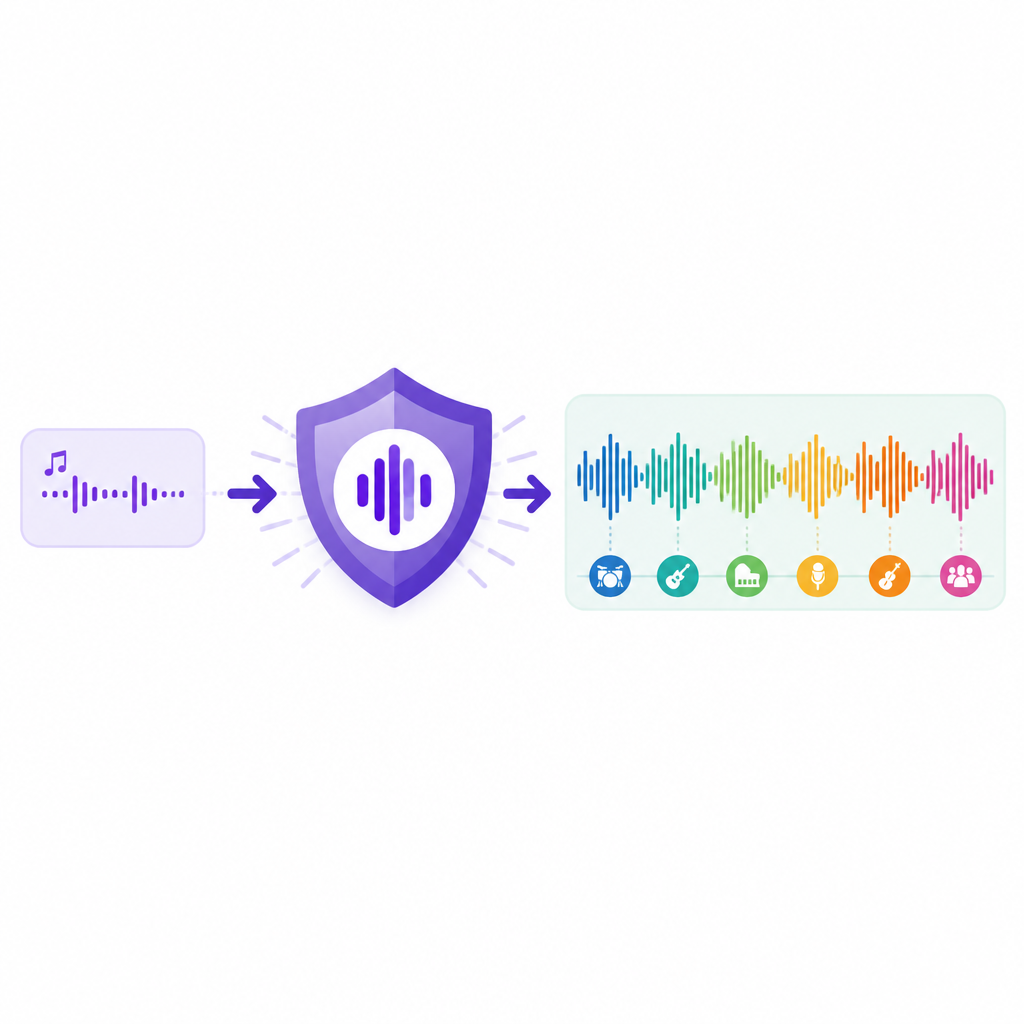
LeVo 2 uses what the authors call hierarchical modeling. The first stage is a language model, LeLM, which predicts mixed tokens for semantic planning. That gives the system a global blueprint for the song. Then, instead of stopping there, it predicts vocal and accompaniment tokens in parallel to refine each track more specifically.
After that, a diffusion-based Music Codec reconstructs the full-length waveform. So the pipeline is not just “generate tokens, then play them back.” It is more like: plan the song, specialize the tracks, then rebuild the audio signal. The architecture is meant to preserve both the high-level musical structure and the low-level acoustic detail.
The extended version of the work adds another layer that is easy to miss but seems central to the paper: an aesthetics-guided training schedule. During pre-training, an automated music aesthetic evaluation framework assigns musicality-tier conditions to large-scale data. The goal is to provide musicality priors before preference alignment begins.
That is a useful idea if you think about training as a sequence of increasingly specific constraints. Rather than jumping straight into preference optimization, the model first learns from data that has been organized by musicality level. Then progressive post-training applies three steps: supervised fine-tuning, large-scale offline DPO, and closed-loop semi-online DPO. According to the abstract, these stages separately improve generation quality, controllability, and musicality.
What the paper actually shows
The paper reports that expert listening tests and objective evaluations show LeVo 2 outperforming open-source baselines across six subjective dimensions. It also says the system approaches leading commercial systems on several listening metrics. Those are encouraging results, but the abstract does not provide the actual scores, the names of the baselines, or the exact metrics used.
That lack of detail is important for interpretation. You can tell from the abstract that the authors are claiming better perceptual quality and stronger controllability, but you cannot yet judge the size of the gain from the text alone. For practitioners, that means the contribution is best read as a method paper with promising evaluation results, not as a fully quantified benchmark report in the abstract.
The paper also includes ablations, and those ablations are said to validate the effects of the training strategy, aesthetics guidance, scaling, and hierarchical architecture. That suggests the authors did not rely on a single trick. Instead, they tried to show that each part of the system contributes to the final behavior.
Why the training schedule matters
The most distinctive piece here may be the progressive post-training recipe. The abstract argues that separating musicality learning, controllability alignment, and acoustic refinement helps reduce optimization conflict. In plain terms: if you try to force one model stage to solve every objective at once, the objectives can fight each other.
Offline DPO and semi-online DPO are used here as staged preference-alignment tools, not as a one-shot fix. The paper’s framing is that static offline preference pairs have limits, especially for something as multi-dimensional as song generation. By using a closed-loop semi-online step, the system can keep refining behavior after the initial supervised phase.
There is also a modular extension step that trains the Track-Specific LM for acoustic refinement while preserving the aligned semantic planner. That detail matters because it suggests the authors wanted to keep the global planning behavior stable while improving local audio quality. For anyone building generative systems, that is a familiar engineering concern: don’t let later tuning destroy earlier capabilities.
What developers should take away
If you work on generative audio, LeVo 2 is interesting because it treats song generation as a layered systems problem. One model stage handles planning, another handles track detail, and another reconstructs the waveform. That separation could make future systems easier to debug, tune, and extend than a single end-to-end stack.
The paper also shows how much training strategy now matters in multimodal generation. Architecture alone is not doing all the work here. The authors put real weight on data conditioning, preference alignment, and staged post-training. That is a useful reminder that for complex creative generation tasks, the training pipeline can be as important as the model family.
At the same time, the abstract leaves several open questions. It does not specify dataset size, benchmark names, listening-test protocols, or the exact commercial systems used for comparison. It also does not tell us how expensive the hybrid LLM-diffusion pipeline is to train or run. Those are practical questions any implementation team would want answered before trying to reproduce the system.
So the short version is this: LeVo 2 is trying to make full-length song generation more stable by decomposing the job into planning, refinement, and reconstruction, then aligning those stages with a progressively staged training recipe. The paper’s results sound promising, but the abstract gives enough detail to understand the idea, not enough to fully audit the numbers.
- Hierarchical token modeling separates global planning from track-level refinement.
- Progressive post-training combines SFT, offline DPO, and semi-online DPO.
- The abstract claims stronger subjective results, but it does not provide exact benchmark values.
// Related Articles
- [RSCH]
HumanTracker fixes humanoid motion eval blind spots
- [RSCH]
OmniScientist aims for full-stack AI science
- [RSCH]
AutoDesign learns better poster-making harnesses
- [RSCH]
Test-Time Harnesses Transfer Skills Without Retraining
- [RSCH]
DreamFly improves aerial VLN with memory and planning
- [RSCH]
AVA-Encoder turns films into editable knowledge graphs