LKValues maps Sri Lankan values into LLM alignment
LKValues builds a Sri Lankan value-alignment suite with survey data, a 150k instruction corpus, and a 1,000-item benchmark.

LKValues builds a Sri Lankan value-alignment suite with survey data, a 150k instruction corpus, and a 1,000-item benchmark.
- Research org: Unspecified in arXiv abstract
- Core data: 1,000-instance benchmark
- Breakthrough: Survey-grounded Sri Lankan value suite from trilingual respondents
What happens when an LLM trained to sound helpful is dropped into a society where “helpful” can still miss the local cultural context? This paper argues that Sri Lankan values are underrepresented in current alignment and evaluation setups, especially for Sinhala, and that gap can lead to culturally off-target responses in multilingual settings.
For engineers, the practical issue is not just abstract fairness. If your model is supposed to serve users in Sri Lanka, you need data and evaluation that reflect Sri Lankan social norms, not only broad global defaults. LKValues is an attempt to make that possible with a reusable pipeline, not just a one-off benchmark.
What problem this paper is trying to fix
Get the latest AI news in your inbox
Weekly picks of model releases, tools, and deep dives — no spam, unsubscribe anytime.
No spam. Unsubscribe at any time.
According to the abstract, value alignment research for LLMs has been biased toward Western norms. That matters because multilingual societies often have local value systems that do not map cleanly onto the assumptions baked into mainstream benchmarks and tuning data.

Sri Lanka is the paper’s case study. The authors say existing benchmarks overlook Sri Lankan-contextualized values in Sinhala, the country’s official language, which makes it harder to evaluate whether a model is actually behaving appropriately in local settings.
The paper is trying to fix two related problems at once: first, the lack of a culturally grounded value set for Sri Lanka; second, the lack of benchmark and training data that can turn those values into something model developers can actually use.
How LKValues works in plain English
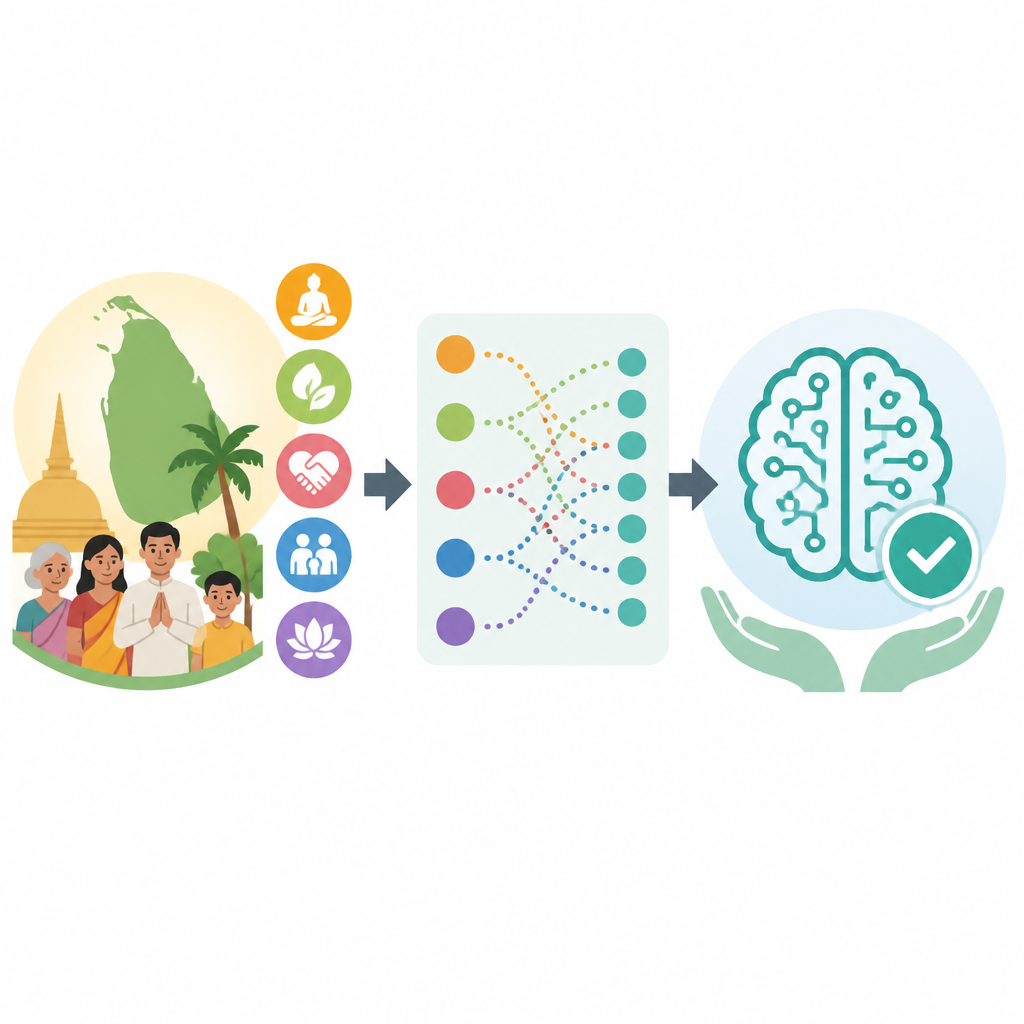
The core idea is straightforward: start with people, not just model outputs. The authors ran a trilingual survey with 205 respondents, then blended adapted global frameworks with LLM-elicited local constructs to derive 40 majority-endorsed societal values.
Those values are then turned into two resources. The first is LKvaluesIT, a Sinhala-English news-derived instruction corpus with 150k scenario-based instances. The second is LKvaluesBench, a value-sensitive evaluation benchmark with 1,000 instances.
That split matters. The instruction corpus is for fine-tuning or adaptation, while the benchmark is for checking whether the model actually learned the intended behavior. In other words, the paper does not just define values; it operationalizes them into training and evaluation artifacts.
The paper also says the suite is “survey-grounded,” which is important because it suggests the values come from human respondents rather than being inferred purely from model generations or imported wholesale from another cultural context.
What the paper actually shows
The abstract says the authors evaluated a set of proprietary and open-weight LLMs with LKvaluesBench, and fine-tuned three open-weight base models: Qwen3.5-4B-Base, Qwen3.5-9B-Base, and Aya-Expanse-8B-Base.
They report that newer and larger LLMs still show low-resource and cultural value-alignment gaps. That is a useful reminder that scale alone does not solve local alignment problems, especially when the target culture is underrepresented in the training mix.
The paper also says LKValues fine-tuning improves Qwen-family models in both English and Sinhala, reducing invalid outputs and cross-lingual disparities. However, the gains are model-family dependent, so the method is not a universal fix.
One thing the abstract does not give is a full set of benchmark scores. There are no specific accuracy or win-rate numbers in the source text, so any deeper performance comparison would require reading the paper itself.
Still, the result is concrete enough to matter: the authors show that a culture-specific alignment pipeline can improve behavior in at least some open-weight models, while also exposing how uneven those gains can be across model families.
Why this matters for developers
If you build multilingual assistants, moderation systems, or public-sector tools, this paper is a reminder that alignment is not one-size-fits-all. A model that looks aligned on broad English-language tests can still fail on local values, especially in lower-resource languages like Sinhala.
LKValues is useful because it gives developers a template: collect local judgments, convert them into a structured value set, build scenario-based instruction data, and validate with a benchmark that reflects the target society. That pipeline is more actionable than an abstract discussion of “cultural sensitivity.”
The fact that the dataset is publicly available on GitHub also makes the work more practical for experimentation and follow-on research. Developers can inspect the resources, adapt the pipeline, or use the benchmark as a more realistic check than generic alignment tests.
Limitations and open questions
The abstract is clear that the gains remain model-family dependent. That means the same recipe may not transfer cleanly across architectures, sizes, or training regimes. If you are planning to reuse the approach, expect to test it carefully instead of assuming it generalizes.
There is also a scope limitation: this is about Sri Lankan societal values, not a universal alignment framework. That is a strength for local relevance, but it also means the resource suite is only as representative as the survey and construction process behind it.
Another open question is how well the benchmark captures real deployment behavior outside the news-derived scenario format. The paper’s abstract does not say whether the benchmark spans all the contexts developers care about, so practical use will likely require supplementing it with domain-specific tests.
Even with those limits, LKValues is a solid example of what low-resource alignment research should look like: local data, explicit values, a training set, and a benchmark that can actually measure whether a model respects the target culture.
Bottom line
LKValues shows that Sri Lankan value alignment can be turned into a concrete resource suite for LLM development, and that doing so can reduce some cross-lingual and invalid-output problems in Qwen-family models.
For teams building AI in multilingual societies, the takeaway is simple: if the values are local, the alignment data has to be local too.
// Related Articles
- [RSCH]
SoftReason makes deductive reasoning differentiable
- [RSCH]
A new SLLN for locally Lipschitz functions
- [RSCH]
Open-Source Android AI Agents Can Run Host Code
- [RSCH]
CodeRescue routes coding-agent recovery by budget
- [RSCH]
Appearance Pointers bring region control to DiTs
- [RSCH]
GEAR cuts copying in long-context reasoning