SoftReason makes deductive reasoning differentiable
SoftReason turns perceptual facts and KG rules into a fully differentiable deductive reasoning pipeline.

SoftReason turns perceptual facts and KG rules into a fully differentiable deductive reasoning pipeline.
- Research org: Unspecified in arXiv abstract
- Core data: No benchmark numbers in abstract
- Breakthrough: Learned differentiable lift of the immediate-consequence operator
How do you do deduction when the facts are not clean symbols, but noisy outputs from perception? That is the problem this paper targets. The authors argue that classical neuro-symbolic systems still leave a gradient gap between perception and logic, which makes end-to-end training awkward when the evidence starts as high-dimensional inputs.
SoftReason is their answer: a neuro-soft-symbolic architecture that keeps the entire deductive path differentiable. The paper says this lets the model combine perceptual grounding, knowledge-graph evidence, and rule-based closure inside one trainable system instead of stitching together separate discrete stages.
What problem SoftReason is trying to fix
Get the latest AI news in your inbox
Weekly picks of model releases, tools, and deep dives — no spam, unsubscribe anytime.
No spam. Unsubscribe at any time.
In many reasoning tasks, the premises are not given as neat symbolic facts. They have to be inferred from images or other high-dimensional perceptual data first. At the same time, the predicate vocabulary, argument structure, and trusted evidence may come from a knowledge graph or from rule definitions. That means a model has to bridge perception and deduction without losing trainability.

Traditional neuro-symbolic pipelines usually have a discrete interface between those two worlds. Once you discretize early, you often lose the ability to backpropagate through the reasoning process itself. The abstract frames that as the core limitation SoftReason is built to remove.
This matters for engineers because the hard part is not just “can the model reason,” but “can the whole stack learn from the final answer when the intermediate facts are uncertain?” If the answer is no, you end up hand-engineering more of the pipeline than you’d like.
How the method works in plain English
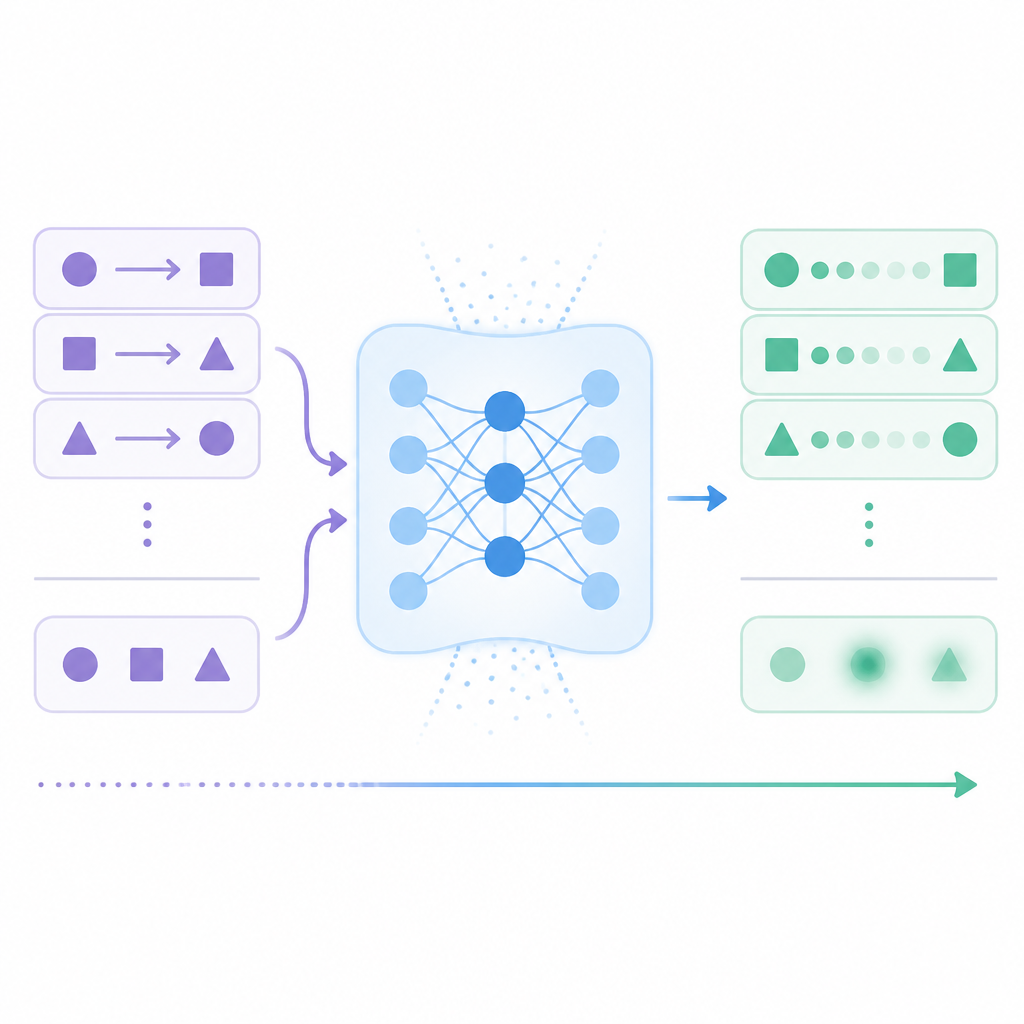
The central idea is to represent the deductive state as a local soft interpretation tensor over candidate constants and predicates. In practical terms, the model does not commit to a single crisp fact too early. Instead, it keeps probabilities around for which constants and predicates might be involved.
Perception proposes probabilistic base facts. Knowledge-graph triples are injected as high-confidence soft evidence. Then every query anchor, predicate choice, and closure update stays differentiable, so the model can be trained end to end.
The paper’s core innovation is a learned differentiable lift of the immediate-consequence operator. The abstract says this operator uses predicate-definition embeddings and latent composition channels to form soft body-predicate mixtures, aggregate over all possible witnesses, propose query-conditioned head facts, and update the interpretation through a monotone probabilistic OR.
That is a dense description, but the practical takeaway is simple: SoftReason is trying to make rule application behave like a neural layer, not a hard symbolic step. Instead of separating “perception produces facts” from “logic consumes facts,” it makes the whole chain differentiable so the model can learn how to route evidence through the rules.
What the paper actually shows
The abstract says the framework is instantiated on Knowledge-aware Visual Question Answering, or KVQA. That is a sensible testbed because it forces the model to combine visual grounding with external knowledge and deductive structure.
What the abstract does not include is benchmark numbers. There are no accuracy scores, no ablation results, and no throughput or latency claims in the text provided here. So the safe reading is that the paper presents the architecture and its KVQA instantiation, but the abstract alone does not let us judge how much it improves over prior systems.
Even without numbers, the contribution is still clear: SoftReason claims to support end-to-end perceptual grounding, KG evidence injection, and differentiable deductive closure in one trainable architecture. That combination is the real pitch.
- What is new: A soft interpretation tensor replaces a hard symbolic interface.
- What gets trained: Query anchors, predicate choices, and closure updates all remain differentiable.
- Where it fits: Knowledge-aware visual question answering with perceptual facts plus KG evidence.
Why developers should care
If you build systems that mix perception with structured reasoning, this paper points at a cleaner training story. You can think of SoftReason as an attempt to make logic-like inference compatible with gradient-based optimization, which is exactly what modern ML stacks want.
That could matter in applications where evidence is uncertain, rules matter, and the model has to learn from end-task supervision instead of a fully annotated symbolic trace. It also suggests a path for treating knowledge graphs as soft evidence rather than brittle lookup tables.
There are still open questions. The abstract does not tell us how expensive the soft interpretation tensor is at scale, how it behaves with large rule sets, or how sensitive it is to noisy perception. It also does not show whether the differentiable closure is easier to debug than a discrete reasoning pipeline.
So the practical reading is cautious but interesting: SoftReason is not just “neural reasoning with a new name.” It is an explicit attempt to remove the interface break between perception and deduction, and that is a useful direction for anyone building multimodal agents, visual QA systems, or KG-augmented reasoning models.
Bottom line
SoftReason proposes a fully differentiable way to do deductive reasoning over perceptual inputs and knowledge-graph evidence. The abstract does not give benchmark numbers, but it does lay out a concrete architectural idea: make the immediate-consequence operator itself learnable and differentiable.
For practitioners, the value is in the training loop. If the method holds up beyond the abstract, it could make neuro-symbolic systems easier to optimize end to end without giving up structured reasoning altogether.
// Related Articles
- [RSCH]
LKValues maps Sri Lankan values into LLM alignment
- [RSCH]
A new SLLN for locally Lipschitz functions
- [RSCH]
Open-Source Android AI Agents Can Run Host Code
- [RSCH]
CodeRescue routes coding-agent recovery by budget
- [RSCH]
Appearance Pointers bring region control to DiTs
- [RSCH]
GEAR cuts copying in long-context reasoning