Mistral’s model lineup proves specialization beats one giant model
Mistral’s docs show that specialized models now matter more than a single flagship model.

Mistral’s model catalog shows specialization is now more valuable than one giant general model.
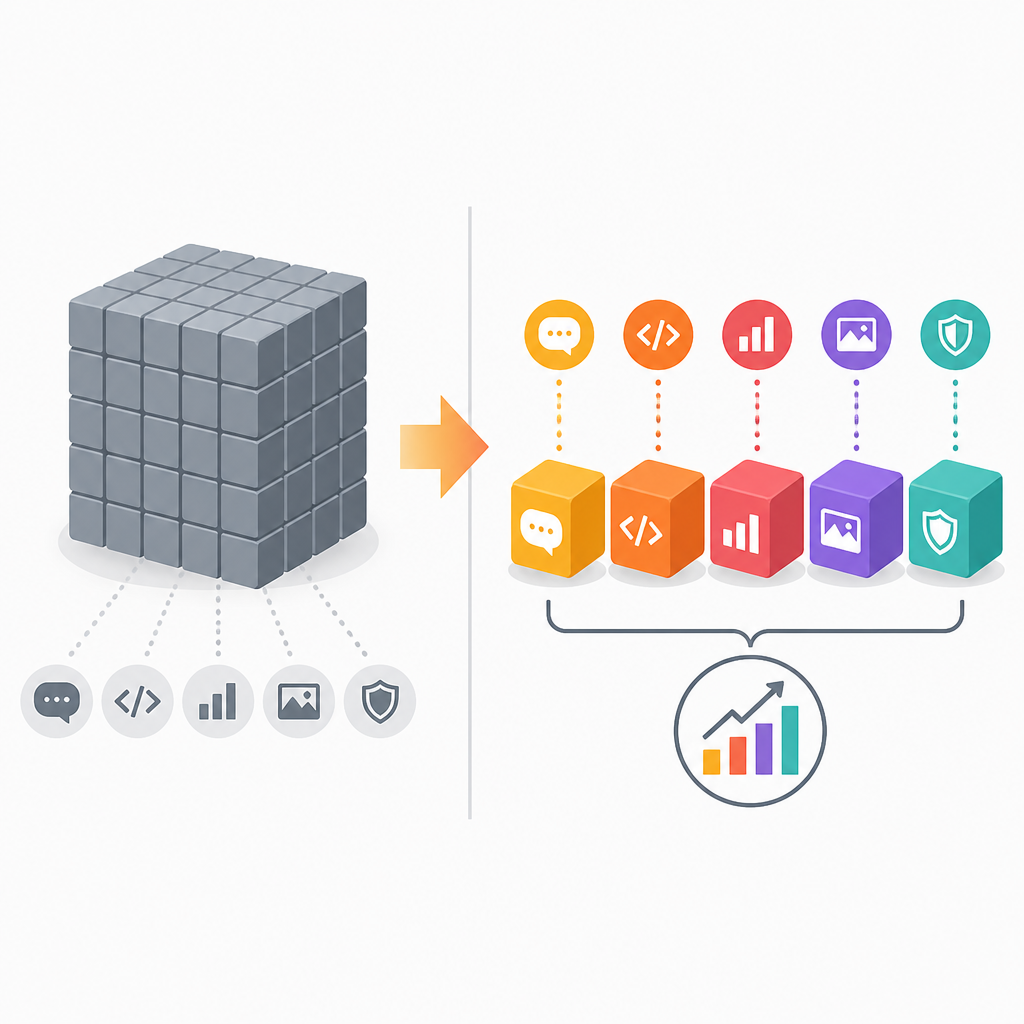
Mistral’s own documentation makes a blunt case for a market shift: the company is not organizing its portfolio around one all-purpose flagship, but around a stack of models tuned for coding, audio, OCR, moderation, embeddings, and multilingual work. That is the right move. The list includes Mistral Medium 3.5 for agentic and coding use, Devstral 2 for software engineering tasks, Voxtral for transcription and voice, OCR 3 for document pipelines, and Mistral Moderation 2 for safety. The message is unmistakable: the winning product strategy is no longer “build the biggest model,” but “build the right model for the job.”
Specialization is the real product advantage
Get the latest AI news in your inbox
Weekly picks of model releases, tools, and deep dives — no spam, unsubscribe anytime.
No spam. Unsubscribe at any time.
The strongest evidence is in the feature set itself. Mistral does not force every customer through a single interface to a single model. Instead, it offers a frontier multimodal model for agentic and coding use cases, a hybrid model that unifies instruct, reasoning, and coding, and a dedicated code agent for software engineering tasks. That separation matters because enterprise buyers do not want one model that is merely decent at everything. They want a model that is excellent at the workflow that costs them the most money. If a team is paying for code review, bug fixing, or repo navigation, a code agent is the product, not a generic chatbot.

The same pattern appears in the audio and document stack. Voxtral Mini Transcribe is optimized for live transcription, Voxtral TTS handles voice cloning and multilingual speech, and OCR 3 powers document AI. Those are not side features. They are distinct workloads with distinct failure modes. A model that is great at text generation but weak at transcription is not a “slightly worse” model, it is the wrong tool. Mistral’s catalog acknowledges that reality and turns it into a commercial advantage: customers can buy exactly the capability they need instead of overpaying for unused generality.
Open-weight distribution is a strategic moat
Mistral’s lineup also shows that openness is not a branding layer, it is a distribution strategy. The docs list open models alongside premier and proprietary ones, including Mistral Nemo 12B as its best multilingual open source model released in July 2024, plus open variants of Mistral Small 4, Mistral Large 3, and Devstral 2. That matters because open-weight models win adoption where control matters more than convenience. Teams that need on-prem deployment, custom fine-tuning, or strict data boundaries do not want to negotiate every constraint with a closed vendor. They want to ship.
The deprecation table reinforces the point. Mistral is not pretending the model surface is static. It publishes replacements, retirement dates, and alternatives for older releases. That discipline is exactly what enterprise buyers need from an open model vendor. Open does not mean chaotic. It means customers can anchor on a model family, migrate on a schedule, and keep ownership of the integration. In practice, that makes the portfolio stickier than a single closed flagship because teams can standardize around capabilities, not a black-box promise.
The best model is the one that matches the task
The docs also reveal a more important truth about AI adoption: performance is now contextual. Mistral’s model list includes frontier-class multimodal systems, tiny efficient models, transcription-specific models, moderation models, and semantic embedding models. That spread is not clutter. It is the shape of a mature market. A startup building customer support automation does not need the same model profile as a bank running moderation checks or a developer tool indexing code. The right architecture is a portfolio, not a monolith.
There is also a cost argument hiding in plain sight. Smaller models such as Ministral 3 3B and Ministral 3 8B exist because many production workloads do not need maximum scale. They need predictable latency, lower serving cost, and enough quality to meet a narrow objective. In other words, the economics of AI are moving toward task-fit efficiency. Mistral’s documentation reads like a rebuttal to the “bigger is always better” era. The company is betting that customers will increasingly choose the model that minimizes total cost of ownership, not the one that scores best in a generic benchmark race.
The counter-argument
The best case for the opposing view is simple: broad general-purpose models reduce complexity. One model means one API, one evaluation harness, one procurement path, and fewer routing decisions at runtime. For smaller teams, that simplicity is real. A single strong model can be easier to integrate than a portfolio that demands model selection logic, fallbacks, and monitoring across multiple workloads.
There is also a quality argument for scale. Frontier models often absorb enough breadth to handle many tasks well enough, and “well enough” is what a lot of products need at launch. If the team is early, the fastest path is often to ship with one capable model and defer specialization until usage patterns are clear.
That argument is valid for prototypes and thin teams, but it breaks at production scale. Once a product has distinct workloads, the hidden costs of a one-model strategy show up fast: higher inference spend, weaker latency, lower accuracy on edge cases, and more brittle prompts. Mistral’s catalog is evidence that the market has already crossed that threshold. The company is not merely offering more choices; it is showing that serious AI systems need routing by task. Simplicity matters, but it is no longer the highest-order principle.
What to do with this
If you are an engineer, stop defaulting to the largest model in the catalog and build a routing layer around task type, latency budget, and data sensitivity. If you are a PM, define your AI feature by the job to be done first, then select the smallest model that meets the quality bar. If you are a founder, treat model choice as product strategy: the winners will not be the teams with one universal model, but the teams that assemble the right mix of specialist models and make that mix invisible to the user.
// Related Articles
- [MODEL]
Google ships Gemini 3.6 Flash and 3.5 Lite
- [MODEL]
Kimi K3 Is Forcing Silicon Valley to Pick Sides
- [MODEL]
Opus 5 lets you ship with fewer refusals
- [MODEL]
Claude Opus 5 undercuts Fable 5 on price
- [MODEL]
OpenAI model catalog adds GPT-5.6 pricing tiers
- [MODEL]
Gemini 3.6 Flash proves Google is betting on efficiency over hype