OpenAI and Anthropic must sell efficiency, not excess
OpenAI and Anthropic now face a market that rewards efficiency over raw AI consumption.

OpenAI and Anthropic now face a market that rewards efficiency over raw AI consumption.
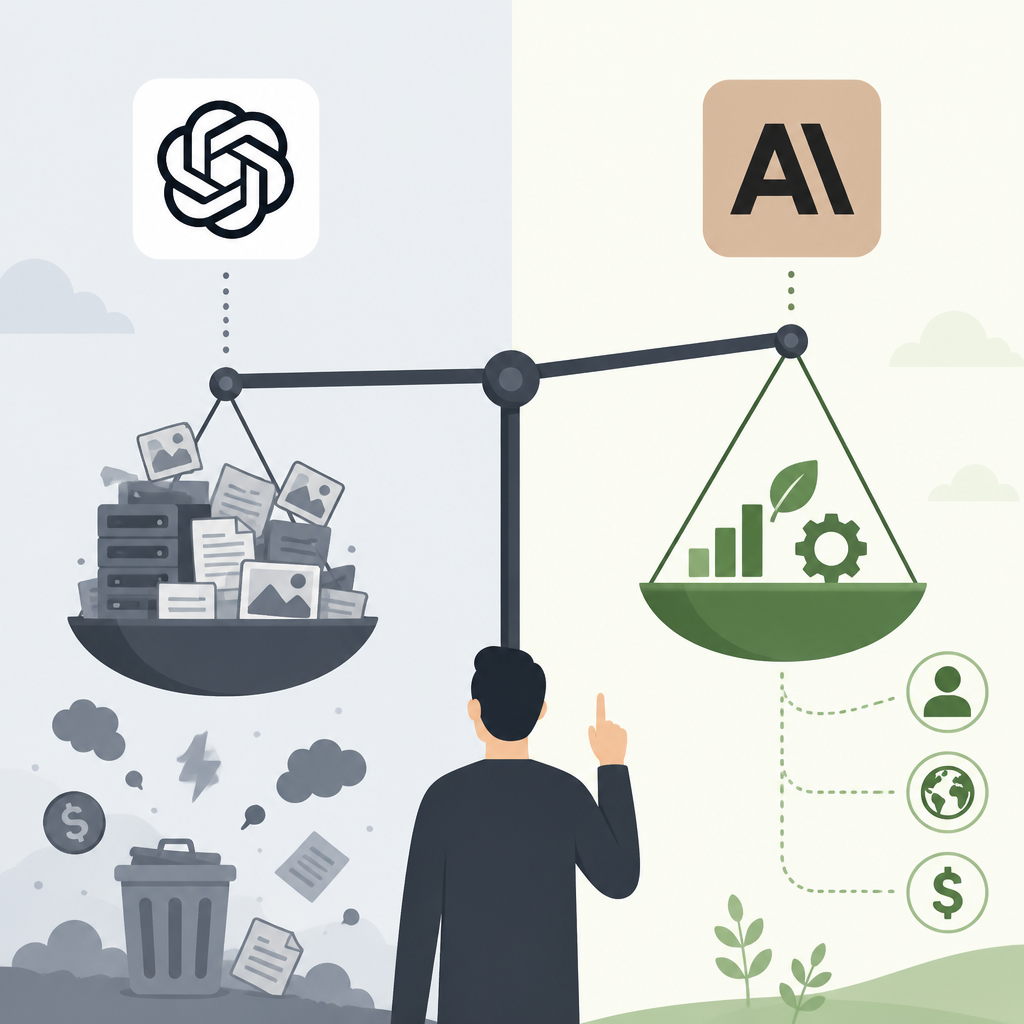
OpenAI and Anthropic are entering a slower, harsher phase of the AI market, and the winners will be the companies that prove they save customers money, not the ones that burn the most tokens.
That shift is already visible in the numbers and in the behavior of buyers. CNBC reports that Lindy moved 100% of its traffic from Anthropic’s Claude to DeepSeek’s cheaper open-weight models and expects to save millions within months. Uber has also imposed spending tiers on AI tools after blowing through its annual AI budget in four months. When startups and enterprise teams start treating model usage like cloud spend, the old “use more AI everywhere” playbook stops working.
First, token growth is no longer a badge of honor
Get the latest AI news in your inbox
Weekly picks of model releases, tools, and deep dives — no spam, unsubscribe anytime.
No spam. Unsubscribe at any time.
The first argument for this stance is simple: AI usage has become too easy to overconsume, and customers are finally noticing. The article describes the era of “tokenmaxxing,” where developers were effectively encouraged to use as much model output as possible. That behavior inflated bills without forcing teams to ask whether the model was the right tool for the job. Once finance teams start reviewing those invoices line by line, brute-force usage becomes a liability, not a strategy.

Flo Crivello’s Lindy is the clearest example. He said the company’s costs were “unsustainable” until it switched away from Claude, and that the move made the cost curve “crash to the ground.” That is not a marginal optimization. It is a signal that customers now have enough alternatives to punish premium pricing when the task does not require a frontier model. In that environment, OpenAI and Anthropic cannot rely on habit or brand prestige to preserve spend.
Second, cheaper routing will eat the easy workloads
The second argument is that the market is learning to separate hard problems from cheap ones. Darren Kimura of AISquared said frontier-model spending is peaking for simple tasks that cheaper models can handle, and Arvind Jain of Glean said roughly 95% of enterprise AI usage is still on frontier models. That imbalance is exactly why the correction is coming. If most routine work is still routed to the most expensive models, there is obvious room for savings.
Model routing is the mechanism that makes the shift durable. Microsoft says GitHub Copilot will route users to the most appropriate model, and Google is pushing Gemini 3.5 Flash at half or even one-third the price of comparable frontier models. Amazon is also leaning on in-house chips to lower its costs. This is the real threat to OpenAI and Anthropic: not that AI demand disappears, but that demand gets sliced into tiers, with premium models reserved for the hardest tasks and commodity tasks pushed down the stack.
The counter-argument
The strongest case against this view is that AI is still early, and enterprise adoption has barely begun. Jeff Henry of Highspring said many midsize companies have not even started experimenting with AI yet, while he also noted that AI is “not going away.” That is true. The market for useful automation is still expanding, and companies that prove clear ROI will keep spending.
There is also a scale argument. OpenAI and Anthropic are still posting stunning revenue run rates, and their products remain the benchmark for many serious workloads. If these firms keep improving quality, safety, and reliability, buyers will pay for them where the work matters. Premium models will not vanish.
That said, the counter-argument only holds for the highest-value use cases. It does not rescue indiscriminate spending. The CNBC report shows exactly where the pressure lands first: on broad, routine, and poorly measured consumption. OpenAI and Anthropic can still win the hard problems, but they will lose margin and growth if they keep assuming every token deserves frontier pricing. The market is already rejecting that premise.
What to do with this
If you are an engineer, PM, or founder, build for model choice, not model loyalty. Instrument spend by workflow, route simple tasks to cheaper models, and reserve frontier systems for cases where accuracy, reasoning, or safety justify the premium. If you run a company, make AI budgets visible to finance early, because the next wave of value will come from proving efficiency, not from celebrating usage volume.
// Related Articles