OpenAI’s API changelog adds spend caps, transcribe, and Fast mode
OpenAI’s API changelog adds Fast mode, hard spend limits, GPT Transcribe, and a Terraform provider for platform management.

OpenAI’s API changelog adds Fast mode, hard spend limits, GPT Transcribe, and a Terraform provider.
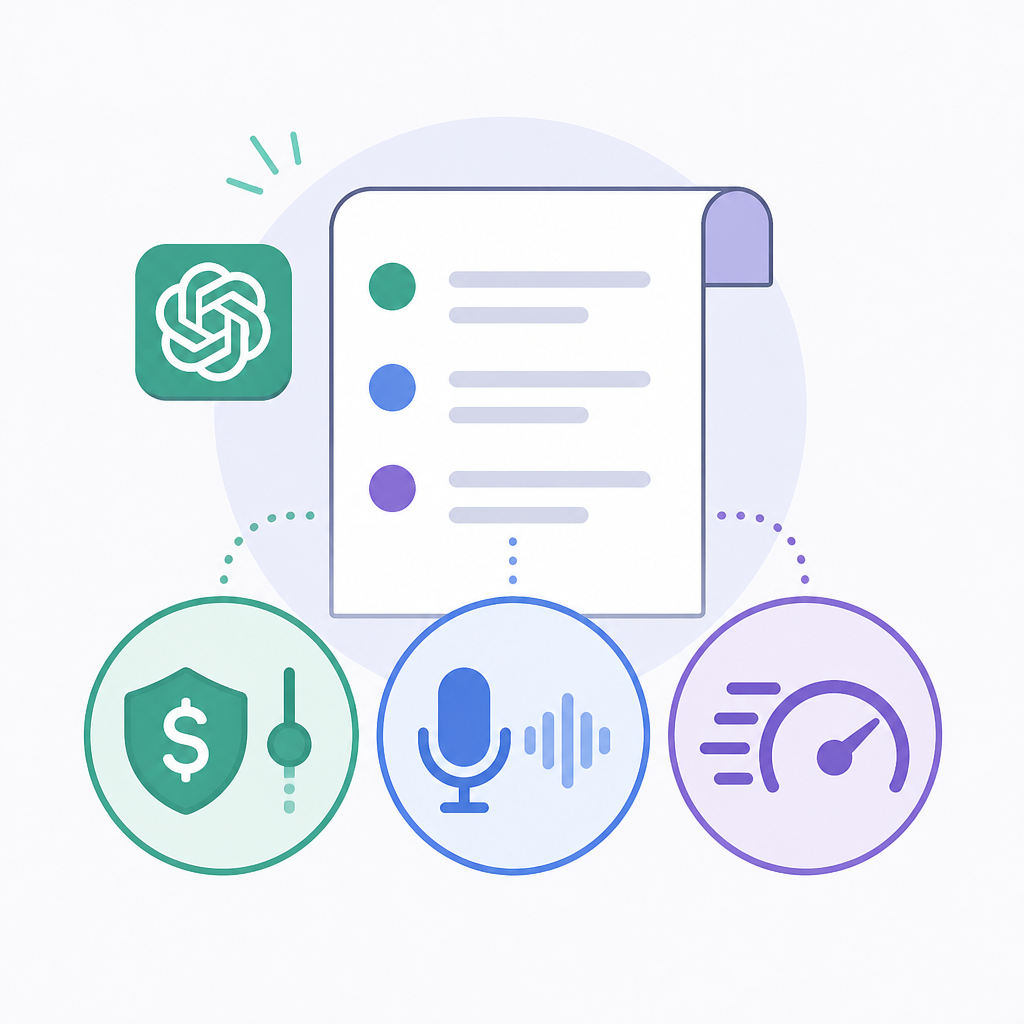
OpenAI spent July 2026 tightening the API platform itself, not just the models behind it. The latest entries add a cheaper, faster pricing tier, a transcription stack, and infrastructure tooling that makes the platform easier to run like real software.
| Date | Change | Key number |
|---|---|---|
| Jul 30, 2026 | GPT-5.6 pricing update | Luna 80% less, Terra 20% less, Fast mode up to 2.5× faster |
| Jul 29, 2026 | Terraform provider release | Projects, users, groups, roles, service accounts, certificates, invitations |
| Jul 28, 2026 | Transcription release | GPT Transcribe and GPT Live Transcribe |
| Jul 22, 2026 | Spend limits | Hard monthly cap with 429 errors at limit |
OpenAI is treating the API like infrastructure
Get the latest AI news in your inbox
Weekly picks of model releases, tools, and deep dives — no spam, unsubscribe anytime.
No spam. Unsubscribe at any time.
The changelog reads less like a model announcement page and more like the release notes for a platform team. That matters because the highest-friction problems in production AI are usually not prompt quality or benchmark scores. They are billing control, access management, latency, and the boring work of keeping everything auditable.

That is why the July updates matter together. A cheaper model tier lowers inference cost. Fast mode gives teams a clearer tradeoff between speed and price. Spend limits reduce the risk of runaway usage. The Terraform provider lets ops teams manage OpenAI resources the same way they manage cloud accounts and permissions.
- GPT-5.6 Luna is 80% cheaper starting July 30.
- GPT-5.6 Terra is 20% cheaper starting July 30.
- Fast mode for GPT-5.6 Sol reaches up to 2.5× faster speeds at twice the price.
- Hard spend limits now return HTTP 429 once the cap is hit.
Fast mode and spend limits solve two different pain points
OpenAI’s new Fast mode replaces Priority Processing, and the company says priority-tagged requests will automatically use it. That backward compatibility matters because teams do not want to rewrite routing logic just to keep latency behavior stable. The pricing is simple: faster responses cost more, and the ceiling is explicit.
Spend limits are the other half of the story. OpenAI added monthly caps at the organization and project level, plus alerts before traffic gets interrupted. That is a cleaner control than trying to infer budget risk from dashboards after the fact. For teams shipping customer-facing features, a hard cap is often the difference between a controlled slowdown and a surprise outage.
“It’s not about building the next big thing, it’s about building the next thing right.” — Sam Altman, OpenAI DevDay 2023
That quote fits this changelog better than a model launch keynote would. The July releases are about operational correctness. The platform is getting more predictable for finance, SRE, and security teams, which is usually what determines whether AI features stay in production.
Transcription finally looks like a first-class API primitive
On July 28, OpenAI released GPT Transcribe for file transcription and final transcripts of committed Realtime turns, plus GPT Live Transcribe for low-latency streaming transcription. The company also says both models support free-form transcription context, keyword hints, and multiple expected input languages.
That combination makes the new transcription tools more practical than a bare speech-to-text endpoint. Context and keyword hints help with jargon, product names, and domain terms. Multiple input languages matter for support, meetings, and voice apps that do not stay in one language for long. The Realtime tie-in also matters because it reduces the gap between live audio and usable text.
- GPT Transcribe covers file transcription and committed Realtime turns.
- GPT Live Transcribe is aimed at low-latency streaming use cases.
- Both support context, keyword hints, and multiple expected input languages.
- The docs point developers to the transcription guide for supported outputs and workflows.
This is the kind of release that helps voice agents move from demos to production. If transcription is slow or brittle, the whole user experience feels off. If it is accurate, configurable, and easy to wire into the rest of the stack, it becomes infrastructure rather than a feature demo.
The Terraform provider changes how teams will manage OpenAI
On July 29, OpenAI released an official Terraform provider for OpenAI API Platform resources. It covers projects, users, groups, roles, access assignments, service accounts, certificates, invitations, and project-level rate limits. That is a big clue about who OpenAI expects to run the platform now: not just developers, but platform engineers and security teams.
The practical value is in the workflow. Terraform lets teams review changes before applying them, import existing resources, and detect drift when the real system no longer matches the declared config. In other words, OpenAI resources can now sit inside the same change-management process as cloud IAM, networking, and app deployment.
For organizations with multiple apps and multiple teams, that matters more than a flashy model launch. A platform becomes easier to scale when access control, budget policy, and environment setup all live in code. It also becomes easier to audit, which is a real requirement once AI usage starts touching customer data or regulated workflows.
If you want the broader context, this update fits the same pattern as OpenAI’s recent work on Responses API state management and its push toward more structured platform operations. The message is consistent: the API is turning into something enterprises can govern, not just call.
What this changelog says about OpenAI’s priorities
The July entries show a clear order of operations. First, lower the cost of the newest model variants. Second, give teams a faster lane when they need it. Third, add hard budget controls so usage cannot run away. Fourth, make transcription and infrastructure management feel native instead of bolted on.
That mix is useful because it reflects how teams actually buy and keep AI software. Price matters. Latency matters. Control matters. So does the ability to express those controls in code instead of manual dashboards. OpenAI is clearly trying to reduce the number of reasons a team would need to build its own wrapper or switch vendors for operational reasons.
The next question is whether the rest of the platform keeps moving in the same direction: more admin tooling, better defaults, and fewer surprises in production. If OpenAI keeps shipping updates like these, the API will look less like a collection of endpoints and more like a managed system teams can trust with real workloads.
// Related Articles
- [TOOLS]
Astra Turns a Math Post Into a Model Launch
- [TOOLS]
Windsurf’s IntelliJ plugin is a shortcut, not a strategy
- [TOOLS]
SWE-1.7 free preview lands in Devin Desktop
- [TOOLS]
Vibe Island’s changelog shows the right product bets
- [TOOLS]
OpenAI Newsroom turns announcements into a digest
- [TOOLS]
Trendshift monthly repos let you spot real momentum