OpenAI Cuts GPT-5.6 Prices as AI Bills Climb
OpenAI slashed prices for GPT-5.6 Luna and Terra, signaling a sharper fight on AI cost efficiency.

OpenAI cut prices for GPT-5.6 Luna and Terra as AI model pricing gets more competitive.
OpenAI has cut the cost of using two of its newest models by as much as 80%, and the timing says a lot about where the AI business is headed. On July 30, CEO Sam Altman announced lower prices for GPT-5.6 Luna and GPT-5.6 Terra, while also adding a faster option for GPT-5.6 Sol in the API.
The move is about more than a cheaper bill. It shows OpenAI wants buyers to think in terms of cost per useful output, not just raw model quality. For customers already watching token spend in Codex and ChatGPT Work, the new pricing changes the math immediately.
| Model | Old pricing | New pricing | Change |
|---|---|---|---|
| GPT-5.6 Luna | Not stated | $0.20 input / $1.20 output per million tokens | 80% drop |
| GPT-5.6 Terra | Not stated | $2 input / $12 output per million tokens | 20% drop |
| GPT-5.6 Sol Fast mode | Standard mode only | Up to 2.5x speed for 2x price | New API option |
OpenAI is pricing for usage, not hype
Get the latest AI news in your inbox
Weekly picks of model releases, tools, and deep dives — no spam, unsubscribe anytime.
No spam. Unsubscribe at any time.
Altman wrote on X that OpenAI wants to offer the “best price/intelligence tradeoff at every level.” That phrasing matters because it shifts the conversation away from benchmark bragging and toward practical buying decisions.

OpenAI said Luna now costs 80% less to use, while Terra is 20% cheaper. It also said those lower prices flow through to paid subscriptions when customers use Codex and ChatGPT Work, which means the discount is not confined to the API.
That matters for teams that build products on top of OpenAI models. Lower token costs can turn a feature that was barely economical into one that can be shipped at scale, especially when usage spikes and the bill grows faster than the user base.
- Luna: $0.20 per million input tokens and $1.20 per million output tokens
- Terra: $2 per million input tokens and $12 per million output tokens
- Sol Fast mode: up to 2.5x speed for 2x the price
- Pricing changes apply to paid subscriptions in Codex and ChatGPT Work
The pressure on token spending is real
EMARKETER senior analyst Jacob Bourne told Business Insider that “the era of tokenmaxxing is over.” His point is simple: companies have learned how quickly AI costs can balloon without clear business value.
“Enterprises have figured out how easy it is to burn tokens without getting value back, and they're pushing back on those increasing AI bills.” — Jacob Bourne, EMARKETER senior analyst
That pushback is showing up across the market. The companies buying AI are no longer impressed by raw capability alone. They want predictable spend, clearer unit economics, and fewer surprises when usage ramps up.
This is also why pricing has become such a hot topic for frontier model vendors. If the best models remain expensive to run, customers will keep splitting workloads across multiple providers, or they will reserve premium models for only the hardest tasks.
Efficiency has become the new selling point
OpenAI said the price cuts came from improvements across the model itself, the inference systems that run it, and the agentic harness that connects the model to tools and context. In plain English, the company is saying it got better at turning compute into useful tokens.
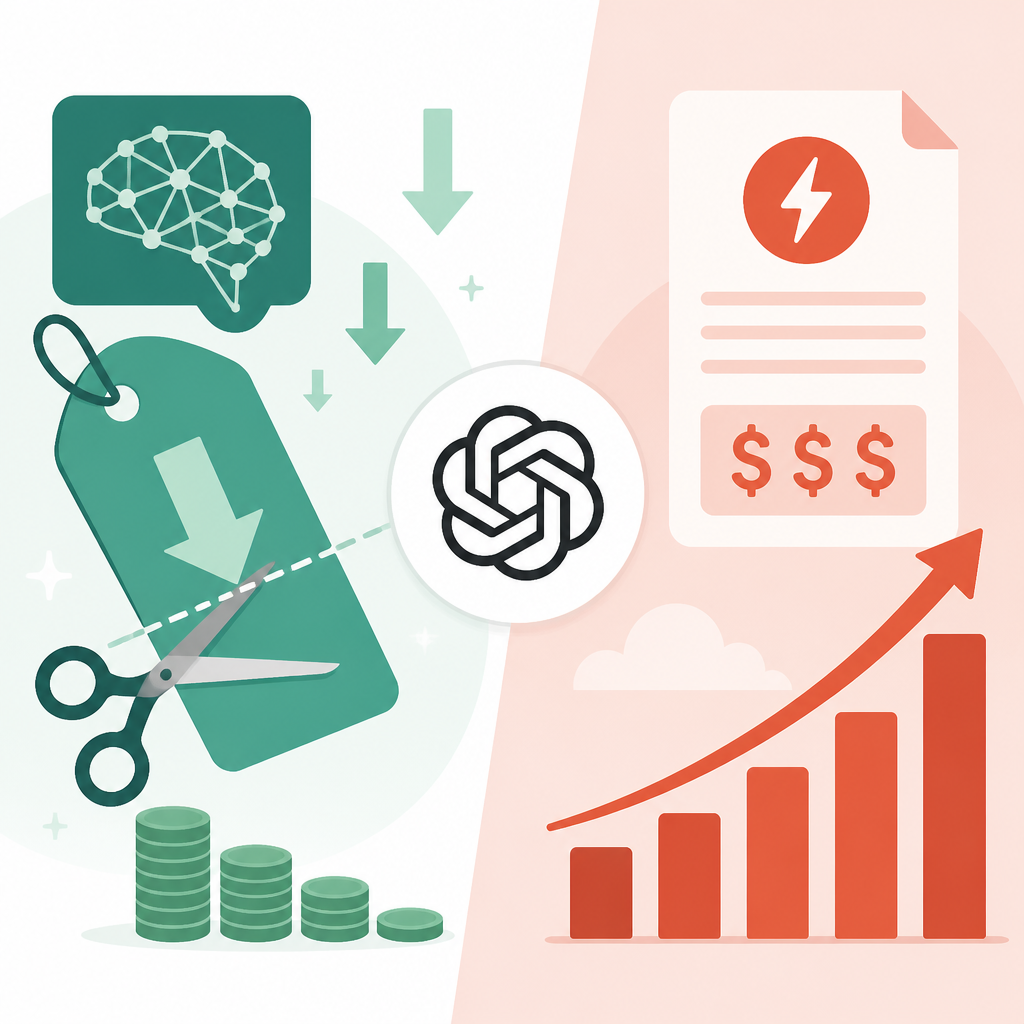
The company added that better routing keeps hardware productive, optimized production software generates tokens more efficiently, and smarter context management helps agents avoid repeating work they already completed. That is the real story here: cost reductions are being treated as an engineering problem, not a marketing one.
Microsoft CEO Satya Nadella made a similar point during an earnings call on Wednesday, saying cost efficiency was central to MAI-Thinking-1.
He said, “We are building a new model system where the harness, context, memory, and action space are separate from any one model family, thereby moving the frontier on the cost to outcome curve.” That is a very Microsoft way of saying the same thing OpenAI is now emphasizing: the wrapper around the model matters almost as much as the model itself.
- OpenAI said the 5.6 series rolled out about three weeks earlier
- GPT-5.6 Sol was not included in the price-cut announcement
- OpenAI paused a broader rollout at the U.S. government's request before the 5.6 launch
- Moonshot AI's open-weight Kimi K3 has increased price pressure on closed-model vendors
What this means for buyers and rivals
Arun Chandrasekaran, a distinguished vice president analyst at Gartner, told Business Insider that the price cuts give buyers more room to negotiate with frontier AI labs. He said pricing and commercial terms have been notoriously hard to change until now.
That is a meaningful shift for procurement teams. If OpenAI lowers prices this visibly, other vendors will have to answer with either cheaper access, stronger enterprise terms, or more explicit proof that their models save money elsewhere in the workflow.
The competitive pressure is coming from multiple directions. Anthropic is trying to balance subscription and usage pricing against limited compute, while Google has been talking up model efficiency. OpenAI is now telling the market that better economics can be part of the product story, not a concession made after the fact.
OpenAI has also filed confidentially for an IPO, which makes this price war more interesting. Public-market investors tend to ask harder questions about margins, infrastructure spend, and whether growth is buying enough revenue to justify the compute bill.
The next test is whether these lower prices stay in place long enough to reset buyer expectations. If they do, AI procurement teams will start treating token costs the way cloud teams treat storage and bandwidth: a line item to optimize, not a mystery to accept.
OpenAI’s new pricing sets a marker
OpenAI is telling the market that model quality alone is no longer enough to win enterprise budgets. The companies that can make strong models cheaper to run will have an easier time keeping customers, especially as teams compare every token against actual business output.
The obvious question now is whether rivals will match these cuts or try to outdo OpenAI on speed, context handling, and enterprise controls. Either way, the next pricing update from a frontier lab will matter less as a headline and more as a signal of who can still make the economics work.
// Related Articles
- [MODEL]
Opus 5 proves premium AI is becoming a commodity
- [MODEL]
OpenAI Gives Scientists Free GPT-5.6 Access
- [MODEL]
Google ships Gemini 3.6 Flash and 3.5 Lite
- [MODEL]
Kimi K3 Is Forcing Silicon Valley to Pick Sides
- [MODEL]
Opus 5 lets you ship with fewer refusals
- [MODEL]
Claude Opus 5 undercuts Fable 5 on price