OpenAI Prepares Election Cyber Defenses in U.S.
OpenAI is offering cyber tools to voting system makers and briefing election officials before U.S. elections.

OpenAI is offering cyber tools to voting system makers and briefing election officials before U.S. elections.
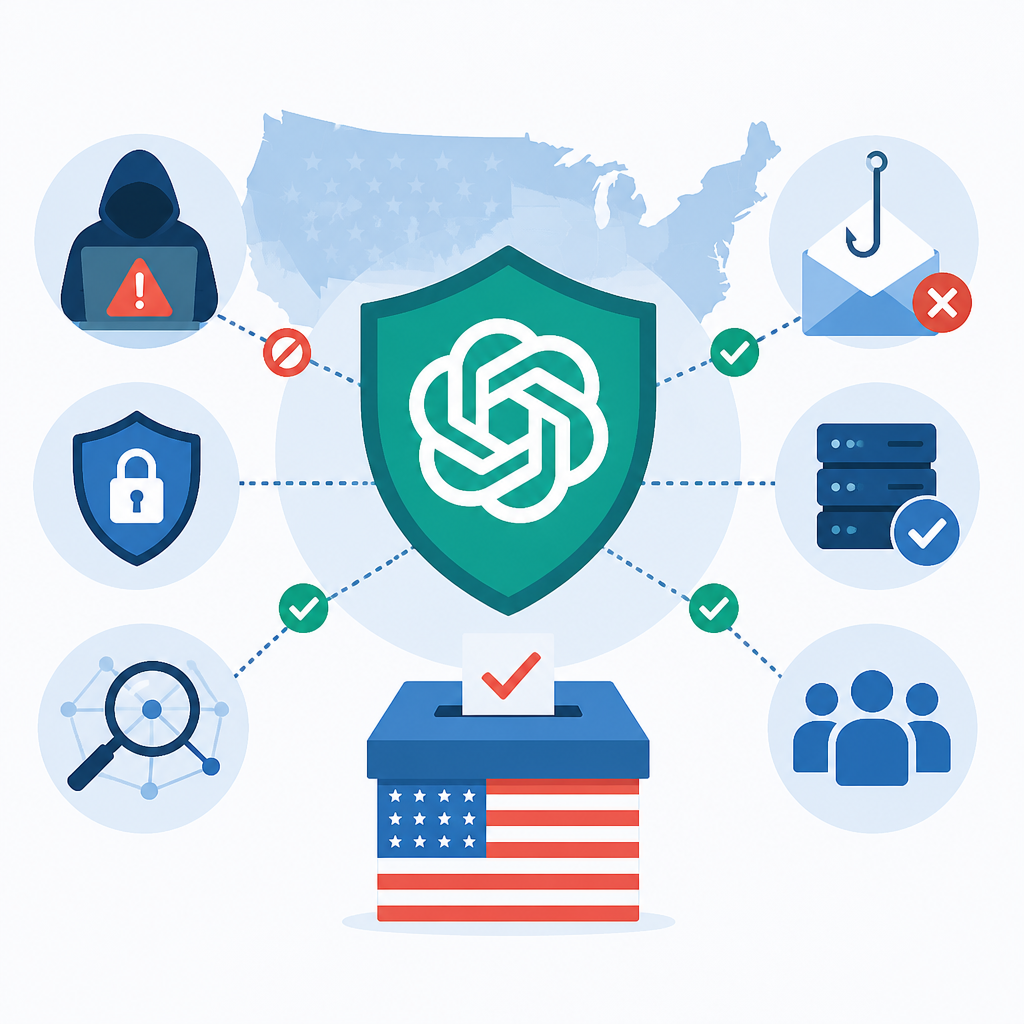
OpenAI is moving its election work into a more practical phase. The company is offering Codex Security and its Trusted Access for Cyber program to registered voting system manufacturers in the U.S., while also briefing state election groups on its latest cyber capabilities.
The timing matters. The message is simple: if AI tools are going to be used to attack election systems or spread false claims, the same category of tools can also help defend them. OpenAI is making that case before the next election cycle gets louder.
| Item | What OpenAI is doing | Why it matters |
|---|---|---|
| Codex Security | Offering it to registered voting system manufacturers | Helps test and harden software used in elections |
| Trusted Access for Cyber | Making the program available to the same manufacturers | Supports controlled access for defensive work |
| Election briefings | Meeting with NASS and NASED | Gets state officials up to speed on current cyber capabilities |
Why OpenAI is pushing into election defense
Get the latest AI news in your inbox
Weekly picks of model releases, tools, and deep dives — no spam, unsubscribe anytime.
No spam. Unsubscribe at any time.
Election security has become a test case for how AI companies want to be seen in public life. OpenAI is not just talking about misuse in the abstract. It is putting products in front of the people who build and oversee voting infrastructure.

That is a meaningful move because voting system manufacturers sit close to the software and hardware that states depend on. If those vendors can spot weaknesses earlier, they can patch them before attackers get a chance to exploit them.
The company is also briefing the National Association of Secretaries of State and the National Association of State Election Directors, which puts election administrators in the loop rather than forcing them to react after a problem shows up.
- OpenAI is targeting registered voting system manufacturers in the U.S.
- The company is sharing cyber capabilities with state election organizations
- The focus is on defense, access control, and early detection
What Codex Security and Trusted Access mean in practice
Codex is best known as a coding assistant, but a security-focused version can help review code, surface suspicious behavior, and speed up defensive analysis. In election infrastructure, that matters because many risks hide in boring places: update paths, admin tools, vendor integrations, and legacy code.
Trusted Access for Cyber is more about controlled use. The name suggests OpenAI wants to give vetted users access to capabilities that can support legitimate security work without opening the door to broad misuse. That balance is hard, and election systems make it harder.
“We need to make sure our technology is used for good and not for harm,” OpenAI CEO Sam Altman said in a 2023 Senate Judiciary hearing on AI and privacy.
That quote fits this moment because the company is trying to show exactly what “used for good” looks like in a high-stakes setting. Election offices do not need hype. They need tools that help them find weak spots, document threats, and respond fast when something looks off.
How this compares with other election-security efforts
OpenAI is entering a space that already has established players. The Cybersecurity and Infrastructure Security Agency has spent years helping state and local officials harden systems, and vendors across the security industry already sell scanning, monitoring, and incident-response services.
The difference here is distribution. OpenAI has a direct line to developers, product teams, and security staff who may already be using its models for coding or analysis. That can make adoption faster, especially when the pitch is framed around practical work rather than policy talk.
- CISA focuses on public-sector coordination and guidance
- Traditional security vendors sell monitoring and response tools
- OpenAI is offering AI-native products directly to election-adjacent vendors
- The company is pairing product access with briefings for state officials
There is also a reputational angle. AI firms have spent the past two years under pressure to prove they can help defend against misinformation and cyber abuse, not just generate content at scale. Election security is one of the clearest places to test that claim.
What to watch next
The immediate question is whether voting system manufacturers actually adopt these tools and whether state election offices treat the briefings as useful or just another vendor pitch. If the tools help surface real issues before ballots are cast, OpenAI will have a concrete example of AI used in defense.
If you follow this space, watch for two signals: public partnerships with election vendors and any sign that other model makers copy the same playbook. That would tell us whether this is a one-off announcement or the start of a broader pattern in election security.
For more on AI policy and security, see our coverage of OpenAI policy updates and AI cybersecurity tools.
// Related Articles
- [IND]
Cloudflare sets its Q2 2026 earnings call for Aug. 6
- [IND]
AI needs targeted regulation, not an FDA for models
- [IND]
Chrome 150 and Firefox 152 Fix Critical Bugs
- [IND]
OpenAI’s GPT releases trace the path to GPT-5.6
- [IND]
Hidden partner code is not due diligence, and Qualcomm’s scare proves…
- [IND]
The AI AGENT Act could reshape platform access