Private mode finding for regression and clustering
Private mode estimation gets nearly optimal error rates and powers regression and clustering.

Private mode estimation gets nearly optimal error rates and powers regression and clustering.
- Research org: Unspecified in arXiv abstract
- Core data: O((polylog(n,δ)/(n^2ε^2))^((β-1)/(d+β))) error term
- Breakthrough: DP-GRAMS uses noisy mean-shift ascent with private initialization
Density modes are a useful way to summarize multimodal data: instead of modeling every detail of a distribution, you focus on its peaks. This paper asks what happens when you want that same localized, interpretable summary but also need rigorous differential privacy. The answer is a new private mode-learning method, plus extensions for modal regression and clustering.
What problem this paper is trying to fix
Get the latest AI news in your inbox
Weekly picks of model releases, tools, and deep dives — no spam, unsubscribe anytime.
No spam. Unsubscribe at any time.
The core challenge is straightforward: many real datasets are multimodal, and the modes often carry the most actionable structure. In clustering, a mode can represent a dense region of points; in regression, modal structure can describe how the target concentrates around different local patterns. But standard mode estimation can leak information about individual records, which is exactly what differential privacy is meant to prevent.
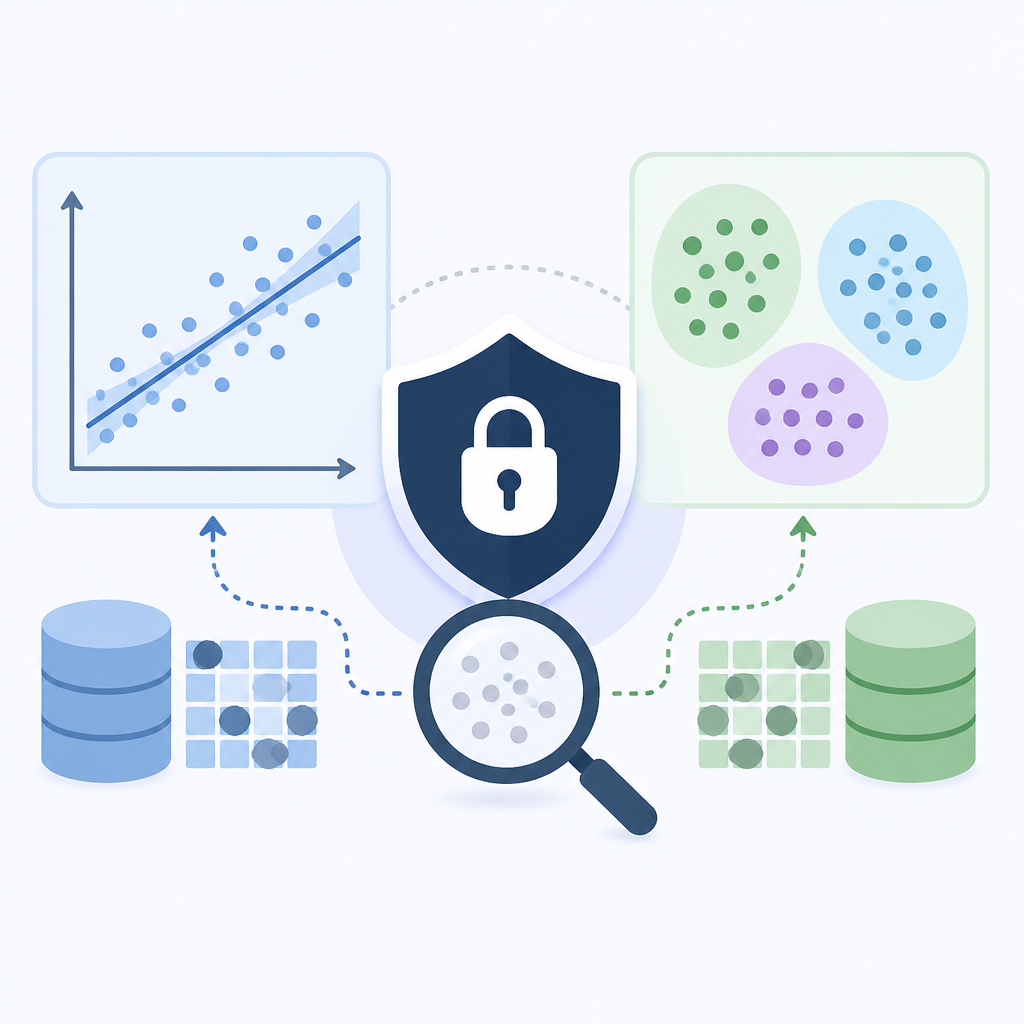
The paper studies private recovery of density modes for multivariate distributions under local smoothness, curvature, and separation assumptions. That matters because mode finding is not just another estimation problem; it is a building block for downstream tasks where you want a compact summary that is easier to interpret than a full density estimate. The authors frame the problem around rigorous privacy guarantees, rather than heuristic noise injection.
One important detail: the abstract does not give benchmark numbers for the experiments. It does, however, give theoretical error rates and says the experiments on synthetic and real data show favorable privacy-utility trade-offs relative to common baselines. So the main evidence here is a combination of theory and qualitative empirical comparison, not a leaderboard-style result.
How DP-GRAMS works in plain English
The main method is DP-GRAMS, which is described as mean-shift inspired. Mean shift is a classic idea: start from a point, estimate the local gradient of the density, and keep moving uphill until you land near a mode. DP-GRAMS keeps that basic shape, but makes each part private.
First, the paper assumes the density is locally in a Hölder class with smoothness parameter β > 2. Under that assumption, the score estimator uses higher-order kernels to reduce bias. Then the ascent step is privatized using gradient clipping and calibrated Gaussian noise. In other words, the algorithm tries to preserve the direction of ascent while limiting how much any one data point can influence the update.
The initialization step is also privacy-aware, and this is one of the more interesting pieces. The paper combines a density-aware utility score with a suppression rule, then draws k ≍ M log n candidates over a public h_DAP-grid. The suppression radius is ρ_init ≍ (log n)^(-1/d), and the idea is to cover the modal basins with high probability while successively suppressing selected local neighborhoods in competitive regions. That helps avoid repeatedly starting in the same area and improves the chance of finding distinct modes.
The abstract also notes that correlated noise across multiple starts enables joint release under a single (ε,δ)-differential privacy guarantee. For engineers, that means the method is not just “add noise everywhere”; it is structured so multiple searches can be coordinated under one privacy budget.
What the paper actually shows
The strongest claim is theoretical: the authors prove that all population modes are recovered with high probability. They also derive asymptotic error rates of the form O((log n / n)^((2(β-1))/(d+2β))) + O((polylog(n,δ)/(n^2ε^2))^((β-1)/(d+β))). The paper further gives minimax lower bounds for private mode estimation and argues that the proposed estimators are nearly optimal, up to a logarithmic factor in the MSE.
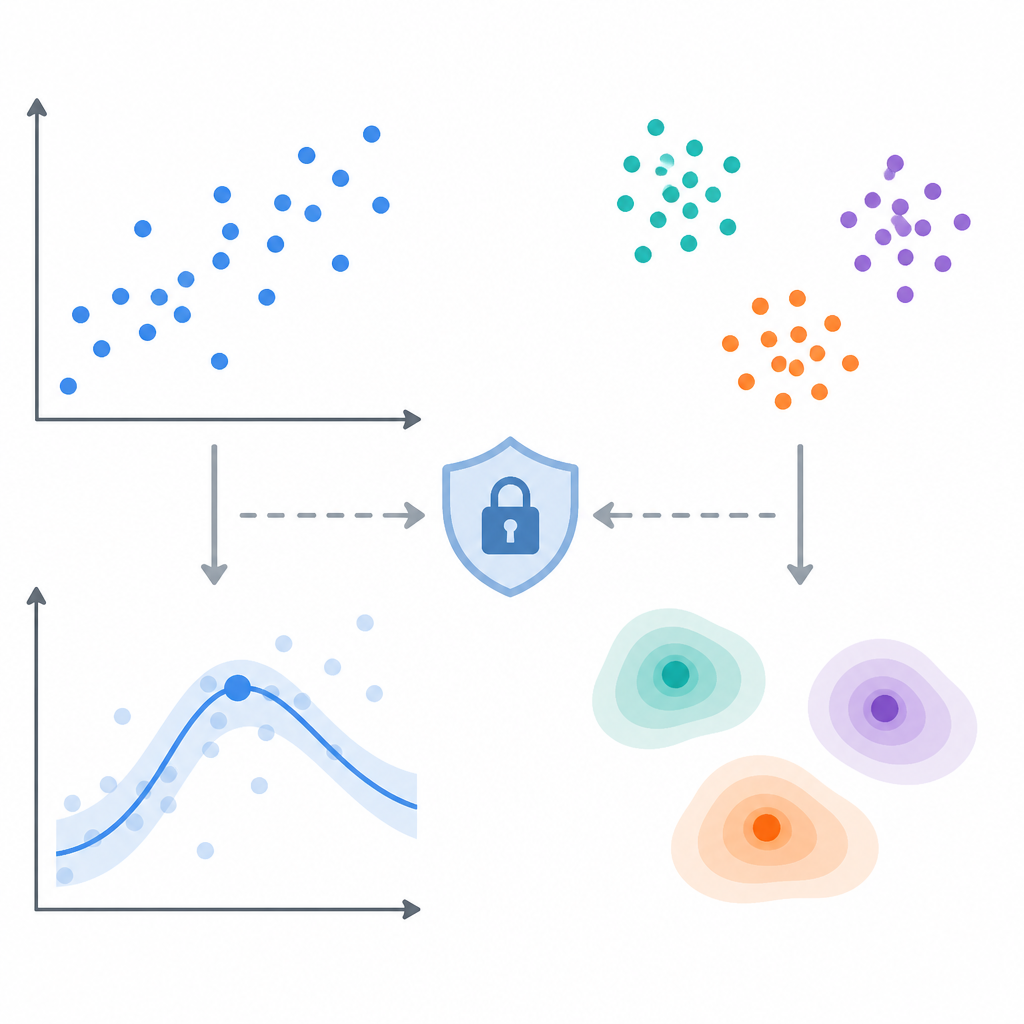
That nearly-optimal claim is important because private estimation often pays a sharp accuracy penalty. Here, the paper says the method is close to the best possible under the stated assumptions, which suggests the privacy cost is being controlled as tightly as the theory allows. The exact constants are not given in the abstract, so the practical runtime and tuning burden are still things you would need to inspect in the full paper.
The empirical section is described more modestly. The authors say they present extensive experiments on synthetic and real data, and that the results show favorable privacy-utility trade-offs relative to common baselines. Since the abstract does not list datasets, metrics, or exact numbers, that is all we can responsibly say from the source.
Why developers should care
If you build systems that need to summarize sensitive data without exposing individuals, mode estimation is a useful primitive. Think of customer segmentation, anomaly-heavy telemetry, or any pipeline where dense regions matter more than global averages. A private mode finder can be a better fit than a blunt fully private model if the underlying structure is genuinely multimodal.
The paper’s two extensions make that point even clearer. DP-PMS adapts the idea to private modal regression, and DP-GRAMS-C turns it into a clustering pipeline. That means the method is not only about estimating peaks in isolation; it is intended as a reusable privacy-preserving component for downstream analytics.
Limitations and open questions
The method comes with assumptions: local smoothness, curvature, and separation conditions, plus a Hölder smoothness parameter β > 2. Those are reasonable for theory, but they may not hold cleanly in messy production data. If the density is weakly separated or highly irregular, mode recovery can get much harder.
Another limitation is that the abstract does not provide concrete benchmark tables, dataset names, or implementation details. So while the paper claims favorable trade-offs, there is not enough in the summary to judge wall-clock cost, parameter sensitivity, or how much engineering effort the private initialization requires.
Still, the contribution is clear: this paper treats private mode finding as a first-class problem, not a side effect of private clustering or private density estimation. For practitioners, that is useful because it gives a principled way to extract interpretable structure from sensitive multimodal data while keeping an explicit privacy guarantee.
- Private mode estimation can be done with a structured mean-shift-style algorithm and formal privacy guarantees.
- The paper proves recovery guarantees, near-optimal error rates, and minimax lower bounds under stated assumptions.
- It extends the core method to modal regression and clustering, but the abstract does not include benchmark numbers.
For teams working on privacy-preserving analytics, the main takeaway is not that differential privacy makes mode finding easy. It is that with the right estimator, initialization strategy, and noise handling, you can get a mathematically grounded pipeline that still tracks the geometry of the data.
// Related Articles
- [RSCH]
ExtractBench benchmarks schema-guided document extraction
- [RSCH]
TokTier cuts tokenization overhead for agentic LLMs
- [RSCH]
Systema turns AIVC scores into a harder test
- [RSCH]
Stablecoin remittances hit 9% in Bank of Italy test
- [RSCH]
Stablecoins Hit $308B as SVB’s Shock Still Echoes
- [RSCH]
Rust compiler speed wins from July 2026