TokTier cuts tokenization overhead for agentic LLMs
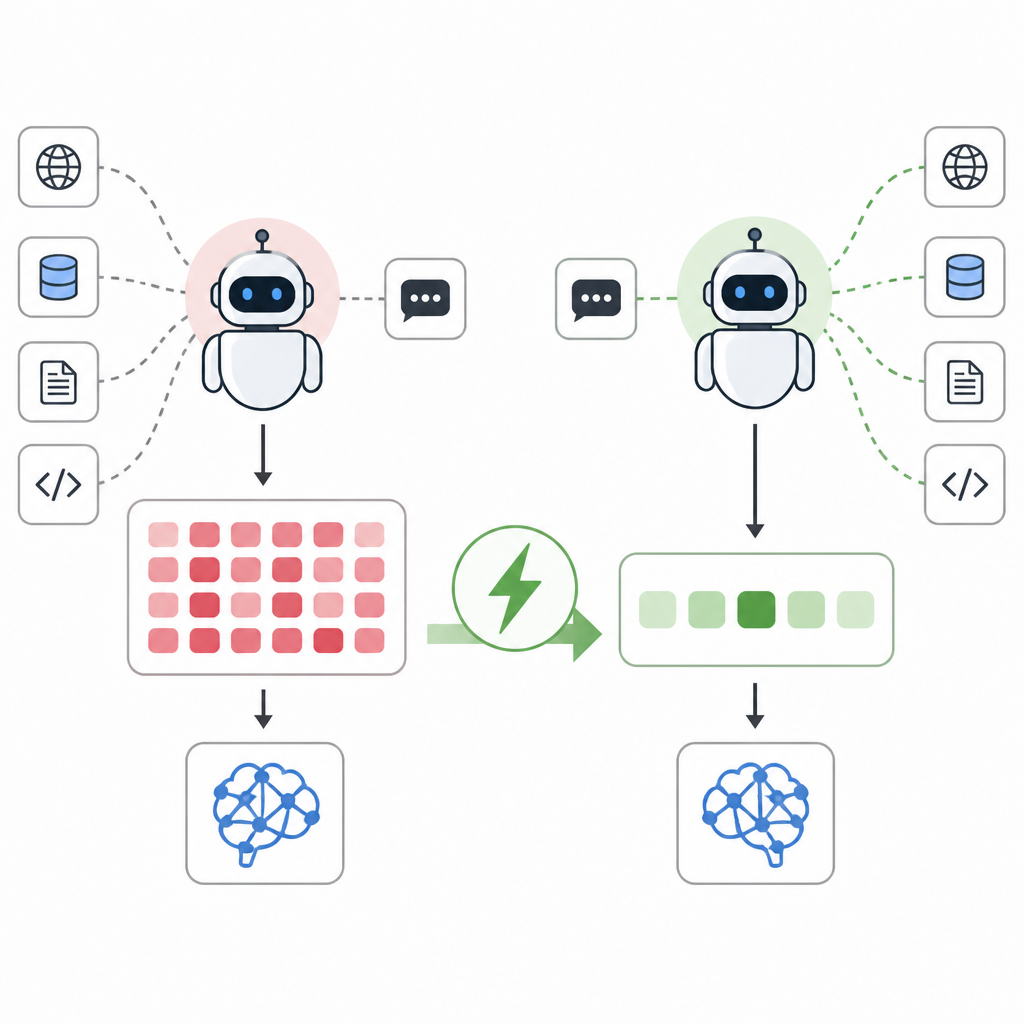
TokTier keeps tokenization exact while avoiding full re-tokenization on every agent call.

TokTier keeps tokenization exact while avoiding full re-tokenization on every agent call.
- Research org: Unspecified in arXiv abstract
- Core data: 64% of time to first token
- Breakthrough: Stateful tokenization with stable-boundary repair and exact fallback
Agentic LLM systems do a lot of tiny, repetitive work that has nothing to do with generation quality. One of the biggest hidden costs is tokenization: even when the server already caches prompt KV state, the front end often still re-tokenizes the full request text on every call. TokTier is built to remove that waste without changing the token IDs the model would have produced from scratch.
That matters because coding agents are a worst-case workload for today’s serving stack. They keep resubmitting a long transcript after each tool result, and the text usually changes by only a small append. But token boundaries near the end of the previous sequence can shift, which makes simple prefix reuse unsafe. The paper’s point is straightforward: if you can make tokenization stateful while keeping it exact, you can cut a real bottleneck in agent serving.
What problem TokTier is trying to fix
Get the latest AI news in your inbox
Weekly picks of model releases, tools, and deep dives — no spam, unsubscribe anytime.
No spam. Unsubscribe at any time.
LLM serving systems already know how to cache prompt KV state, but the front end often throws away tokenization work and starts over. In normal chat, that may be tolerable. In agentic workflows, it becomes expensive because the same growing transcript gets sent over and over, with only a small change at the end.

The authors quantify that workload with data from 153,951 calls across two agent ecosystems. The median call appends about 1.4K characters, and only 1.0-3.6% of calls start or rebuild a session with contexts of millions of characters. That means the common case is not “brand-new prompt,” but “small append to a long existing state.”
At a 94.1% fleet prompt-cache hit rate, tokenization can still take up to 64% of time to first token. That is the core engineering problem this paper targets: once the model-side cache is already doing its job, tokenization becomes the part that can dominate latency.
How the method works in plain English
TokTier is a stateful tokenization service with one strict contract: the token IDs it emits must always match full reference tokenization of the request text. That exactness requirement is important. The system is not trying to approximate tokenization or invent a new tokenizer format; it is trying to make the existing behavior cheaper.
For a session continuation, TokTier does not re-tokenize the entire transcript. Instead, it re-tokenizes a small window around the append and then splices the result only after a per-request stable-boundary check. If the boundary is not safe, it widens the window or falls back to full tokenization. In other words, it tries the cheapest exact path first, then expands only when needed.
For calls that do not have a reusable prefix, TokTier uses a different trick. It decomposes GPT-family regex pre-tokenization into run-local rules and then runs exact pre-tokenization and BPE on a GPU. That gives the system a fast path even when it cannot rely on session state.
The paper also adds a sampled shadow verifier that re-checks live traffic. That is a practical detail worth noticing: the system is designed not just for throughput, but for continuous validation that the fast path still matches full tokenization.
What the paper actually shows
The evaluation is broad. Across 17 tokenizer families, the authors report differential campaigns covering 1.5x10^10 split checks, a 12.4 TB real-text corpus, and more than 93,000 replayed agent steps, with zero divergence. That is the key correctness result: TokTier stays exact across the tested cases.
On speed, incremental repair takes 0.5-1.1 ms from 100K to 3M characters. The paper says that is up to 437x faster than Hugging Face tokenization and 2.1x faster at 1M characters than the strongest cache-based baseline, Gigatoken, when fully prewarmed. Those numbers make the point that the “small append” path is where TokTier really pays off.
For full tokenization without a reusable prefix, the GPU path encodes a 1M-character request in 0.87 ms. The authors report that this is up to 491x below Hugging Face and 23.4x below the fastest published CPU method. The paper does include benchmark numbers, and they are central to the claim: the system is not only exact, it is also fast enough to matter in serving.
With vLLM, the median time to first token drops 16-34% and P99 drops 23% under recorded bursts. Under a 50 ms P99 objective, four repair cores plus one GPU sustain 1,821 requests/s, while a 16-core stateless front end saturates at 40. Those are the deployment-facing results that suggest TokTier can change real serving capacity, not just microbenchmark timing.
Why developers should care
If you are building agent infrastructure, the lesson is that tokenization can become a first-order latency problem even when model inference is already optimized. The more your product looks like a coding agent, tool-using assistant, or long-lived workflow engine, the more you are likely to pay for repeated tokenization of nearly identical text.
TokTier’s design is useful because it respects the one thing serving teams cannot break: exactness. Engineers can treat it as a stateful front end that preserves the same token IDs a full tokenizer would have produced, while using repair windows, fallback logic, and GPU acceleration to reduce work on the common path.
There are still limits to keep in mind. The abstract gives strong performance and correctness claims, but it does not spell out implementation complexity, integration cost, or how often the system falls back to full tokenization in production. It also does not claim that every tokenizer family is equally easy to accelerate; instead, it reports coverage across 17 families and exactness in the tested campaigns.
What is still open
The most interesting open question is operational: how much of TokTier’s gain depends on the agentic workload pattern versus the tokenizer itself? The paper makes clear that small appends are common in the measured ecosystems, but different products may have different transcript shapes, cache hit rates, and session lifetimes.
Another question is how the stable-boundary repair behaves under messy real traffic. The authors address correctness with a shadow verifier and large-scale differential testing, which is reassuring. But for production teams, the practical tradeoff will still be how often the system needs to widen the repair window or fall back, and how that affects tail latency under mixed workloads.
Even with those caveats, the paper makes a strong case that tokenization is no longer just a preprocessing detail. In agent serving, it can be one of the main latency costs, and TokTier shows a concrete way to attack it without giving up exactness.
- TokTier targets repeated re-tokenization in agentic LLM serving, where small appends are common.
- It keeps token IDs exact by using repair windows, stable-boundary checks, and fallback paths.
- The paper reports large latency and throughput gains, plus zero divergence in extensive testing.
// Related Articles
- [RSCH]
Private mode finding for regression and clustering
- [RSCH]
ExtractBench benchmarks schema-guided document extraction
- [RSCH]
Systema turns AIVC scores into a harder test
- [RSCH]
Stablecoin remittances hit 9% in Bank of Italy test
- [RSCH]
Stablecoins Hit $308B as SVB’s Shock Still Echoes
- [RSCH]
Rust compiler speed wins from July 2026