RWA tokenization turns assets into on-chain rails
A practical breakdown of how 2026 RWA tokenization works, why businesses care, and the legal and ops checklist to copy.

This breaks down how businesses can tokenize real-world assets and copy the launch checklist.
I've been following tokenization for a while now, and honestly, most of the writeups felt like they were written by someone who had never had to actually move money, clear compliance, or explain custody to a lawyer. The pitch was always the same: put an asset on-chain, cut out the middlemen, instant efficiency, everyone wins. Cool story. In practice, I kept seeing the same mess. The token looked neat, but the legal wrapper was fuzzy. The transfer rules lived in a slide deck instead of the token logic. Treasury wanted yield, operations wanted fewer tickets, and legal wanted nobody to say the word “fractional” without a memo.
That’s why this Vanderbilt Report piece grabbed me. It finally treats real-world asset tokenization like infrastructure, not a crypto slogan. It talks about Treasury bills, private credit, gold, real estate, and the boring plumbing around settlement, compliance, and custody. That’s the part I care about. If I’m going to take this seriously, I need to know where the asset lives, who has the keys, what happens when an investor transfers, and what breaks when the venue has no liquidity. The article gets closer to that reality than most of the hype I’ve seen. Source: The Vanderbilt Report.
The piece is by Jake Rivers at The Vanderbilt Report, published June 19, 2026. It doesn’t give social numbers, and that’s fine. What matters here is the actual argument: tokenization is moving from pilot theater to something businesses can use to raise capital, manage treasury, and open access to assets that used to be locked behind slow process and high minimums.
Tokenization is not magic; it is a wrapper with rules
Get the latest AI news in your inbox
Weekly picks of model releases, tools, and deep dives — no spam, unsubscribe anytime.
No spam. Unsubscribe at any time.
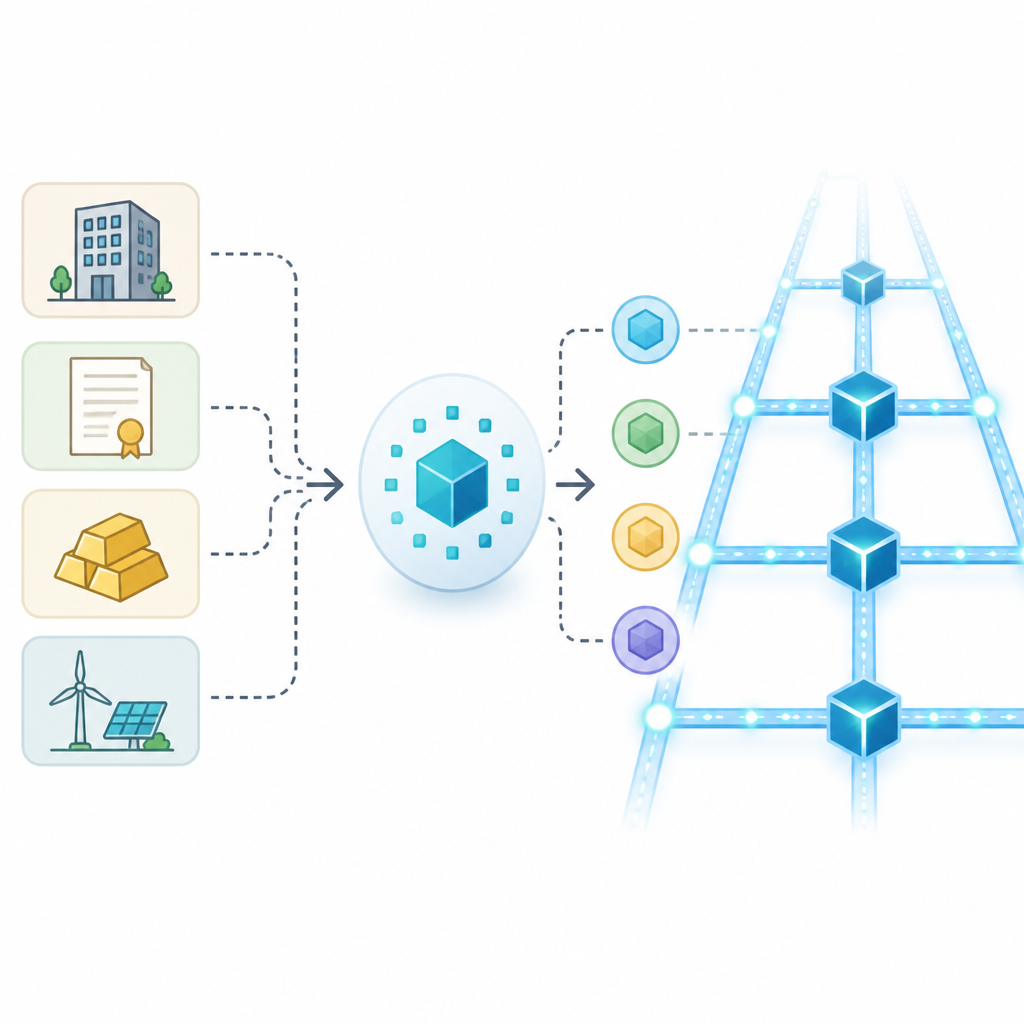
“In plain terms, real-world asset tokenization means taking something that exists off-chain — a Treasury bill, a building, a private loan, a barrel of gold — and issuing a digital token on a blockchain that represents the legal and economic rights to that asset.”
What this actually means is pretty unglamorous: the token is only useful if it reliably maps to enforceable rights. If the token says you own a slice of a note, but the legal docs don’t back that up, you’ve built a decorative database entry. I’ve seen teams get hypnotized by the chain part and treat legal structure like a later concern. That is exactly backwards.

The Vanderbilt Report frames tokenization as a bridge between off-chain assets and on-chain settlement. That’s the right mental model. The blockchain is not the asset. It is the transfer and coordination layer. The asset still needs a home: a trust, SPV, custodian, issuer, or some other structure that makes the claim real in the eyes of law and accounting.
How to apply it: before you mint a single token, write down three things in plain English. First, what does the token represent? Second, who has the legal claim if something goes wrong? Third, what document or agreement proves the claim outside the chain? If you can’t answer those cleanly, you’re not ready to tokenize anything except your own risk.
- Map the token to a legal instrument, not just a product idea.
- Separate asset ownership, custody, and transfer rights.
- Assume legal review will be slower than engineering and plan for it.
Why businesses care: liquidity, speed, and less operational drag
The article’s strongest business point is simple: tokenization matters when it changes something expensive or stuck. Private credit, real estate, fund interests, and commodities are hard to move. They settle slowly, they have high minimums, and they often live in systems that require a stack of intermediaries just to move from one holder to another.
That’s the pain. I’ve worked around enough finance workflows to know that the real cost is not just fees. It’s waiting. It’s reconciliation. It’s the person in operations who has to chase a missing approval because the transfer agent, the custodian, and the compliance team each have their own queue. Tokenization is interesting because it can collapse some of that drag into code and shared state.
The Vanderbilt Report calls out three business benefits that actually matter: liquidity for assets that never had it, faster settlement, and programmable yield or collateral. That last one is the part that gets people’s attention once they stop thinking like crypto traders and start thinking like treasury managers. If an asset can sit on-chain and still function as collateral, it becomes more than a static holding. It becomes working capital.
How to apply it: don’t start with “what can we tokenize?” Start with “what asset is expensive to administer, slow to move, or hard to finance?” If the answer is a private loan book, a treasury allocation, or a fund share class, you’re in the right neighborhood. If the answer is “because we want to be on-chain,” stop there and go back to the whiteboard.
- Look for assets with high admin cost or poor secondary liquidity.
- Measure settlement time before and after any pilot.
- Track whether tokenization improves access, not just branding.
The market moved because institutions finally stopped pretending
The article points to a real change in 2026: the growth curve is no longer just retail speculation or startup demos. It cites RWA.xyz data showing tokenized real-world assets on public blockchains rising from roughly $5.8 billion in early 2025 to more than $30 billion by April 2026. It also notes that, when stablecoins are included, the broader tokenized market sits north of $240 billion.
I care less about the exact headline number than the signal behind it. When BlackRock, Franklin Templeton, and J.P. Morgan are making balance-sheet decisions around tokenization, the conversation changes. At that point, it stops being a side quest for crypto-native teams and starts being a tooling decision for finance orgs.
The article also ties the shift to two regulatory anchors: the U.S. GENIUS Act and the EU’s MiCA framework. That matters because institutions do not want to improvise legal posture every time they move an asset. They want a boring answer from counsel. They want to know what is allowed, what is restricted, and what the reporting burden looks like. Without that, tokenization stays stuck in pilot mode.
How to apply it: if you’re building in this space, make regulatory compatibility part of the product spec. Not a note in the appendix. A spec. Work with counsel early, define target jurisdictions, and document transfer restrictions in a way that engineering can actually implement. If you’re buying, ask whether the issuer can explain the wrapper, the jurisdiction, and the compliance controls without hand-waving.
For reference, the article links to background material from Coinbase Institutional Research, RWA.xyz, and reporting on BlackRock’s BUIDL fund. Those are useful anchors because they show this is not just one outlet making a big claim.
Private credit and Treasuries are doing the heavy lifting
The Vanderbilt Report’s category breakdown is worth paying attention to because it tells you where the real activity is. Private credit is listed around $16.8 billion, tokenized U.S. Treasuries around $13 to $15 billion, commodities around $5.5 billion, real estate as multi-billion and growing, and tokenized equities still early at about $0.5 billion. That tells a very specific story: the market is not beginning with consumer stocks or flashy retail products. It is starting with assets that already have clear cash flows or clear benchmark value.
That makes sense. Treasuries are easy to understand because they are the risk-free rate benchmark. Private credit is attractive because it already lives in a world of yield, structuring, and investor access constraints. Gold-backed tokens fit because the underlying asset is easy to explain. Real estate is slower, but the story is obvious: people want fractional exposure without writing a giant check.
I ran into this exact pattern when advising on product design for a financial workflow. Everyone wanted to tokenize the most visible asset first. I pushed back. The visible asset was the wrong one. The right one was the boring one that already had a paper trail, a defined yield profile, and a clear reason to exist on a ledger. Boring wins because boring is easier to explain to legal, operations, and investors all at once.
How to apply it: if you are choosing a first asset, rank candidates by three criteria: clarity of rights, clarity of cash flow, and clarity of demand. If one of those is fuzzy, the pilot will probably turn into a demo that nobody can operationalize. Start with the asset that makes your compliance team sigh less.
Settlement is where the pitch becomes real
The article says smart contracts can automate issuance, transfers, and compliance at the asset level, compressing settlement from days to near-instant. That is the part that matters most to me because it changes the work, not just the packaging. Settlement is where a lot of financial friction hides. If you’ve ever waited on T+2, chased reconciliation, or dealt with manual transfer approvals, you know exactly how much time gets burned there.
But I also think people oversell this part. Faster settlement is great, but only if the surrounding process can keep up. If the token settles instantly and the off-chain records lag behind, you just moved the bottleneck. You didn’t remove it. You relocated it. That’s still progress, but it’s not the fairy tale version.
How to apply it: design the flow end to end. Token issuance, transfer checks, investor eligibility, reporting, and recordkeeping should all be part of the same system design. Don’t bolt compliance on afterward. Put transfer restrictions into token logic. Put event logging into the workflow. Put reconciliation into the operating model, not a spreadsheet someone updates on Friday.
Useful tools and references here include J.P. Morgan’s Onyx / blockchain treasury work, BlackRock’s BUIDL fund page, and MiCA information from the EU. I’m not saying copy their exact architecture, but I am saying they’re the kind of references you want when you’re designing something that touches real money.
The failure mode is simple: pretty token, broken stack
The Vanderbilt Report gets this right in its cautionary section: tokenization touches legal structure, custody, technology, and investor operations all at once. A weak link in any one layer creates problems everywhere else. That’s the part many teams ignore because it is less fun than minting something and posting a dashboard screenshot.
I’ve seen this failure mode before. The team gets the token live, then discovers the issuer agreement is vague, the custodian setup is awkward, the transfer policy is not machine-readable, and the investor onboarding flow still depends on email. At that point, the token is not the product. The product is the cleanup project.
How to apply it: treat tokenization like a regulated operating system, not a feature. Ask hard questions early. Who holds the asset? Who controls the keys? What happens on transfer? What happens on death, insolvency, sanctions screening, or jurisdictional change? If those questions feel annoying, good. That means you’re asking the right ones.
- Define custody and key management before launch.
- Write transfer restrictions in code and in legal docs.
- Test the ugly cases: failed transfers, revoked access, and jurisdiction changes.
The template you can copy
RWA Tokenization Launch Checklist

1. Asset selection
- Asset: [Treasury bill / private credit / real estate / commodity]
- Why this asset: [liquidity, yield, admin cost, access]
- Target investors: [institutions / qualified investors / retail where allowed]

2. Legal wrapper
- Issuer entity: [name]
- Legal instrument: [note, share, trust interest, fund interest, etc.]
- Token represents: [economic rights / legal claim / both]
- Governing jurisdiction: [country/state]
- Counsel review complete: [yes/no]

3. Custody and control
- Asset custodian: [name]
- Key custodian / wallet control: [name]
- Recovery process: [describe]
- Audit trail source of truth: [chain / off-chain system / both]

4. Compliance rules
- KYC required: [yes/no]
- AML screening: [yes/no]
- Transfer restrictions: [who can receive tokens]
- Whitelist / allowlist method: [smart contract / registry]
- Sanctions controls: [process]

5. Smart contract behavior
- Minting rules: [who can mint]
- Transfer rules: [who can transfer]
- Pause / freeze function: [yes/no, by whom]
- Redemption rules: [how holders cash out]
- Corporate actions: [interest, dividends, splits, defaults]

6. Investor operations
- Onboarding flow: [steps]
- Reporting cadence: [monthly / quarterly]
- Support channel: [email / portal / phone]
- Reconciliation process: [how records match]

7. Liquidity plan
- Secondary venue: [name or none]
- Market maker: [yes/no]
- Redemption window: [daily / weekly / monthly]
- Minimum trade size: [amount]

8. Launch gate
- Legal approved: [yes/no]
- Compliance approved: [yes/no]
- Custody approved: [yes/no]
- Contract tested: [yes/no]
- Investor comms ready: [yes/no]

Copy rule:
If any answer is "not sure," do not launch yet.
This template is the part I’d actually hand to a team. It forces the conversation out of vibes and into decisions. If you can fill this out cleanly, you’re probably ready for a pilot. If you can’t, tokenization is not your problem yet; process design is.
What I like about the Vanderbilt Report piece is that it doesn’t pretend tokenization is a single trick. It’s a stack: legal, custody, compliance, settlement, and market access. That’s annoying, but it’s honest. And honestly is what this space needs more than another slick diagram.
Source attribution: original article at The Vanderbilt Report. My breakdown is derivative in structure and commentary, but the checklist and framing above are my own synthesis from the source and linked references.
// Related Articles
- [IND]
Citigroup Sees Tokenized Assets Hitting $8.2T
- [IND]
Blackwell’s MLPerf sweep shows why training speeds up
- [IND]
AI companies should stop pretending midterm spending is neutral
- [IND]
This AI market map list is a better signal than most AI newsletters
- [IND]
Worldcoin’s rally is a credibility test, not a breakout to chase
- [IND]
A24 and DeepMind put $75M into AI tools