TurboQuant does not hurt search quality at equal byte budgets
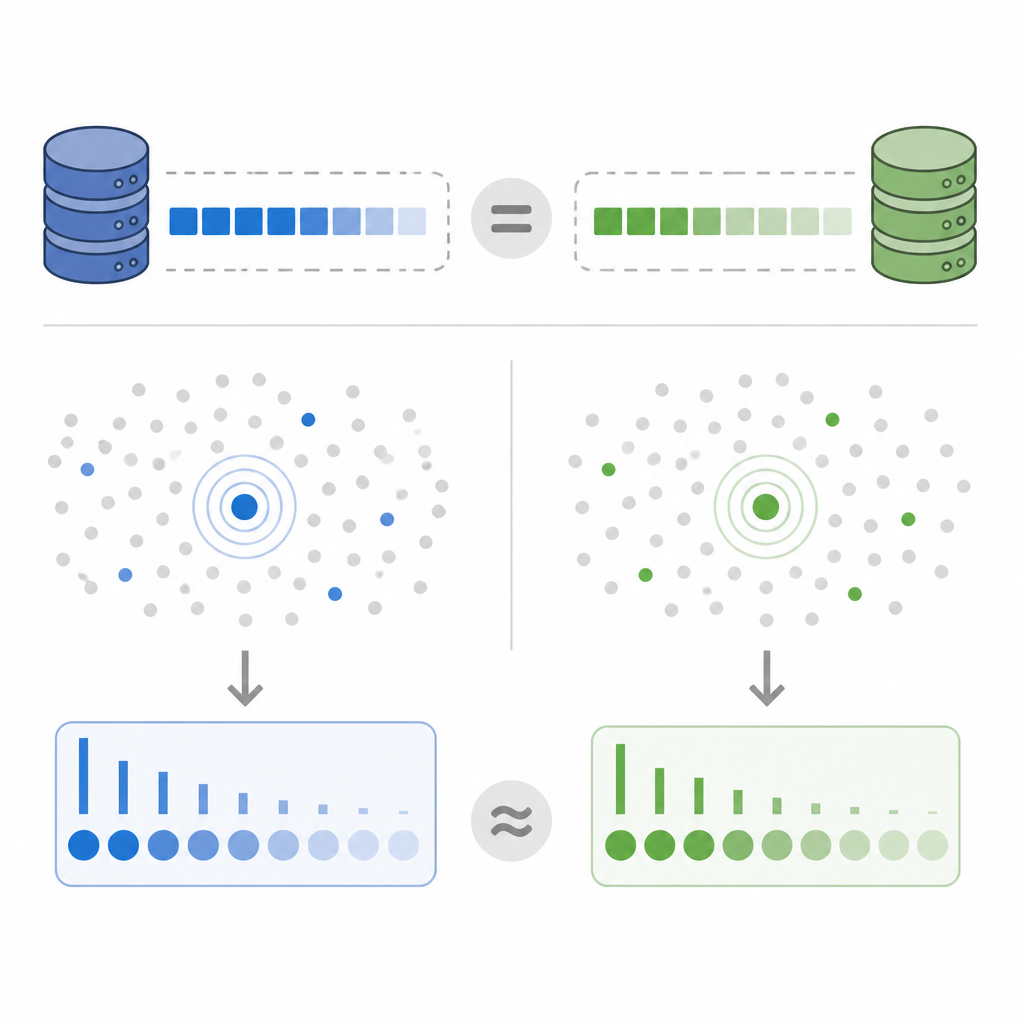
TurboQuant cuts vector memory by about 20× without meaningful search-quality loss when compared at equal bytes.

TurboQuant cuts vector memory by about 20× without meaningful search-quality loss when compared at equal bytes.
I’m firmly in the yes camp: TurboQuant does not hurt search quality in any way that matters for production retrieval, as long as you compare systems at the same byte budget.
Our benchmark on BEIR, using Milvus and Qwen3 embeddings on a single local machine, showed the core pattern clearly. On NFCorpus and SciFact, the ~20× compressed TurboQuant setup kept nDCG@10 almost flat, with changes measured in thousandths rather than tenths. That is not a marginal win. It is the difference between “interesting compression trick” and “usable default for real RAG systems.”
First argument: the quality curve is flat where it counts
Get the latest AI news in your inbox
Weekly picks of model releases, tools, and deep dives — no spam, unsubscribe anytime.
No spam. Unsubscribe at any time.
The strongest evidence is the nDCG@10 result. On NFCorpus, full precision scored 0.4019, while TurboQuant b1 landed at 0.3987 and TurboQuant b1 prod at 0.4006. On SciFact, full precision scored 0.7730, while TurboQuant b1 came in at 0.7662 and TurboQuant b3 prod at 0.7747. Those are tiny deltas, not operationally meaningful losses. In a retrieval system, that is exactly what you want from compression: less memory, same ranking behavior.

The ANN recall numbers tell the same story from a stricter angle. Against exact search, TurboQuant b1 still reached 0.862 recall@100 on NFCorpus and 0.883 on SciFact, and the higher-bit variants climbed further. The point is not that quantization is invisible. The point is that the ranking degradation is small enough to disappear into normal benchmark noise for most production use cases.
Second argument: the method is efficient enough to matter in production
TurboQuant is data-oblivious, so it avoids the usual training overhead that makes many compression schemes annoying to operationalize. In this experiment, encoding the whole corpus took under a second, with no codebook fitting and no pass over the data. That matters because production teams do not want another offline training pipeline just to save memory. They want a switch they can flip.
The broader system profile is even more persuasive. The corpus embedding step took 15 to 20 minutes, while quantization took about one second and Milvus index build took 3 to 5 seconds. That means the bottleneck in a local RAG stack is not compression. It is embedding. If compression is effectively free, then a 10× to 20× memory reduction becomes pure upside: lower RAM pressure, larger indexes, cheaper nodes, and faster iteration without a quality tax.
The counter-argument
The best objection is that TurboQuant is not the only compression game in town, and it is not automatically the best one. Milvus IVF_RABITQ and IVF_PQ, when configured at comparable byte budgets, are genuinely competitive. In fact, the experiment showed that a sloppy comparison can make PQ look terrible when it is really just being starved of bytes. At equal budgets, the gap narrows fast, which means TurboQuant is not a monopoly on good retrieval under compression.
There is also a scientific caveat. The article notes that TurboQuant’s vector-search claims are still contested, and its strongest uncontested results are in KV-cache compression rather than ANN search. That is a fair warning. Benchmarks are not proof of universal superiority, and a single corpus pair does not settle the literature.
Still, that counter-argument does not overturn the conclusion. It sharpens it. TurboQuant does not need to be uniquely best to be useful. It only needs to show that aggressive compression can preserve retrieval quality closely enough for production, and it does. The real lesson is not “TurboQuant wins forever.” The real lesson is “equal-bytes benchmarking changes the answer, and TurboQuant clears the bar.”
What to do with this
If you are an engineer or PM building search or RAG, stop evaluating vector compression by raw recall alone and stop comparing systems at mismatched sizes. Set an equal-byte budget, test nDCG@10 and ANN recall against exact search, and include a no-training quantizer in the baseline set. If your workload looks like NFCorpus or SciFact, TurboQuant-style compression is a practical default: it buys memory headroom with negligible ranking loss, and that is the kind of tradeoff production teams should take every time.
// Related Articles
- [RSCH]
CUDA binaries turn PTX into ELF you can inspect
- [RSCH]
OctoLong trains LMs on cross-repo code context
- [RSCH]
Argus: a self-evolving runtime for long tasks
- [RSCH]
Reasoning Core builds better procedural reasoning data
- [RSCH]
Anthropic’s security evals are failing on the real internet
- [RSCH]
WorldCup Arena Tests LLM Forecasting Live