UAV TomoSAR Gets PSF Sidelobes Under Control
A PSO-based method jointly tunes UAV formation and offload power to suppress TomoSAR point spread sidelobes.

A PSO-based method jointly tunes UAV formation and offload power to suppress TomoSAR point spread sidelobes.
- Research org: Unspecified in arXiv abstract
- Core data: Peak sidelobe levels between −17 dB and −33 dB
- Breakthrough: Jointly optimize UAV formation and communication power with particle swarm optimization
This paper is about making UAV-based 3D radar imaging cleaner by reducing the point spread function’s sidelobes. If you work on sensing systems, robotics, or optimization, the interesting part is that the paper treats radar geometry and communication offloading as one coupled problem instead of two separate ones.
That coupling matters because the radar data is not processed onboard: it is offloaded in real time to a ground station over an FDMA air-to-ground backhaul link. So the system has to balance where the UAVs fly, how they sense, and how much power they use to send data down to the ground.
What problem the paper is trying to fix
Get the latest AI news in your inbox
Weekly picks of model releases, tools, and deep dives — no spam, unsubscribe anytime.
No spam. Unsubscribe at any time.
The paper focuses on UAV-borne multiple-input multiple-output tomographic SAR, or MIMO TomoSAR. In plain terms, a swarm of UAVs collects radar measurements from different positions so the system can reconstruct a 3D height profile of a scene.
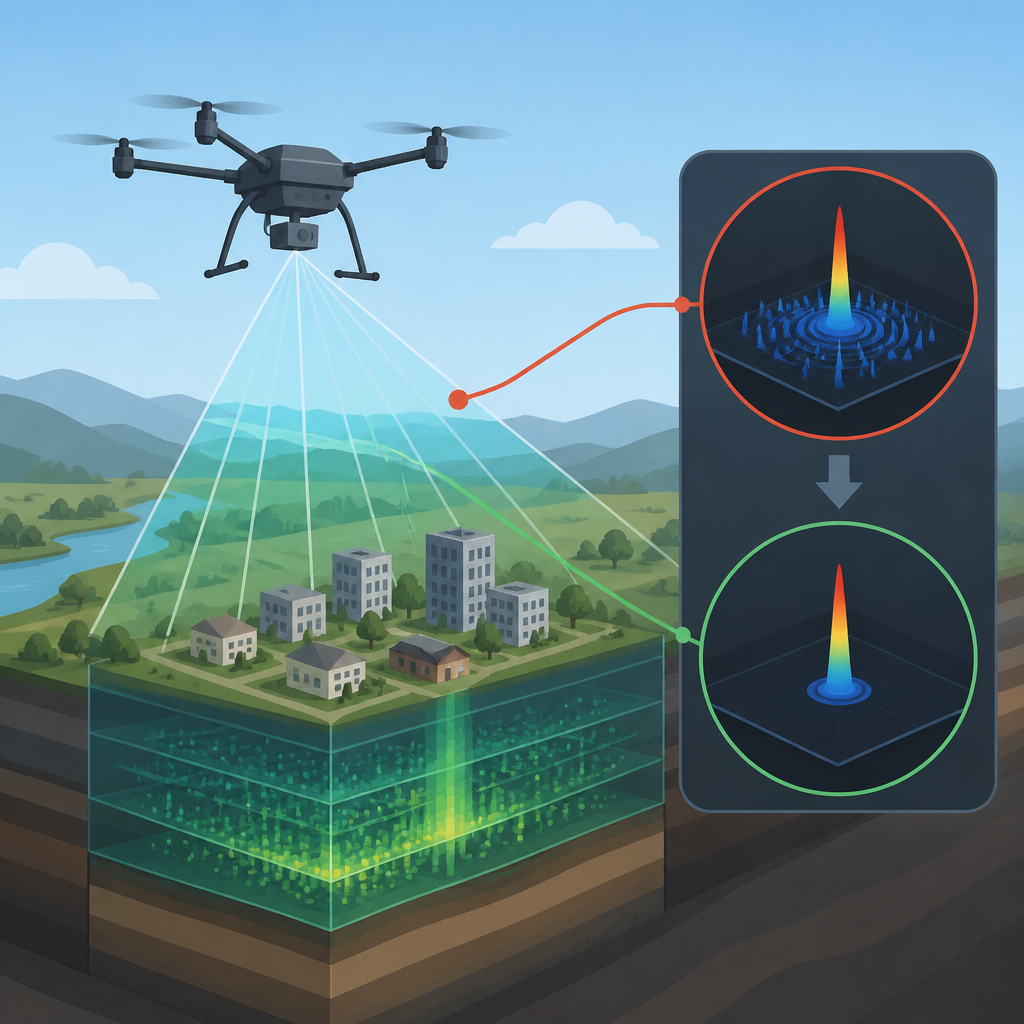
The key imaging issue is the point spread function, or PSF. In tomographic SAR, the PSF describes how a single scatterer shows up in the reconstructed image. If the PSF has strong sidelobes, energy leaks into nearby elevation bins, which can hide weak scatterers and create ghost targets.
The authors frame this as a practical systems problem, not just a signal-processing one. The UAVs have to sense the scene, move in formation, and offload the collected data in real time. That means imaging quality depends on both radar geometry and communication constraints.
The paper also notes that prior work on UAV interferometric SAR does not directly solve this problem, because interferometric SAR uses acquisition pairs and cannot recover scatterer distribution along elevation the way TomoSAR can. The paper is specifically about optimizing the 3D reconstruction side of the system.
How the method works in plain English
The system uses a swarm of rotary-wing UAVs that fly in stripmap mode along parallel linear trajectories. Each UAV transmits radar waveforms and also receives echoes from the other UAVs, forming a MIMO sensing setup.
At the same time, the radar data is sent to a ground station through an FDMA air-to-ground backhaul link. The heavy image-generation work happens on the ground, so the UAVs are not trying to do all the computation onboard.
The optimization target is the peak sidelobe level, or PSL, of the PSF. The paper jointly optimizes two things: the UAV formation in the across-track plane and the communication power allocated for offloading. Both sensing and communication constraints must be satisfied.
To solve that optimization problem, the authors propose a particle swarm optimization, or PSO, approach. In other words, the algorithm searches for a good UAV layout and power allocation by iteratively moving a swarm of candidate solutions toward better PSF sidelobe performance.
What the paper actually shows
The abstract and notes do not provide a full benchmark table, so there are no detailed per-scheme numbers to compare here. What the paper does state is that the proposed solution can significantly improve sidelobe suppression relative to several benchmark schemes.
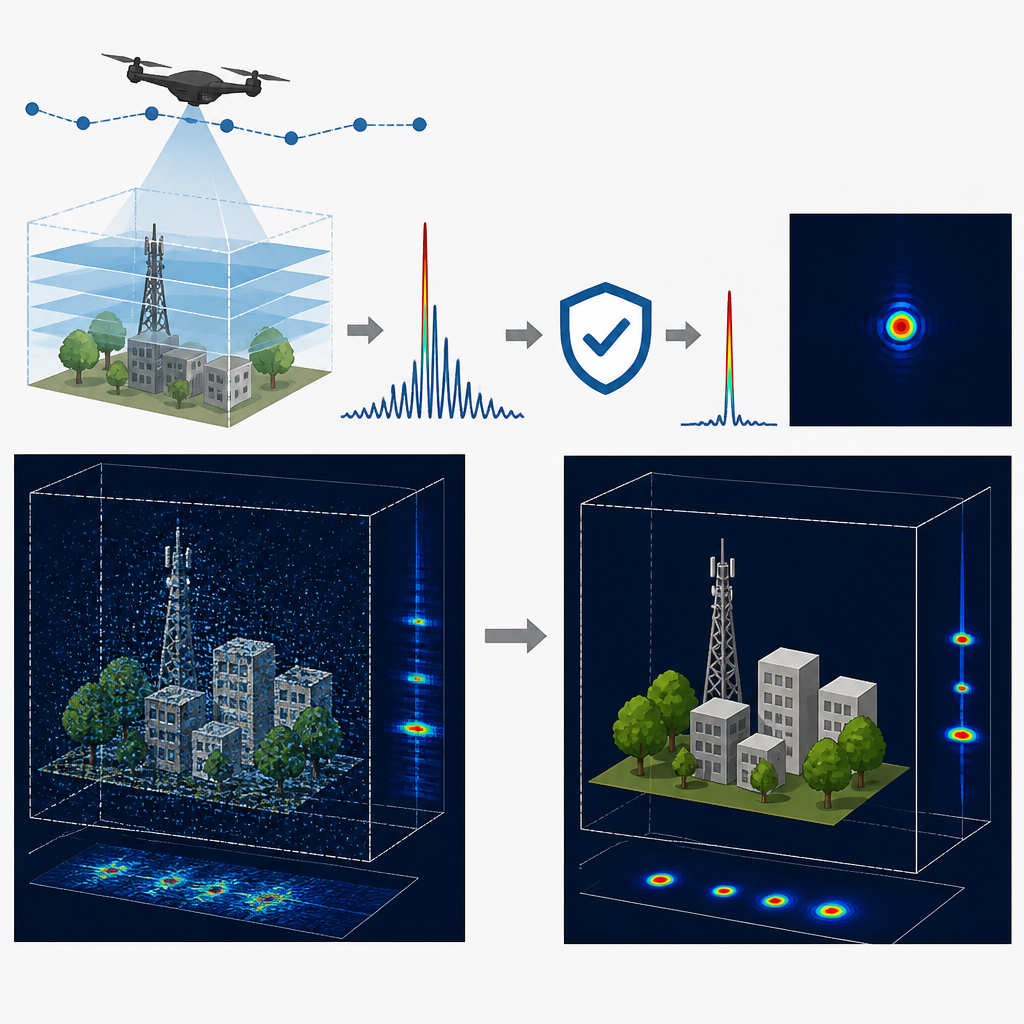
The one concrete numeric result called out in the notes is a PSL range between −17 dB and −33 dB. That gives you a sense of the scale of improvement the authors are reporting, even though the abstract excerpt does not break down which scenario achieved which value.
The paper also positions PSF optimization as a meaningful metric for UAV TomoSAR because it affects tomographic resolution, height of ambiguity, and sidelobe levels. Those are the quantities that determine whether a reconstructed 3D scene is actually interpretable.
Another useful detail is that the optimization is not limited to sensing alone. The formulation explicitly includes communication power allocation, which makes the result more realistic for systems where data has to be moved off the aircraft before reconstruction.
Why engineers should care
If you build sensing systems, this paper is a reminder that image quality is often constrained by the full stack. A radar algorithm can look good in isolation, but once the platform has to fly, communicate, and process under real constraints, the best solution may depend on joint optimization.
For developers working on UAV autonomy, multi-agent control, or wireless backhaul, the structure is familiar: geometry, resource allocation, and performance metrics are all intertwined. The paper shows how a swarm optimization method can be used to search that coupled design space.
For radar and signal-processing engineers, the practical takeaway is that sidelobe suppression is not just a filter-design problem here. It is shaped by platform placement and the way sensing data is offloaded for reconstruction.
There are also clear limitations in what the excerpt shows. The abstract does not give detailed simulation settings, runtime costs, or robustness analysis. It also does not provide exact benchmark-by-benchmark numbers, so you cannot yet tell how stable the gains are across different scenarios.
What is still open
Because the source is an arXiv abstract and notes rather than a full results section, several questions remain open. How sensitive is the method to UAV count, geometry, or channel conditions? How expensive is PSO in practice for real-time deployment? And how well does the approach scale when the swarm gets larger?
Those are the kinds of questions that matter if you want to turn this into an operational system. The paper establishes a useful optimization framing: treat sensing and communication as one problem, then search for a formation and power allocation that suppress PSF sidelobes.
That framing is the real value here. It gives system designers a concrete way to think about UAV-borne TomoSAR: not as a fixed radar pipeline, but as a coupled sensing-and-networking problem where the geometry of the swarm directly shapes the quality of the 3D reconstruction.
Bottom line
This paper proposes a PSO-based joint optimization of UAV formation and offloading power for communication-assisted UAV-borne MIMO TomoSAR, with the goal of lowering PSF sidelobes and improving 3D image quality.
- It treats radar geometry and communication as one coupled design problem.
- It uses particle swarm optimization to satisfy sensing and communication constraints.
- It reports sidelobe suppression in the −17 dB to −33 dB range.
For anyone building UAV sensing stacks, the message is simple: if you want cleaner 3D radar images, you may need to optimize the flight formation and the network link together, not separately.
// Related Articles
- [RSCH]
MeanFlowNFT brings RL to few-step generators
- [RSCH]
RoboTTT scales robot memory to 8K timesteps
- [RSCH]
Partition, Prompt, Aggregate: Testing LLM Self-Consistency
- [RSCH]
MetaPerch uses metadata to boost bioacoustics models
- [RSCH]
OT-ICA Uses Wasserstein Distance for Linear ICA
- [RSCH]
MOJO adds unlabeled training to neural decoding