Web3 Wallets Should Become Financial Super Apps
Web3 wallets are becoming the best place to access crypto, tokenized assets, and onchain markets.

Web3 wallets are evolving from storage tools into single-entry financial super apps.
Web3 wallets should become financial super apps, because the market already rewards the product that removes friction between holding assets and using them. The old wallet model was narrow: store keys, sign transactions, and hand users off to separate apps for swaps, lending, derivatives, and anything resembling traditional finance. That made sense when crypto was a handful of isolated rails. It makes less sense now that tokenized stocks, ETFs, perpetuals, real-world assets, and cross-chain activity are converging into one user journey. KuCoin Web3 Wallet is a useful signal here. It already extends beyond asset storage into dApps, cross-chain activity, perpetual futures, and tokenized U.S. stocks and ETFs, which shows the wallet is no longer just a vault. It is becoming the front door to a broader market stack.
The wallet is the right layer for market convergence
Get the latest AI news in your inbox
Weekly picks of model releases, tools, and deep dives — no spam, unsubscribe anytime.
No spam. Unsubscribe at any time.
Users do not think in chains, protocols, or venue categories. They think in tasks: buy exposure, hedge risk, move funds, and trade an asset when the opportunity appears. A wallet that can hold crypto, route across chains, and open access to multiple products in one place matches that behavior far better than a patchwork of standalone apps. The industry has already spent years teaching users to treat wallets as the trusted center of their digital financial life, so the expansion into trading and tokenized exposure is not a stretch. It is the logical next step.

The strongest evidence is product behavior, not branding. KuCoin Web3 Wallet’s move into tokenized U.S. stocks and ETFs, then its integration of Hyperliquid’s HIP-3 framework for perpetual markets tied to equities, commodities, forex, indices, and digital assets, shows that the wallet is being used as a distribution layer for multiple asset classes. That matters because it collapses discovery, custody, and execution into one surface. Once a wallet can do that, it stops being a utility and starts acting like a financial operating system.
Self-custody becomes more valuable when it includes access
The biggest weakness of traditional finance apps is that they force users to choose between control and convenience. Centralized brokers offer convenience but keep users inside closed systems. Pure self-custody offers control but often asks users to jump across too many interfaces to do anything useful. A wallet that combines self-custody with access to trading, tokenized assets, and decentralized applications solves that tradeoff directly. It gives users ownership of keys without making them sacrifice product breadth.
This is why the wallet category now has room to compete on utility, not just security. In the earlier era, the differentiators were chain support, private-key management, and basic transaction signing. Those features are table stakes today. The real competition is about how much market access a wallet can surface while keeping users in control of their assets. That shift benefits wallets that can integrate derivatives, tokenized securities, and real-world assets, because those products are becoming the new reasons to open the app in the first place.
The best wallets will win by reducing fragmentation
Fragmentation is the tax users pay for the current state of digital finance. One app for custody, another for swaps, another for perpetuals, another for tokenized exposure, and another for cross-chain movement is not a durable consumer experience. It creates more steps, more sign-ins, more confusion, and more chances for users to abandon the process. The wallet that becomes the default entry point can strip out that friction by placing all of those actions in one interface. That is a much stronger product proposition than asking users to assemble their own stack.
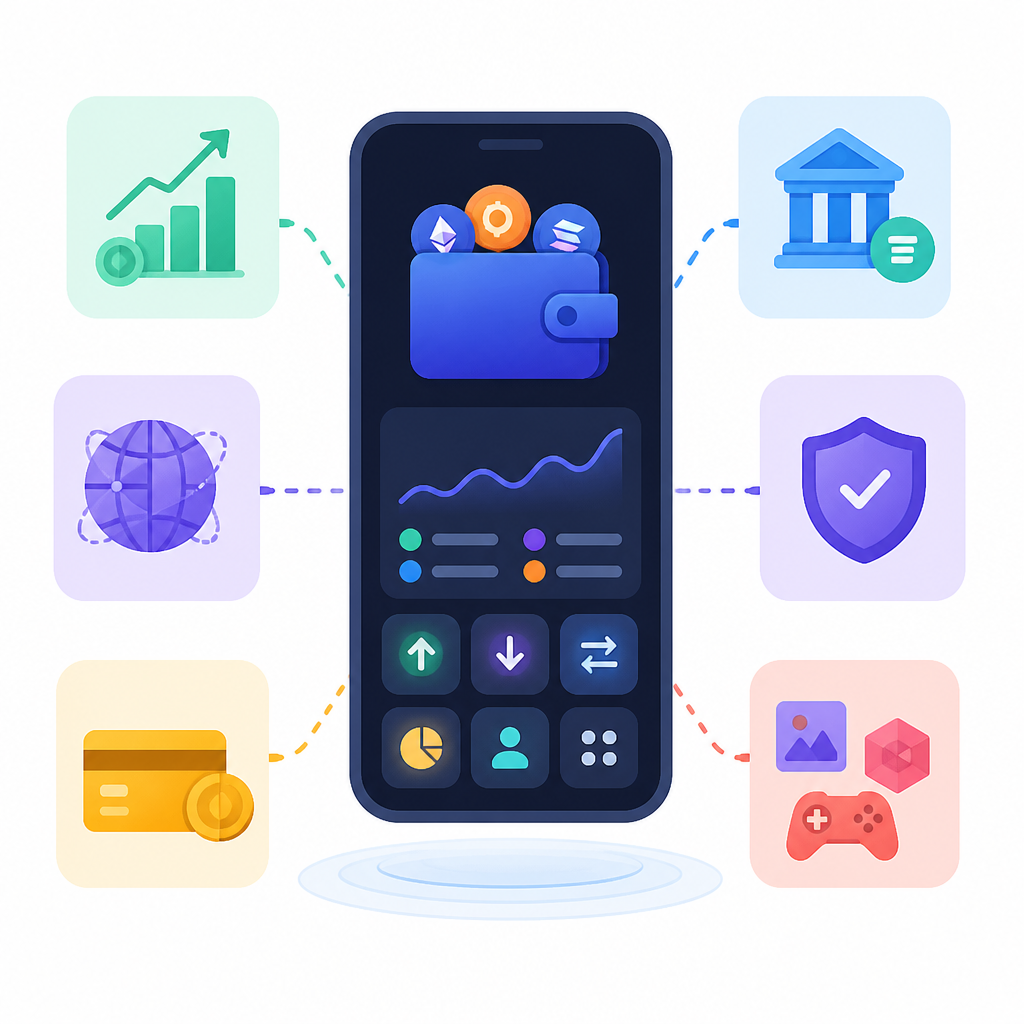
The market is already moving in this direction because the products themselves are converging. DeFi is no longer only about token swaps. Real-world assets are gaining traction, perpetual futures are expanding, and tokenized stocks and ETFs are moving from novelty to expectation. Once those categories coexist, the wallet that organizes them best has the advantage. KuCoin Web3 Wallet’s expansion is important not because it is unique, but because it reflects where the category is headed: from isolated storage to unified access.
The counter-argument
The strongest objection is that wallets are not supposed to become everything. A super app can become bloated, confusing, and risky. If a wallet tries to do custody, trading, tokenized assets, and cross-chain routing all at once, it may dilute the very simplicity that made wallets valuable. Security concerns also rise as more functions are packed into one interface. One compromised product surface can damage trust across the whole experience.
There is also a philosophical critique. Some users want a wallet to remain a neutral tool, not a platform that steers them toward specific markets or products. In that view, the wallet should stay minimal and let specialized apps compete on their own merits. That argument has merit when the goal is purity of function.
But the counter-argument fails on one crucial point: users already experience fragmentation as the bigger problem. A wallet that integrates more access does not automatically become worse; it becomes worse only if it sacrifices clarity or security. That is a design constraint, not a reason to reject the model. The right answer is not to keep wallets small. It is to make them coherent, secure, and explicit about what they let users do. The market is rewarding breadth because breadth now solves a real workflow problem.
What to do with this
If you are building a wallet, treat access as the product and custody as the trust layer. Engineers should design for modular integrations so new asset classes can be added without turning the app into a mess. PMs should prioritize the workflows users repeat most: funding, swapping, hedging, and moving across chains. Founders should stop pitching wallets as storage software and start positioning them as the place where users actually enter financial markets. The winners will not be the wallets with the most features on a slide. They will be the wallets that make the entire onchain financial stack feel like one product.
// Related Articles
- [CHAIN]
Layer 2 Is Ethereum’s Real Product, Not a Detour
- [CHAIN]
Ethereum’s price should be read as network demand, not just speculati…
- [CHAIN]
Ethereum’s shake-up turns ETH into a cleaner bet
- [CHAIN]
Bitcoin’s price page explains the market in one view
- [CHAIN]
Web3 Banking Guide for Fintech Teams
- [CHAIN]
10 prediction market builders that can ship Polymarket-style apps