Cloudflare’s Monetization Gateway makes pay-per-use real
5 ways Cloudflare’s Monetization Gateway turns any protected resource into a paid, request-level product with x402 settlement.

Cloudflare’s Monetization Gateway lets customers charge for protected web resources at request time.
Cloudflare says its new Monetization Gateway can charge for any resource behind its network, from pages to APIs to MCP tools. The pitch is simple: one payment control plane, edge enforcement, and x402 settlement for sub-cent usage, with Cloudflare citing more than 330 cities in its global network.
| Item | What it charges | How payment works | Where it runs |
|---|---|---|---|
| Monetization Gateway | Pages, datasets, APIs, MCP tools | x402 with stablecoins | Cloudflare edge |
| Pay Per Crawl | Crawler access to content | Payment-gated crawl requests | Cloudflare edge |
| x402 | HTTP resources and calls | 402 Payment Required flow | Inside ordinary requests |
| Web Bot Auth | Verified agent access | Identity plus usage rules | Cloudflare rules and API |
1. One control plane for paid web assets
Get the latest AI news in your inbox
Weekly picks of model releases, tools, and deep dives — no spam, unsubscribe anytime.
No spam. Unsubscribe at any time.
The biggest change is that Cloudflare wants payment policy to sit next to access control. Instead of building a billing stack on your origin, you define rules for which callers pay, what they pay for, and when the request should stop at the edge.

That matters most for teams selling digital resources with uneven usage. A page view, a dataset fetch, a model input, or a tool call can all be priced as discrete requests, which fits better than seat-based billing when buyers are agents or other software.
- Protect web pages behind a payment rule
- Charge for API routes such as
/api/premium/* - Meter dataset access or MCP tool calls
2. x402 turns HTTP into the payment rail
Cloudflare is anchoring the launch on x402, an open protocol built around the long-unused HTTP 402 status code. The flow is straightforward: a client requests a protected resource, the server replies with pricing details, the client pays, and then retries with proof of payment attached.
Because the exchange happens inside normal request and response traffic, there is no checkout redirect and no separate payment API to stitch into every product. Cloudflare says the goal is to keep the overhead low enough for tiny charges, including fractions of a cent.
Request -> 402 Payment Required -> pay -> retry with proof -> resource returned
3. Stablecoins fit the new unit of sale
At launch, the gateway settles in stablecoins, including USDC and Open USD. That choice is practical for machine-driven purchases because the amounts can be tiny, the fees can stay low, and settlement can happen in less than a second.
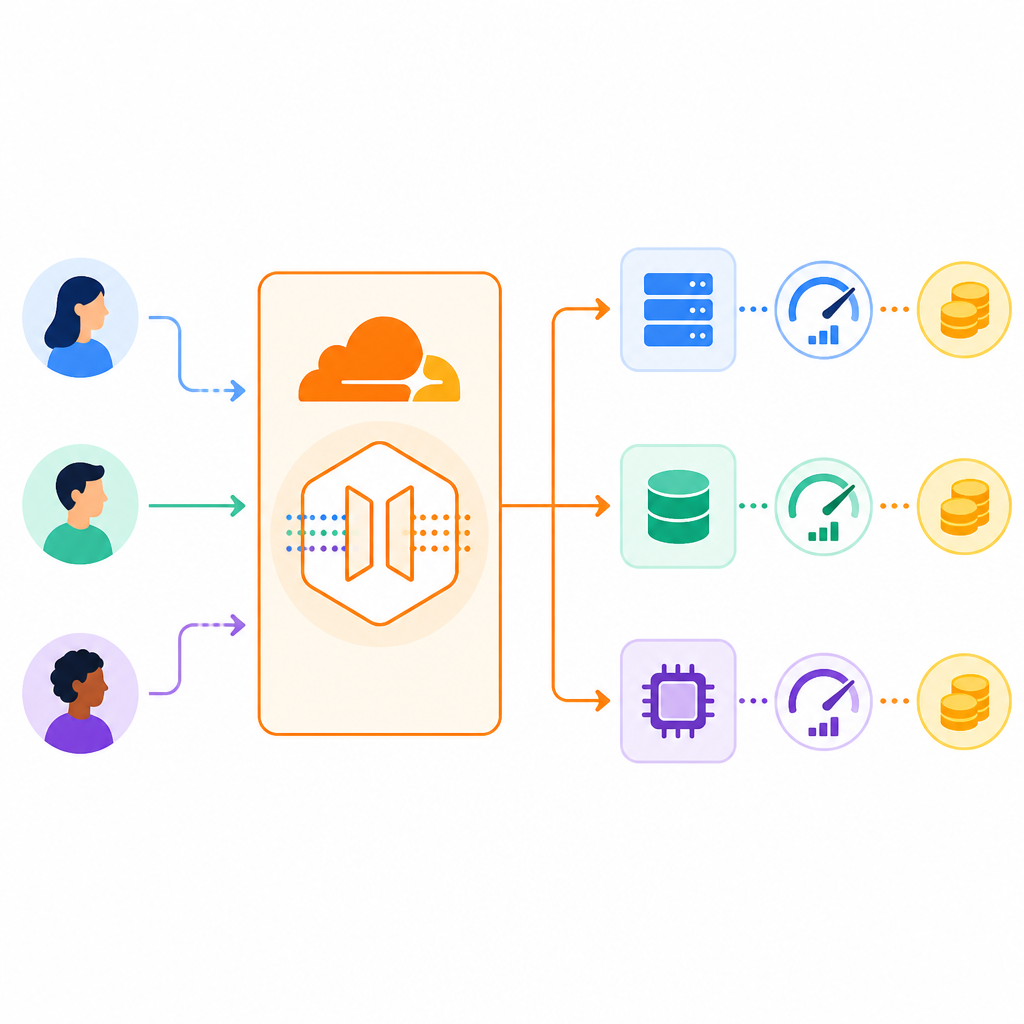
Cloudflare’s examples show the intended pricing shape: a few cents per search, a base fee plus a per-megabyte upload charge, or payment only when a task succeeds. The common thread is usage-based pricing that matches the actual cost of the request.
- Microtransactions for searches and content reads
- Per-call API billing
- Outcome-based pricing for support or compute tasks
4. Edge enforcement keeps the origin out of billing
Cloudflare is also selling the operational simplification. The gateway verifies payment before traffic reaches the origin, so your app does not need to onboard buyers, maintain invoices, or absorb payment verification load during traffic spikes.
That edge-first model is meant to work with Cloudflare’s global footprint, which the company says spans 330+ cities. Less payment logic on the origin means lower latency for buyers and less infrastructure work for sellers.
- Intercept unauthenticated requests and return 402 instead of 401
- Verify payment before forwarding the request
- Manage rules in the dashboard, API, or Terraform
5. Agent-first billing is the real target
The launch is aimed at a web where agents, not people, are the main buyers. Cloudflare argues that software agents can make thousands of micropayments without the friction that would make humans abandon the flow, which makes request-level pricing more realistic than monthly subscriptions for many services.
That is why the company pairs monetization with identity and authorization options such as Web Bot Auth. A seller can require both proof of agent identity and proof of payment, then decide which resources are free, which are gated, and which are priced by usage.
How to decide
If you sell APIs, datasets, compute, or tool access, the Monetization Gateway is the clearest fit when buyers are unpredictable and requests are easy to meter. It is especially attractive if you want payment enforcement at the edge and do not want to build a billing system around your origin.
If you only need crawler payments, Cloudflare’s earlier Pay Per Crawl approach may be enough. If you need broader request-level monetization for software buyers, x402 plus the gateway is the more complete option, especially for teams that want stablecoin settlement and infrastructure-as-code control.
// Related Articles
- [IND]
AI Weekly: 2026-08-10 ~ 2026-08-17
- [IND]
Polonius Alpha changes Rust borrow checking now
- [IND]
Anthropic’s Q2 revenue tops $11.5 billion
- [IND]
Rust’s best work this week is less about agents and more about simple…
- [IND]
Anthropic’s IPO Rumor Meets Investor Fatigue
- [IND]
Grok 4.6 makes frontier AI cheaper for builders