Free AI Agent Resources Worth Bookmarking
A curated GitHub hub for AI agents packs beginner courses, code labs, and frameworks from Microsoft, LangChain, OpenAI, and more.

Free AI Agents Resources is a GitHub list with 621 stars and 76 forks, and that number matters because it tells you this is filling a real gap. AI agents have moved from demo videos into actual software stacks, but the learning material is still scattered across repos, YouTube playlists, docs, and community posts.
This collection tries to fix that by pulling beginner courses, hands-on notebooks, framework docs, and practical tutorials into one place. If you have been trying to understand what an agent is, how multi-agent systems differ from simple chatbots, or which framework is worth your weekend, this repo saves a lot of tab-hopping.
What this repo actually gives you
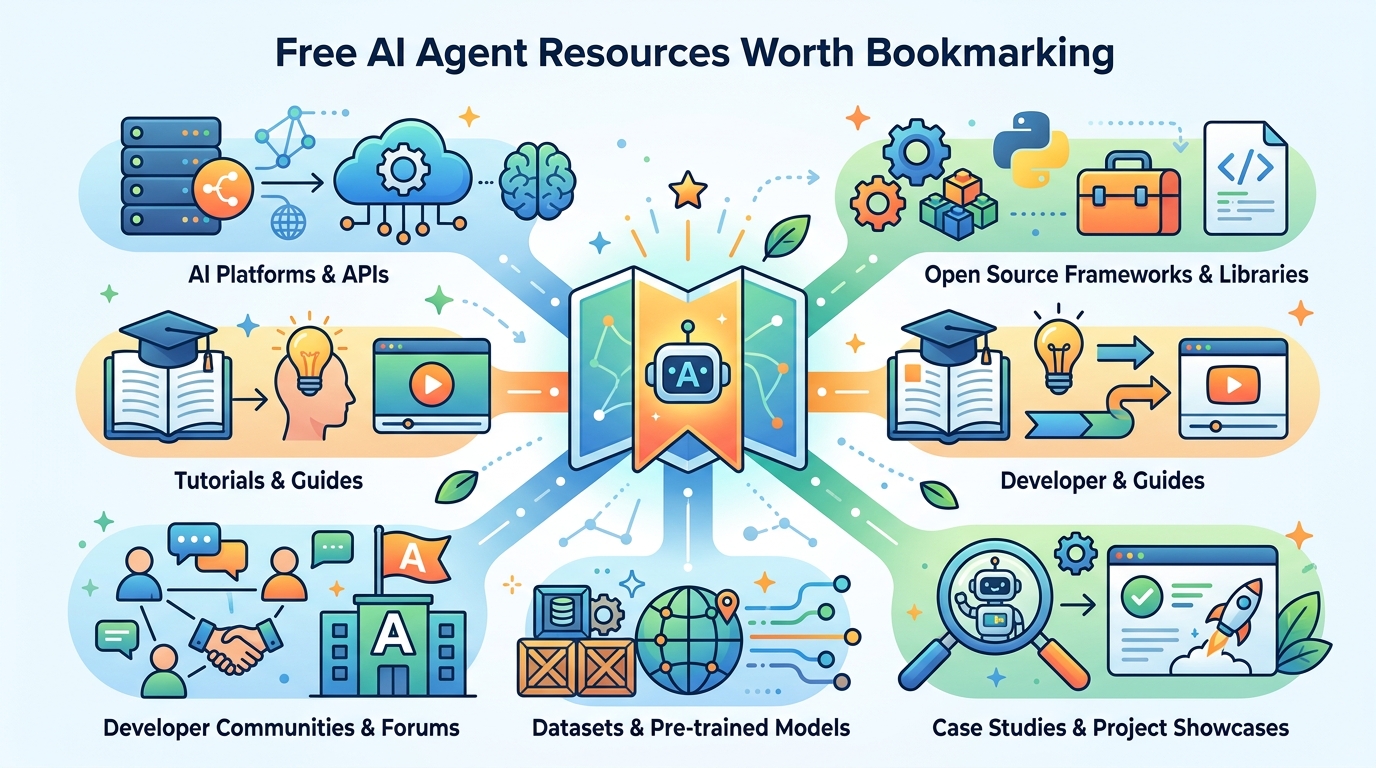
The strongest part of this project is its structure. It does not just dump links into a wall of text. It groups resources by use case, which makes it easier to start with a course, then move into code, then compare frameworks when you are ready to build something real.

The README opens with a quick-start path that points beginners toward Microsoft AI Agents for Beginners, NirDiamant/GenAI_Agents, and video playlists from Microsoft Developer and Nate Herk. That is a smart mix: one structured course, one notebook-heavy code repo, and two video tracks for people who learn faster by watching builds happen.
- Microsoft AI Agents for Beginners: 12 lessons on fundamentals, tool use, memory, and planning
- GenAI_Agents: 45+ Jupyter notebooks for conversational AI, RAG, and multi-agent systems
- Microsoft Developer AI Agents for Beginners: 14 videos, with a one-hour compiled version
- Nate Herk AI Agent Tutorials: 70+ hands-on videos on automation and no-code agents
Why this list is more useful than a generic roundup
Most AI agent roundups fail because they mix theory, code, and tooling without telling you where each link fits. This repo does better by separating curated lists, educational resources, frameworks, and community links. That matters because the agent world is already crowded with overlapping names and half-finished projects.
For framework selection, the list includes LangChain, LangGraph, OpenAI Swarm, OpenHands, and MetaGPT. That mix covers lightweight multi-agent handoffs, graph-based workflows, software engineering agents, and collaborative role-based systems.
There is also a practical edge here: the list includes tools for visual building, debugging, and retrieval-heavy applications, which is where many real deployments live. A lot of teams do not need a research toy. They need a way to prototype, inspect failures, and ship something that can read documents, call tools, and hand work between agents without collapsing after five steps.
“The models are the easy part. The hard part is the product.” — Andrej Karpathy, X profile
That quote fits this repo well. The value here is not in pretending every agent framework is equally mature. It is in giving builders a map of the messy middle between a model demo and a useful system.
How the main tools compare in practice
If you are comparing frameworks by real-world usefulness, the repo’s picks line up pretty cleanly. Some tools are best for orchestration, some for app structure, and some for fast prototyping. The numbers below come from the resource descriptions in the repo and the linked project docs.
- Microsoft AI Agents for Beginners: 12 lessons, built for first-time learners
- GenAI_Agents: 45+ notebooks, aimed at people who want code they can run immediately
- LangGraph: stateful graph-based orchestration for more complex workflows
- OpenHands: open-source software engineering agent for coding and debugging tasks
- AgentGPT: visual no-code agent builder for browser-based experiments
The practical takeaway is simple: Swarm is useful if you want lightweight multi-agent coordination, LangChain is still the broad general-purpose option, and LangGraph is the better fit when state and branching logic matter. If your goal is software tasks, OpenHands is the one to watch closely.
For people who want to learn by building, the repo’s inclusion of 500 AI Agents Projects and awesome-llm-apps is especially helpful. One gives you breadth, the other gives you runnable examples. That is a better combo than reading abstract blog posts about “autonomy.”
Who should bookmark this now
If you are a beginner, start with the Microsoft course and one notebook repo. If you are already shipping LLM features, jump straight to LangGraph, OpenHands, and the debugging resources like WFGY. If you are teaching a team, this repo is useful as a shared syllabus because it cuts down on the usual “which tutorial should I trust?” debate.
The big reason this collection matters is timing. AI agents are moving from novelty to engineering problem, and the people who understand tool calling, memory, planning, and orchestration will have a real advantage over teams that only know prompt writing. A curated hub like this does not teach everything, but it shortens the path to useful knowledge.
My prediction: the next wave of agent work will favor teams that can combine one learning track, one orchestration framework, and one debugging workflow without overcomplicating the stack. If you are starting now, this repo is a sensible place to build that habit. The only real question is whether you will use it to skim links, or to ship your first agent project this month.
Related Articles

AI-Papers-of-the-Week tracks the ML paper firehose
Apr 21

Inside Claude Design: From Prompt to Slide Deck in One Conversation
Apr 19

OpenAI Codex额度缩水,Pro会员却更划算了
Apr 14

Qdrant vs Milvus vs Weaviate for RAG in 2026
Apr 14

Redis Vector Search: Quick Start Guide Explained
Apr 14

Awesome Open Source AI: the best projects list
Apr 12