Why Stablecoins Will Become the Default Currency for AI Agents
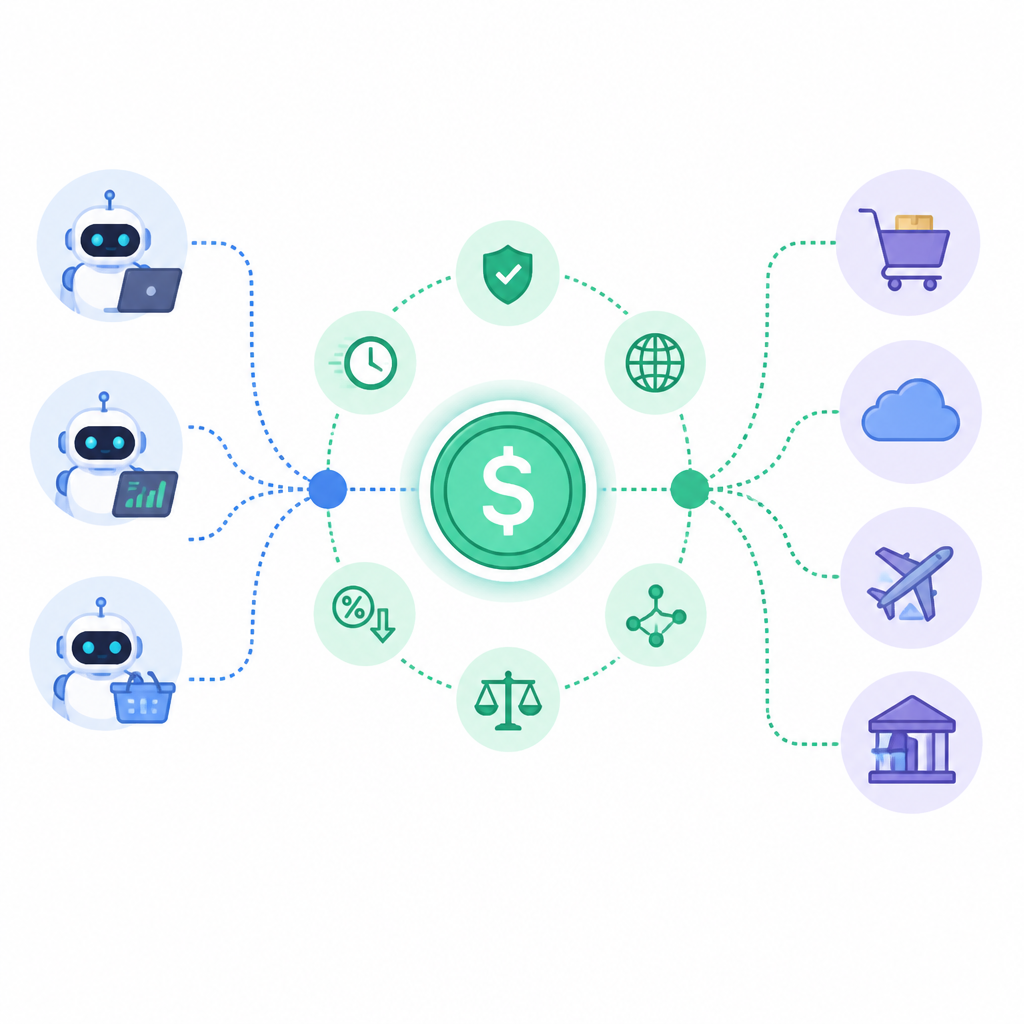
Stablecoins will become the default currency for AI agents because bots need fast, cheap, predictable payments.

Stablecoins will become the default currency for AI agents because bots need fast, cheap, predictable payments.
Stablecoins will become the default currency for AI agents because autonomous software needs money that behaves like software, not like speculation.
First, AI agents need a payment rail that can survive microtransactions
Get the latest AI news in your inbox
Weekly picks of model releases, tools, and deep dives — no spam, unsubscribe anytime.
No spam. Unsubscribe at any time.
Legacy payment systems were designed for people buying things occasionally, not for software firing off dozens of tiny payments per minute. That mismatch matters. If an agent needs to pay 2 cents for a data query and the network fee is 30 cents, the transaction is dead on arrival. Credit cards, ACH, and bank transfers all assume a world where the fee can be hidden inside a larger purchase. AI agents operate in the opposite world: high frequency, low value, and constant settlement.

Stablecoins fit this pattern because they combine blockchain speed with fiat-like stability. A bot holding $100 for API calls needs that budget to remain $100, not swing to $87 or $113 because the market moved. That predictability is the real product. The article’s example of x402 makes the point sharply: a script requests data, receives a quote, and pays in USDC immediately, with no human approval step and no subscription wrapper. In early 2026, more than 140 million autonomous transactions reportedly cleared in nine months with an average size of $0.31. That is not a niche use case. That is proof of demand.
Second, stablecoins solve the cross-chain mess that agents cannot afford
AI agents do not live on one chain, one app, or one liquidity pool. They need to move capital wherever compute, data, or execution lives. The crypto stack is still fragmented, and fragmentation is poison for autonomous systems. If an agent has to wait for liquidity, deal with wrapped assets, or tolerate slippage just to complete a purchase, the system loses the determinism that makes automation valuable in the first place.
Native transfer systems are the right answer because they preserve fungibility and reduce operational risk. Circle CCTP, for example, burns USDC on one chain and mints the equivalent amount on another, avoiding the baggage of lock-and-mint bridges. LI.FI’s aggregation layer goes a step further by routing across bridges and DEXs through one API, which is exactly the kind of abstraction developers want. For agents, this is not a convenience feature. It is infrastructure. A machine that can spend across networks without manual intervention is a machine that can actually function as an economic actor.
The counter-argument
The strongest objection is simple: stablecoins are still crypto, and crypto still carries regulatory, custody, and infrastructure risk. Governments can restrict access. Issuers can freeze addresses. Bridges can fail. And if the agentic economy becomes large enough, the payment layer may need bank-grade compliance, not just blockchain-grade speed. There is also a real concern that a system built around USDC or similar assets concentrates power in a small number of issuers and platforms.
That critique is valid, but it does not defeat the case for stablecoins as the default currency for agents. It only defines the limits. AI agents need a unit of account and settlement rail that works now, at machine speed, across borders and chains. Traditional finance does not offer that. Stablecoins do. The answer is not to wait for banks to reinvent themselves; it is to build compliance, risk controls, and policy layers on top of the rail that already works. If regulators want a different outcome, they need to create a better machine-native payment system. Today, they have not.
What to do with this
If you are an engineer, design your agent stack around stablecoin settlement from day one: budget in fiat terms, route through native cross-chain rails, and treat payment latency as a core product constraint. If you are a PM, stop thinking in subscriptions and start thinking in usage-priced workflows. If you are a founder, build for the agentic economy now, because the winners will be the companies that make autonomous spending boring, reliable, and invisible.
// Related Articles