AI agents in Web3 need strict controls, not hype
AI agents in Web3 are useful only when spending, signing, and access are tightly controlled.

AI agents in Web3 are useful only when spending, signing, and access are tightly controlled.
AI agents should be allowed into Web3 only as supervised operators, not autonomous free agents. The reason is simple: once an agent can sign a transaction, it stops being a helpful interface and starts acting like an economic actor with real liability. That changes the risk profile immediately. A bad prompt can become a bad trade, a bad approval, or a drained wallet, and the blockchain will preserve the result with perfect permanence.
First, Web3 gives agents real power, and real power needs hard limits
Get the latest AI news in your inbox
Weekly picks of model releases, tools, and deep dives — no spam, unsubscribe anytime.
No spam. Unsubscribe at any time.
The strongest argument for AI agents in Web3 is also the clearest warning. These systems can read on-chain state, call smart contracts, manage wallets, and coordinate actions without a human clicking every step. That is useful for treasury moves, DeFi execution, compliance checks, and security monitoring. But the same capabilities make the agent dangerous if permissions are loose. A wallet with broad approvals is not automation, it is an open invitation to loss.

The engineering failure modes are not abstract. A mismanaged nonce can trigger replacement transaction errors. A rushed call can revert because the contract role was not granted yet. A chain mismatch can send value to the wrong network. These are ordinary Web3 problems, but agents make them more frequent because they increase the number of actions and the speed of execution. The answer is not to avoid agents. The answer is to separate reasoning from signing, then enforce chain ID checks, function-level allowlists, spend caps, and revocation paths before any transaction leaves the system.
Second, the best use cases are supervised automation, not full autonomy
AI agents are genuinely useful when they reduce repetitive work in environments that already have clear rules. DeFi portfolio rebalancing is a good example. An agent can compare routes, estimate gas under EIP-1559, monitor liquidity, and prepare a suggested action faster than a human analyst. In compliance, an agent can flag suspicious wallet behavior, cluster addresses, and package evidence for review. In security, it can watch for privileged role changes or proxy upgrades and alert a team before damage spreads.
These are strong use cases because they fit staged autonomy. Low-risk actions can run automatically, while high-risk decisions stay behind a human approval step. That model is better than pretending an LLM can safely manage everything end to end. It also matches the direction of account abstraction and smart accounts, where session keys, spending limits, and scoped permissions make delegated execution practical. In other words, Web3 does not need smarter chatbots. It needs software that can act inside strict boundaries.
The counter-argument
Supporters of fully autonomous agents make a fair case. Web3 is built on programmable assets, open APIs, and verifiable state, so it is a natural environment for software that can act on its own. A treasury agent can rebalance stablecoins faster than a committee. A trading agent can respond to market shifts in seconds. A governance agent can summarize proposals, monitor votes, and execute approved actions without waiting for office hours. In a system that already runs on code, adding an agent seems like the next logical step.
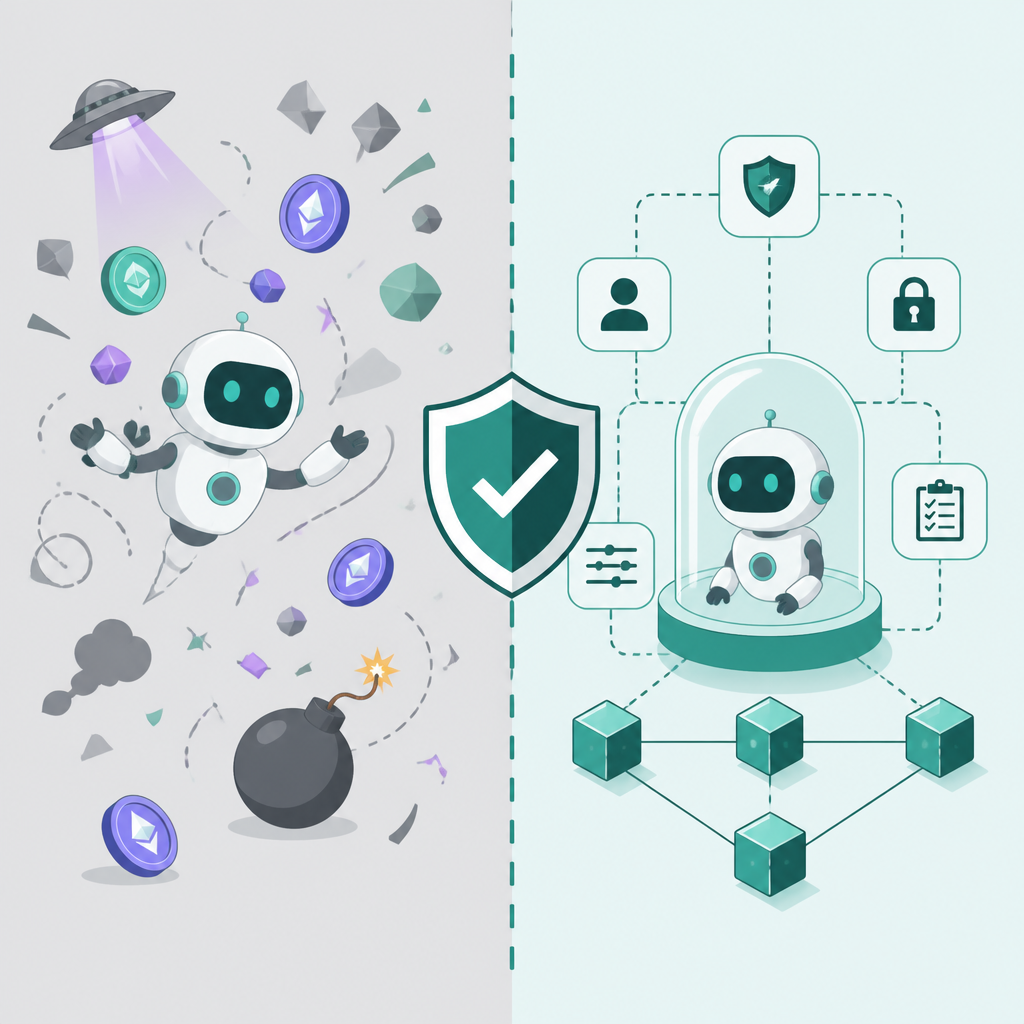
They are right about the opportunity, and wrong about the conclusion. The fact that blockchain records are transparent does not make mistakes harmless. It makes them permanent. Regulators still expect accountability for trades, sanctions screening, data handling, and treasury control. Security still depends on key management, prompt injection defense, and limited approvals. The right response is not to reject autonomy. It is to constrain it so tightly that the agent can optimize within policy, not rewrite policy on the fly.
What to do with this
If you are an engineer, build the agent as a two-part system: an LLM or planner that proposes actions, and a deterministic policy engine that validates chain, contract, value, function, and permission before signing. If you are a PM or founder, start with read-only workflows, then move to low-value actions with spend caps, allowlists, multisig review, and detailed logs. Test on a network where failure is cheap, and treat every agent decision like an audit event. In Web3, the winning product is not the one that acts the fastest. It is the one that can act, explain, and stop safely.
// Related Articles
- [CHAIN]
Anthropic’s Riot deal shows AI compute now costs billions
- [CHAIN]
Bitcoin’s CLARITY Act now faces a 60-vote test
- [CHAIN]
Pepeto's DeFi push is a distraction from Ethereum's real upside
- [CHAIN]
AI agents will not save Web3; they will expose its weakest systems
- [CHAIN]
Panda AI launches Golden Presale for AI blockchain
- [CHAIN]
Layer 2 vs Layer 3: $38B TVL trade-off