AI regulation in India is now a business risk
India’s AI rules now touch data privacy, fintech, content liability, and cybersecurity, with DPDPA penalties reaching ₹250 crore.

India’s AI rules now affect privacy, liability, and sector compliance for businesses.
India is already treating artificial intelligence as a live legal issue, not a future policy debate. In 2026, a company using AI in lending, hiring, healthcare, or content moderation can run into the Ministry of Electronics and Information Technology, the Information Technology Act, 2000, the Digital Personal Data Protection Act, 2023, and sector regulators at the same time.
The legal picture is messy, but the commercial message is simple: if your product touches personal data or automated decisions, you need a compliance plan before launch, not after a complaint lands.
| Rule or regulator | What it affects | Why businesses care |
|---|---|---|
| DPDPA 2023 | Personal data processing | Penalties can reach ₹250 crore per instance |
| IT Act 2000 | Intermediary duties, cyber liability, content issues | AI-generated content and platform duties can trigger exposure |
| RBI rules | Digital lending and credit models | Automated credit decisions must be explainable |
| SEBI rules | Algorithmic trading and advisory tools | Audit trails and controls matter |
| TRAI advisories | AI use in communications | Messaging and telecom deployments face extra scrutiny |
India’s AI law is split across multiple statutes
Get the latest AI news in your inbox
Weekly picks of model releases, tools, and deep dives — no spam, unsubscribe anytime.
No spam. Unsubscribe at any time.
There is no standalone AI Act in India yet. That means businesses have to read AI obligations across the IT Act, the DPDPA, consumer protection rules, and sector-specific circulars from regulators such as the Reserve Bank of India and SEBI.
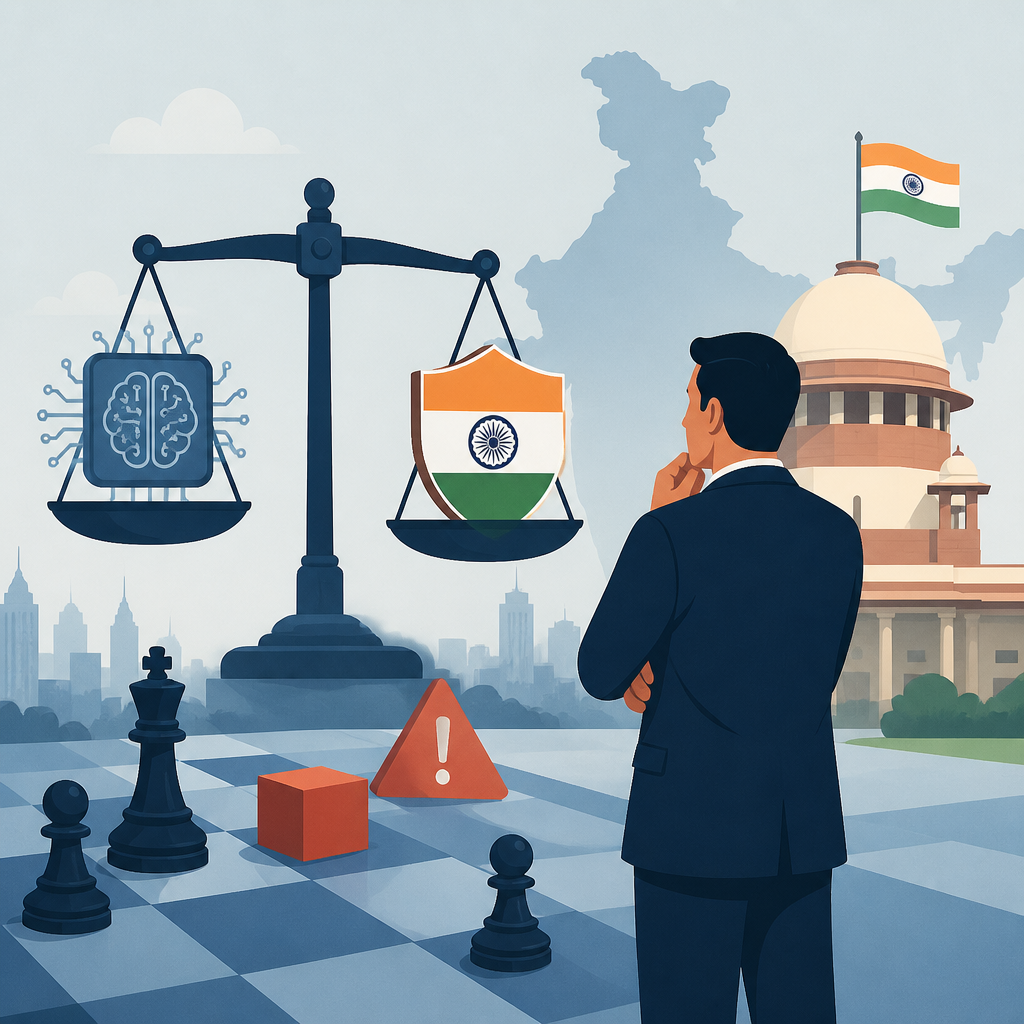
That patchwork matters because AI products rarely sit inside one legal bucket. A fintech model may process personal data, make a lending decision, and generate customer-facing explanations. A healthcare system may do the same with medical data and diagnostic output. One product can trigger several legal duties at once.
For business teams, this means compliance cannot live only with engineering. It has to involve legal, security, procurement, and product leadership from the start. A vendor contract that ignores model drift, output liability, or data ownership can create problems long after deployment.
- Consumer-facing AI usually processes personal data, so DPDPA consent and minimisation rules apply.
- Platform operators can face intermediary duties if AI-generated content causes harm.
- Financial services firms must check RBI guidance before using automated credit or advisory tools.
- Public-facing communications tools can also raise TRAI and cyber compliance issues.
Privacy and explainability are now practical legal tests
The strongest compliance pressure in India comes from data protection. If an AI system trains on customer records, profiles users, or makes automated decisions, the business has to justify what data it collects, why it keeps it, and who can access it.
That is where explainability becomes more than a technical buzzword. RBI guidance in digital lending expects credit decisions to be explainable to applicants, and SEBI’s rules around algorithmic trading demand audit trails. If a company cannot explain why its model rejected a loan, flagged a transaction, or ranked a user, the legal risk rises fast.
“The biggest risk is not the technology itself; it is the use of technology without governance,” said Brad Smith, vice chair and president of Microsoft, in 2023 remarks on AI oversight.
That quote fits India’s situation well. The law is still catching up, but regulators already expect companies to show they took reasonable steps. In practice, that means audit logs, human review for high-risk decisions, and written policies for bias testing and incident response.
Foreign companies often miss one more point: data localisation and cross-border transfer rules can change the architecture of an AI product. If your stack depends on overseas servers, you need to check whether the data flow fits Indian privacy rules before you ship.
- RBI: explainable credit and lending decisions
- SEBI: trading systems need audit trails
- TRAI: AI in telecom and communications faces extra scrutiny
- MeitY: policy direction points toward tighter AI oversight
Contracts and liability matter more than model quality
Indian law does not treat the AI system itself as the liable party. The deploying organisation usually carries the risk when an AI tool causes harm. That makes contract drafting a front-line defense, especially when businesses buy models or APIs from vendors.
AI-specific contracts should address indemnity, ownership of training inputs, output rights, service levels, security incidents, and dispute resolution. Standard SaaS terms rarely cover these issues well enough. If a model drifts, hallucinates, or produces biased results, the contract should say who absorbs the loss and who fixes the damage.
This matters in procurement, too. Many companies now buy AI features as add-ons inside larger software deals, then discover the paper trail never mentioned model updates or retraining. That gap becomes expensive when customers complain or regulators ask for evidence of oversight.
For startups, the legal strategy also has an IP angle. Training datasets, model weights, and proprietary workflows can be protected through a mix of trade secret controls, copyright analysis, and patent filings where appropriate. The point is simple: if the model has value, the legal structure around it should protect that value from day one.
What businesses should do before enforcement tightens
India’s AI policy is still changing, and that creates a narrow window for businesses to get their house in order before the rules harden. The companies that do best will not be the ones with the flashiest model demos. They will be the ones that can prove clean data governance, clear vendor contracts, and a documented review process.
There are four practical moves worth making now. First, map every AI system in the business and classify the risk. Second, write internal AI use rules for employees and vendors. Third, update contracts so liability, ownership, and security terms are explicit. Fourth, test whether cross-border data flows and sector rules match how the product actually works.
If you want a simple benchmark, ask one question: can your team explain the legal basis for every AI decision your product makes? If the answer is fuzzy, the compliance work is not done yet.
India is moving toward tighter AI oversight, and the next serious policy step could arrive within the next 12 to 18 months. Companies that treat AI as a legal program, not just a product feature, will be in a much better position when that happens.
For a related read on how India’s privacy law changes product design, see our DPDPA compliance guide.
// Related Articles
- [IND]
Google’s Q2 2026 results prove AI spend is now the story
- [IND]
Europe should standardise the AI Act through harmonised technical rul…
- [IND]
AMD and Anthropic’s 2GW deal reshapes AI supply
- [IND]
OpenAI’s comeback proves coding now drives the AI race
- [IND]
System design interviews get easier with 5 core ideas
- [IND]
EU AI Act’s 2026 Omnibus buys firms more time