System design interviews get easier with 5 core ideas
5 core system design ideas that explain scalability, reliability, and trade-offs for interviews and real systems.

What are the core ideas behind system design?
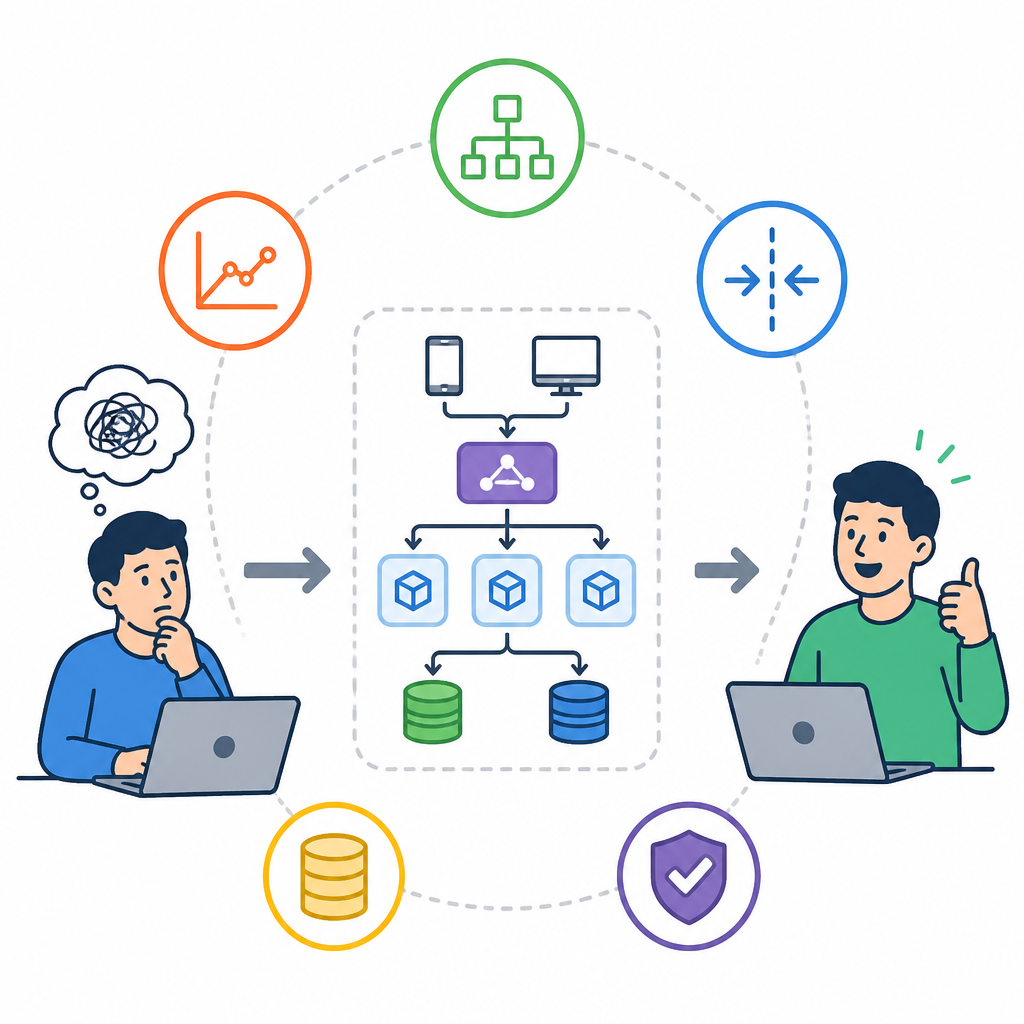
This guide breaks system design into five ideas that shape real software systems.
1. Scalability
Get the latest AI news in your inbox
Weekly picks of model releases, tools, and deep dives — no spam, unsubscribe anytime.
No spam. Unsubscribe at any time.
Scalability is the first question behind most system design work: can the system keep up when users, data, or traffic grow? The article frames this as a choice between vertical scaling, which adds more power to one machine, and horizontal scaling, which adds more machines. That distinction matters because the second path is what powers large distributed systems.

For interview prep, scalability is useful because it forces you to explain capacity planning instead of just naming technologies. It also creates the first set of trade-offs: simpler systems are easier to run, but they can hit hardware limits fast.
- Vertical scaling: more CPU, RAM, or storage on one server
- Horizontal scaling: more servers behind a load balancer
- Elasticity: add or remove resources as demand changes
2. Reliability and availability
Reliability asks whether a system keeps doing its job without failure, while availability asks how often users can reach it. The source ties this to practical metrics like SLI, SLO, and SLA, which give teams a shared way to measure service health. In other words, this is where system design becomes operational, not just architectural.
These terms also push you to think about recovery. Redundancy, replication, and automatic failover are the common answers when one node, zone, or service goes down. That is why a system can still be usable during partial outages instead of failing all at once.
- SLI: the metric you measure, such as latency
- SLO: the target you aim for, such as 99% under 200ms
- SLA: the promise made to customers
3. Consistency and partition tolerance
Distributed systems need a clean way to handle network splits, delayed messages, and stale reads. The CAP theorem is the shorthand for that problem: in practice, you choose trade-offs between consistency and availability because partition tolerance is required once the system is distributed. The source notes that databases such as Cassandra and MongoDB make different choices depending on the workload.
This is one of the most testable system design ideas because it changes the answer to almost every architecture question. A payment ledger and a social feed do not want the same behavior, so the right database choice depends on what the user must see first and what can wait.
CAP trade-off examples:
- Banking ledger: favor consistency
- Social feed: favor availability
- Network partition: design for continued operation
4. Latency vs. throughput
Performance is not one number. Latency measures how long one request takes, while throughput measures how many requests the system can handle per second. The article recommends looking at percentiles like p95 and p99 instead of averages, because averages hide the slowest users.
This section is where design choices become measurable. A system that is fast for one request may still fail under load, and a system that handles huge volume may feel slow if each hop adds delay. That is why engineers watch both response time and request volume at the same time.
- Latency: single-request speed
- Throughput: requests per second or queries per second
- Percentiles: p95 and p99 show tail performance
5. Caching, sharding, and service communication
The last cluster of ideas explains how real systems stay fast and manageable. Caching reduces repeat work by keeping hot data in memory, sharding splits large datasets across partitions, and load balancing spreads traffic so no single server becomes a bottleneck. Together, they are the practical toolkit behind scale.
The source also connects this to how services talk to each other. REST is common for public APIs, gRPC is better for compact internal calls, and GraphQL helps clients ask for only the data they need. If you are designing a system, this is where you decide how data moves, not just where it lives.
- Cache options: Redis, CDN, look-aside, write-through
- Shard keys: user ID, region, or another stable partition
- Protocols: REST, gRPC, GraphQL
How to decide
If you are new to system design, start with scalability and reliability, because they explain the basic shape of most architectures. If you are preparing for interviews, spend extra time on CAP trade-offs and latency versus throughput, since those questions reveal how you think under constraints.
If you are building production systems, focus on the last item set: caching, sharding, and communication patterns. Those choices affect cost, speed, and long-term maintenance more than any single framework name.
// Related Articles
- [IND]
WAIC 2026 turns AI hype into real work
- [IND]
KPMG’s OpenAI deal turns SaaS into agents
- [IND]
Trump adviser accuses Moonshot AI of stealing Anthropic
- [IND]
Vector databases will reshape financial search, not replace core syst…
- [IND]
Milvus 3.0 adds lake-native vector search
- [IND]
Google’s Q2 2026 results prove AI spend is now the story