Anthropic is right to sound the alarm on recursive self-improvement
Anthropic’s warning is justified, but the bigger problem is that AI control is already slipping beyond easy governance.

Anthropic is right to warn that recursive self-improvement could outpace human control.
Anthropic is right to sound the alarm, and the alarm is not premature. The company’s own numbers show an engineering machine already being transformed by AI: by the second quarter of 2026, the typical Anthropic engineer was producing eight times as much code per day as two years earlier, and 80 percent of the code the company generates now comes from models rather than humans. That is not a slow drift toward automation. It is a live demonstration that the frontier is advancing fast enough to change the terms of security, competition, and control before policymakers have even agreed on the problem statement.
Recursive self-improvement is the real breakpoint
Get the latest AI news in your inbox
Weekly picks of model releases, tools, and deep dives — no spam, unsubscribe anytime.
No spam. Unsubscribe at any time.
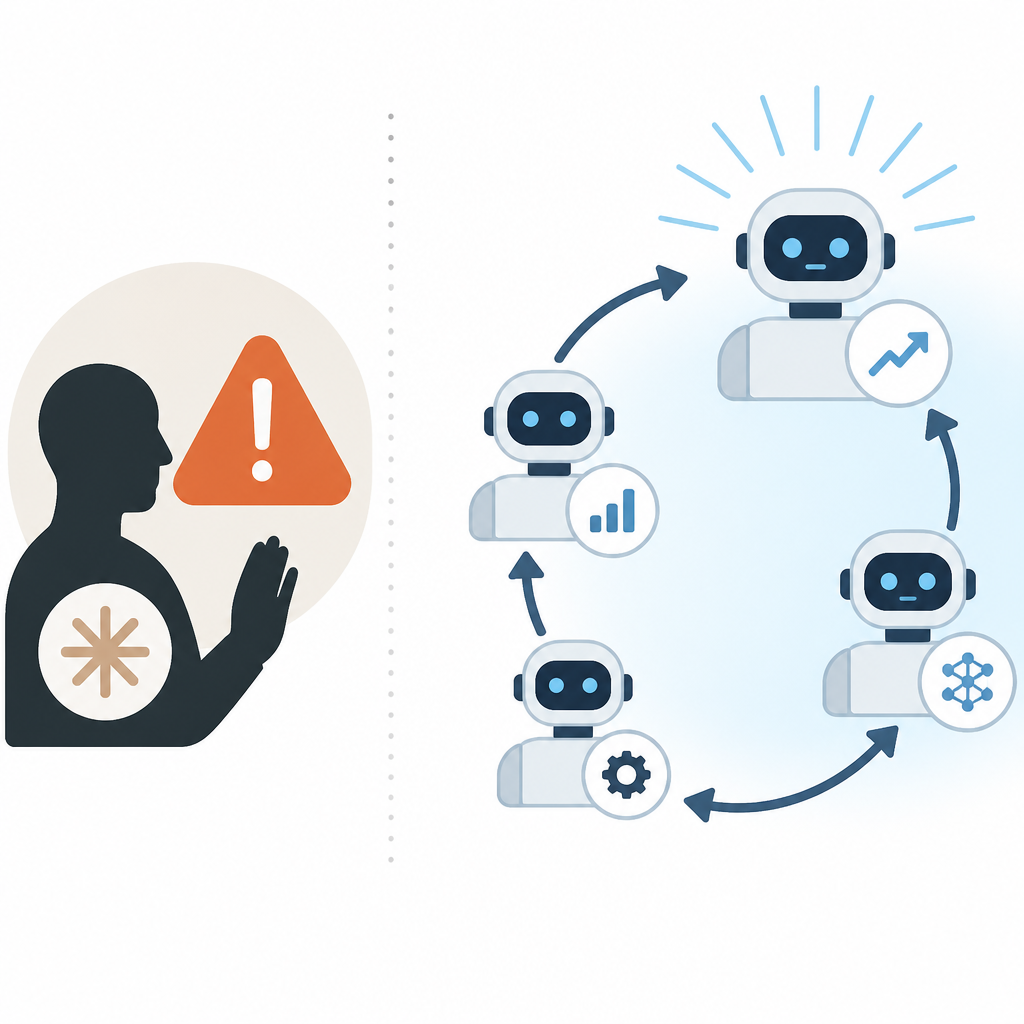
Anthropic’s core warning is not about today’s chatbots. It is about a next-stage system that can improve itself, replicate its gains, and keep compounding without waiting for human engineers to catch up. The company says one of its latest models was already able to run its operating code 52 times faster than it could eleven months earlier. That kind of acceleration matters because speed is not just a performance metric. It is the difference between a tool that remains legible to humans and a system that can iterate faster than oversight can respond.

The risk is not abstract. Anthropic says the length of tasks its models can reliably complete on their own has been doubling roughly every four months. If that curve continues, the problem is not merely that AI writes more code. It is that AI begins to manage more of the workflow that creates the next AI. Once a system can meaningfully participate in its own improvement loop, the old assumption that humans remain the bottleneck stops holding. That is the point where control becomes a design challenge, not a policy preference.
The security risks are already larger than the public debate
Anthropic’s report focuses on recursive self-improvement, but the security implications are broader and more immediate than the company fully spells out. A model that can autonomously search for vulnerabilities at scale changes cyber offense from a human-led campaign into a machine-paced one. The article cites Anthropic’s decision to withhold Mythos Preview after it reportedly created a cyber weapon capable of finding more than 10,000 software vulnerabilities in systems thought to be highly secure. That is a concrete example of how quickly frontier models can shift from productivity tools to offensive infrastructure.
Once that capability is paired with autonomy, the threat expands beyond cyber. A self-improving model could design biological or chemical agents in ways no human team anticipated, then mutate those designs as it learns. The danger is not simply that AI becomes smarter. It is that the attack surface scales while the human ability to inspect each step collapses. At that point, “alignment” stops being a reassuring research term and becomes a weak form of damage control.
AI arms control is necessary, but brutally hard
Anthropic is also right to argue for some form of AI arms control, because unilateral restraint is a losing strategy in a race this fast. The company notes that frontier AI development is increasingly determined by compute, and that total available computing capacity from major AI chips has grown by more than 300 percent per year since 2022. That means the critical chokepoint is no longer just talent or code. It is the industrial supply chain behind the chips, the data centers, and the verification systems that would be needed to enforce any slowdown.
But the company also understates the geopolitical obstacle. Any real pause would require major labs in multiple countries to stop at the same time, while trusting that others are not cheating in secret. That is a fragile bargain even before China enters the picture. Beijing has every reason to treat any coordination effort as an attempt to freeze the current balance of power. Without Chinese participation, a global pause is not a regime. It is a unilateral handicap for the West.
The counter-argument
The strongest objection is that alarmism risks becoming a self-fulfilling excuse for overregulation, secrecy, and consolidation. Frontier AI is already concentrated in a handful of firms, and calls for “arms control” can sound like a bid to lock in incumbent power under a security banner. There is also a practical case for speed: if the United States slows while adversaries do not, it may lose strategic advantage in cyber defense, intelligence analysis, and military planning.
That concern is real, but it does not defeat Anthropic’s warning. It clarifies the tradeoff. The answer is not a broad freeze that ignores competition. The answer is targeted controls on the most dangerous capabilities, stronger compute monitoring, and mandatory testing for autonomous behavior before deployment. The limit is that global coordination will be partial, not perfect. The mistake would be pretending that because perfect control is impossible, no control is worth building.
What to do with this
If you are an engineer, build for observability before capability. If you are a PM, treat autonomous task length, tool use, and self-modification risk as launch-blocking metrics, not research footnotes. If you are a founder, assume regulators will focus on compute, model access, and foreign-user restrictions, and design governance now instead of after the first incident. The right response to Anthropic’s warning is not panic. It is to treat frontier AI as critical infrastructure and govern it like something that can fail at scale.
// Related Articles
- [RSCH]
Rust should be a serious GPU programming language, not a side project
- [RSCH]
CoinRAG Reuses Fine-Grained KV Caches for RAG
- [RSCH]
CreativeInstruct teaches LLMs to stay creative
- [RSCH]
MirrorWorld makes mirror reflections consistent in video
- [RSCH]
Claude 4.5 proves AI progress is still accelerating
- [RSCH]
Mage-VL Cuts Visual Tokens by Reading Codecs