ART fine-tunes multimodal LLMs via pixels
ART fine-tunes frozen multimodal LLMs by optimizing a single input image instead of model weights.

ART fine-tunes frozen multimodal LLMs by optimizing a single input image instead of model weights.
- Research org: University of Stavanger + NORCE Research
- Core data: No benchmark numbers in abstract
- Breakthrough: Optimize one pixel image through the vision path of a frozen MLLM
Fine-tuning Multi-modal LLMs with ART: Art-based Reinforcement Training argues for a very different kind of parameter-efficient fine-tuning: instead of changing weights, it changes the pixels of an image that the model already knows how to process. For engineers, the appeal is obvious: the model stays frozen, the serving stack stays standard, and the fine-tuned “prompt” looks like a normal multimodal request.
The paper is not trying to sell a new model architecture. It is trying to remove the operational friction that comes with common PEFT methods like LoRA and soft prompting, especially in high-throughput engines such as vLLM. The core idea is to adapt a multimodal LLM by training a task-specific image artifact that carries the tuning signal through the vision pipeline.
What problem this paper is trying to fix
Get the latest AI news in your inbox
Weekly picks of model releases, tools, and deep dives — no spam, unsubscribe anytime.
No spam. Unsubscribe at any time.
The authors start from a practical production issue: many downstream tasks are still text-heavy, but the models being deployed are increasingly multimodal. That creates a gap. You want the performance benefits of task specialization, but you do not want to pay the engineering costs of modifying precompiled graphs, dynamically loading adapters, or bypassing standard token pipelines.

LoRA is described as the default PEFT approach, but it adds weights between layers and can create friction in optimized serving systems. Soft prompting avoids weight updates, but still requires custom handling of continuous embeddings and does not fit cleanly into standard high-throughput infrastructure. The paper’s answer is to use the visual channel as the adaptation surface.
That matters because the model’s vision tower and cross-modal projection already map pixels into the same embedding space used by text. If that pathway is differentiable, then pixels themselves can become the trainable object. In other words, the “adapter” is an image, not a new set of weights.
How ART works in plain English
ART stands for Art-based Reinforcement Training. The method freezes the multimodal LLM and optimizes only the raw image input. The image is treated as trainable data, and gradients are pushed back into pixel space. The paper says this supports any fine-tuning objective because the optimization happens through backpropagation into a plain pixel array.
The implementation is described as a two-pass loop. First comes rollout and advantage estimation. Then comes policy clipping and a backward step. The paper also says the ART implementation uses Dynamic sAmpling Policy Optimization, or DAPO, which is presented as a recent GRPO variant. The important point is not the exact reinforcement-learning flavor, but the fact that the optimization objective can be swapped out without changing the frozen model.
The pixel parameterization is also part of the trick. The learnable image is initialized from a seed image and represented in logit space so pixel values stay valid while optimization remains unconstrained. That lets the method tune an image like a continuous parameter tensor rather than a static JPEG or PNG.
There is also a practical side effect: the resulting optimized images can be stylized as computational artworks. The paper explicitly frames these as artifacts that may resemble the seed image while hiding task-specific structure. It even compares them to steganography, because the image can encode fine-tuning information while still looking like ordinary art.
What the paper actually shows
The paper evaluates ART on different sizes of the open Qwen architecture and on several textual benchmarks. The benchmarks named in the abstract and notes are GSM8K, GPQA, and ToolMind. GSM8K is grade-school math, GPQA is graduate-level question answering, and ToolMind is structured tool use.
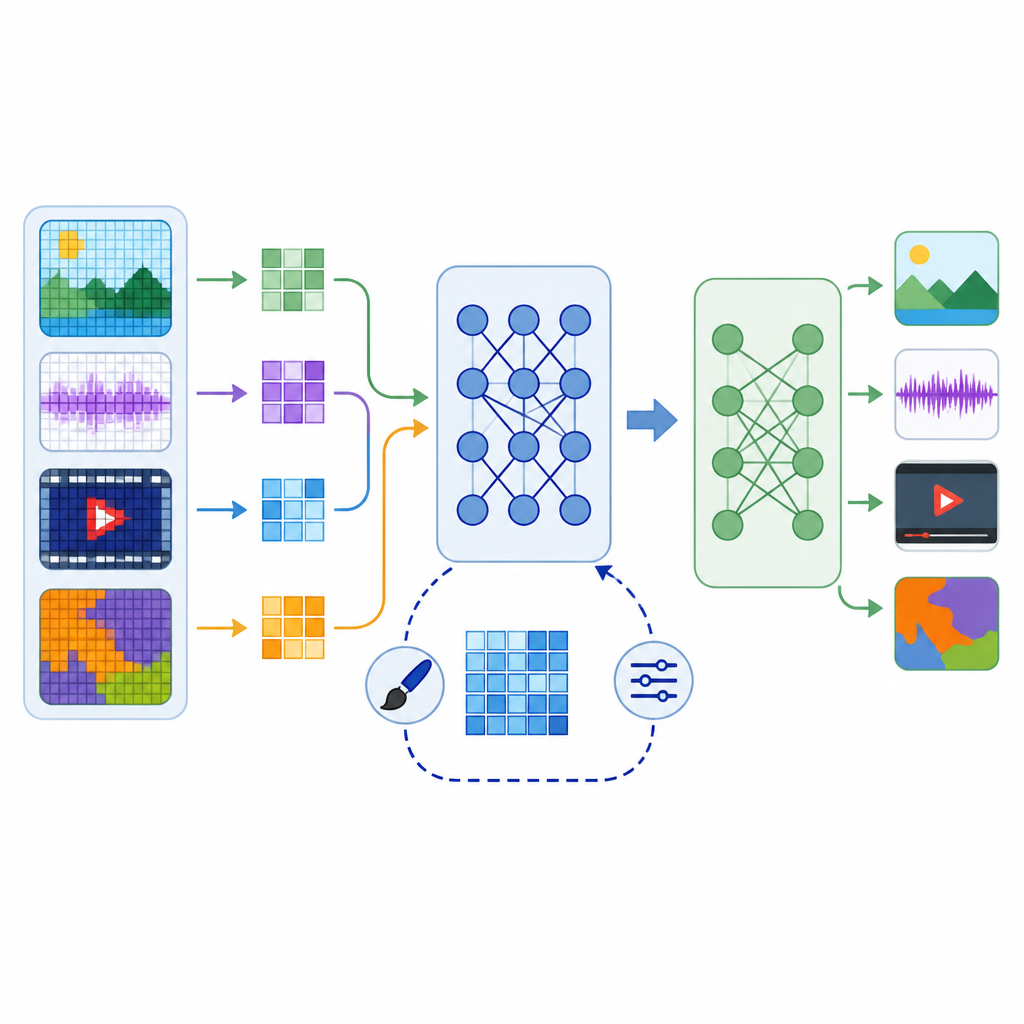
According to the abstract, ART reaches accuracy competitive with LoRA across mathematics and structured-tool-use benchmarks. The paper also says it identifies the tasks where ART falls behind, which is an important qualifier: this is not presented as a universal replacement for weight-space fine-tuning.
The source material does not provide concrete benchmark numbers in the abstract, so there is no percentage, score, or throughput claim to quote here. What it does provide is a directional result: ART can match or beat LoRA on some standard tasks, while also preserving a deployment-friendly interface.
Another result the authors highlight is information storage in the generated art. They use growth in lossless PNG file size as a proxy for stored information. That is an unusual but interesting angle: the artifact is not just a prompt, it is also a container for task adaptation.
Why developers should care
If you are building around a multimodal model serving stack, ART is interesting because it tries to keep everything inside the normal request path. The model stays frozen. The serving engine does not need custom weight managers. You do not need special kernels or architecture workarounds. In theory, that makes the method easier to deploy in systems that are optimized for standard multimodal inputs.
That does not mean it is a drop-in replacement for every fine-tuning workflow. The paper is explicit that ART is evaluated on selected benchmarks, and it acknowledges cases where it underperforms. The source also does not show broad production evidence, latency measurements, or memory comparisons in the abstract, so those would still need validation before anyone treats this as an infrastructure win.
There is also a conceptual limitation worth noting: ART depends on a multimodal model with a vision pathway that can be optimized through pixels. That makes it a fit for MLLMs, not a universal technique for text-only LLMs. The method’s usefulness will likely depend on how stable the vision-text alignment is for a given model family.
Where this fits in the PEFT landscape
ART sits between visual prompting, soft prompting, and adversarial reprogramming, but with a different goal. Earlier work used the visual channel to steer or hijack behavior. ART uses the same channel to improve capability. That distinction is central to the paper’s framing.
Compared with LoRA, ART avoids touching model weights. Compared with soft prompting, it avoids custom token-pipeline handling. Compared with classic visual prompt tuning, it is not just learning a continuous prompt for a vision model; it is using the image as the trainable object for a multimodal language task. That makes it a neat engineering workaround as much as a research idea.
For practitioners, the main question is whether this tradeoff is worth it. ART may be attractive when you want a frozen model, standard serving, and task-specific adaptation without adapter management. But if your use case needs well-understood, widely supported, and easily inspectable weight updates, LoRA still looks like the more conventional path.
Open questions and limitations
The source material leaves several things unresolved. It does not provide benchmark numbers in the abstract, so the scale of the gains is unclear from the excerpt alone. It also does not tell us how robust the learned images are across model versions, prompts, or deployment settings.
Another open question is maintainability. An optimized image that doubles as a task adapter is clever, but it also adds a new artifact type to version control and MLOps workflows. Teams would need to treat these images as model assets, not just decorative inputs.
Finally, the paper hints at information storage inside the image file itself, but the practical implications of that are not fully spelled out in the abstract. Is the image mainly a prompt, a compressed representation of a task policy, or both? The paper makes the case that it can be both, but the source excerpt does not settle how far that idea can be pushed.
Still, the core takeaway is strong: ART shows that a frozen multimodal LLM can be fine-tuned through pixels alone. For engineers, that opens a new design space where the adapter is not a module, but an image that the model already knows how to read.
// Related Articles
- [RSCH]
Test-Time Harnesses Transfer Skills Without Retraining
- [RSCH]
DreamFly improves aerial VLN with memory and planning
- [RSCH]
AVA-Encoder turns films into editable knowledge graphs
- [RSCH]
Sparse Autoencoders Don’t Behave Like Feature Bags
- [RSCH]
ConVAWG generates controlled VAWG dialogues
- [RSCH]
Surgical WAM uses video to train robot control