AURORA-LM brings diffusion to text latents
AURORA-LM models text in a decodable continuous latent space and trains diffusion directly on that representation.

Text models still mostly live in token land, even as image, audio, and video systems move into continuous latent spaces.
AURORA-LM models text in a decodable continuous latent space and trains diffusion directly on that representation.
- Research org: Unspecified in arXiv abstract
- Core data: 1B parameters
- Breakthrough: Query-based encoder-decoder plus block-causal diffusion transformer
If you build or tune generative systems, this paper matters because it attacks a familiar tradeoff: richer latent representations often make generation harder, while simplifying the latent can hurt what the decoder can recover. AURORA-LM’s answer is to keep the latent high-capacity and make the diffusion model adapt to it, rather than squeezing the representation down first.
What problem the paper is trying to fix
Get the latest AI news in your inbox
Weekly picks of model releases, tools, and deep dives — no spam, unsubscribe anytime.
No spam. Unsubscribe at any time.
The abstract frames language as the odd one out in generative modeling. Continuous latent spaces are increasingly common for images, video, and audio, but text generation still depends mostly on discrete tokens. That split matters because token-based systems and latent-based systems come with different bottlenecks, and the paper is trying to close that gap for language.

According to the authors, existing continuous language models tend to fall into two camps. Some inherit embedding spaces that were not built for joint generation and decoding. Others compress autoencoded latents so diffusion becomes easier, but that compression costs token-level fidelity. In other words, the model becomes easier to sample from, but less faithful to the text it should reconstruct.
The paper’s core complaint is straightforward: instead of weakening the representation to fit the generator, why not keep the representation strong and improve the generator? That is the design direction AURORA-LM takes.
How AURORA-LM works in plain English
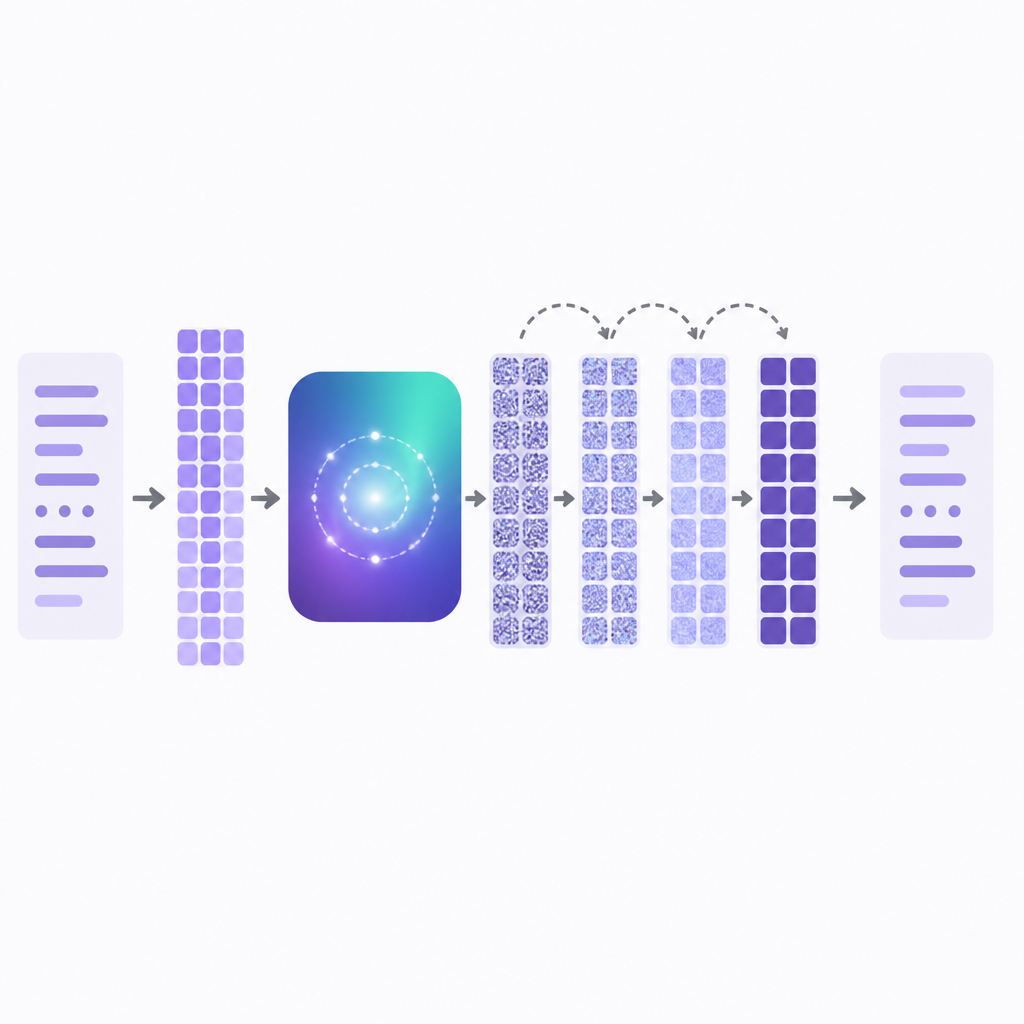
AURORA-LM separates two jobs that are often blurred together. First, it builds a text representation that is meant to be decoded well. Then it trains a diffusion model to learn the distribution of that representation directly. The point is not to invent a lighter latent; it is to make a diffusion system capable of handling a more demanding one.
The representation side uses a Query-based Encoder-Decoder. In the paper’s description, this organizes text into a high-capacity, prefix-aligned latent sequence. “Prefix-aligned” here suggests the latent structure is arranged so generation can proceed in a left-to-right manner, which matches how many language systems are used in practice.
On the generative side, the paper uses a Block-causal Diffusion Transformer trained with flow matching. It generates blocks from left to right while denoising the positions inside each block in parallel. That gives the model a structured way to work through the sequence without falling back to a pure token-by-token decoder.
One important detail is that AURORA-LM does not simply simplify the latent to make diffusion easier. Instead, it restricts only the noisy-input pathway while keeping the clean-latent prediction target at full width. The abstract says this allows the system to preserve decoder-facing capacity even when the latent is hard for diffusion to model.
The paper also adds two supporting pieces. It calibrates the noise-level distribution to match latent width, and it introduces self-trajectory consistency to bridge the gap between independently sampled training noise and iterative denoising at inference. Those are the kinds of details that usually matter when a method works in theory but gets unstable in practice.
What the paper actually shows
The abstract claims AURORA-LM achieves the strongest performance among the evaluated continuous and diffusion-based language models on OpenWebText free generation and XSum summarization. It also says the model scales to 1B parameters with about 1500 EFLOPs of total compute and gains further performance from that scaling.
There is one comparison worth noting: the paper says AURORA-LM surpasses a larger publicly released latent-diffusion language model under a matched evaluation protocol. That is a useful signal because it suggests the gains are not just coming from a bigger model or a friendlier benchmark setup.
What the abstract does not give is the full benchmark table, exact scores, or per-task numbers. So if you are looking for a precise leaderboard delta, the abstract does not provide it. It does, however, make the directional claim clearly: among the evaluated models, AURORA-LM comes out on top on the named tasks.
All experiments were conducted on Ascend NPUs. That matters because implementation and hardware context can shape both training behavior and reproducibility. The abstract does not spell out whether the method is tied to that hardware stack, but it does tell you where the reported results came from.
Why developers should care
For engineers, the interesting part is not just that diffusion is being applied to text. It is the idea that text generation may not need to stay locked to discrete tokens if you can design a latent that remains decodable and still trainable. That opens a path toward language models that borrow ideas from continuous generative systems without giving up reconstruction quality too early.
This also gives practitioners a concrete design pattern: build the representation for the decoder first, then adapt the generator around it. That is a different mindset from compress-first pipelines, and it could be relevant anywhere token fidelity and latent flexibility are in tension.
There are still open questions. The abstract does not tell us how expensive the method is at inference, how sensitive it is to latent width, or how it compares on broader language tasks beyond the two named evaluations. It also does not say whether the approach generalizes cleanly outside the Ascend NPU setting used for the experiments.
Even with those gaps, the paper is a useful signal for people tracking generative model design. It shows that continuous latents for text are not just a theoretical curiosity; they can be paired with a diffusion architecture that is explicitly engineered to preserve decoding quality.
Bottom line
AURORA-LM is trying to make text generation behave more like other continuous generative domains without flattening away the structure that makes text recoverable. If the method holds up beyond the reported settings, it is a meaningful step toward latent-first language models that are still practical to decode.
- It targets the mismatch between high-capacity text latents and diffusion-based generation.
- It pairs a query-based encoder-decoder with a block-causal diffusion transformer.
- It reports strongest results on OpenWebText free generation and XSum summarization among evaluated continuous and diffusion-based models.
// Related Articles
- [RSCH]
onepot-Bench 0 tests lab-aware chemistry models
- [RSCH]
Kimi K3 Is Already Doing Its Own Job
- [RSCH]
Private mode finding for regression and clustering
- [RSCH]
ExtractBench benchmarks schema-guided document extraction
- [RSCH]
TokTier cuts tokenization overhead for agentic LLMs
- [RSCH]
Systema turns AIVC scores into a harder test