Best Prompt Evaluation Tools in 2026, Compared
Braintrust compares the best prompt evaluation tools for 2026, with pricing, features, and tradeoffs for teams shipping AI in production.

Braintrust compares the best prompt evaluation tools for teams shipping AI in production.
Braintrust published a 2026 guide that reads like a field test, not a product brochure. It focuses on prompt evaluation, the part of AI development that tells you whether a prompt actually works before your users do.
The article lands on a simple point: once prompts start changing every day, manual testing stops being enough. You need traces, datasets, scoring, and a way to see whether version 2 is better than version 1 without relying on gut feel.
| Tool | Notable detail | Price or scale |
|---|---|---|
| Braintrust | Production traces, evals, and monitoring in one loop | Free tier, Pro at $249/month |
| Brainstore | Querying AI logs claimed to be 80x faster | Included in Braintrust stack |
| OpenAI | Used as an LLM judge in modern eval workflows | Model usage-based pricing |
| Anthropic | Another common judge model for scoring outputs | Model usage-based pricing |
Prompt evaluation is now part of the shipping process
Get the latest AI news in your inbox
Weekly picks of model releases, tools, and deep dives — no spam, unsubscribe anytime.
No spam. Unsubscribe at any time.
The strongest idea in the article is that prompt evaluation is no longer a side task. It is part of the same loop as prompt writing, testing, deployment, and monitoring. That matters because prompt failures are rarely dramatic in a demo. They show up as vague answers, broken formatting, or a support bot that gets almost everything right and still frustrates users.

Braintrust frames the problem around a practical question: are your prompts structured to produce the output your application needs, every time? That is a better test than asking whether the output feels good in one hand-picked example.
The article also argues that 2026 teams are moving from subjective review to measurable checks. That shift is obvious if you have ever watched a team debate a prompt for 40 minutes because nobody had the same definition of “better.”
- Prompt evaluation checks the quality of a specific prompt, not the model overall.
- LLM evaluation measures a model’s broader ability across tasks.
- Production traces can become test cases for future regressions.
- LLM-as-judge workflows now handle thousands of evaluations overnight.
Braintrust makes the loop explicit
Braintrust’s pitch is that the development loop should stay in one place. Production traces become evaluation datasets, evals validate the next change, and monitoring catches regressions after deployment. That sounds obvious, but a lot of teams still split those steps across separate tools and end up with a mess of exports, screenshots, and Slack threads.
The platform also tries to solve the collaboration problem. PMs can edit prompts in the UI, engineers can keep working in code, and both sides see the same evaluation results. That matters more than it sounds. A prompt tool that only engineers can use becomes a bottleneck the moment product wants to weigh in.
“The smartest teams aren’t just monitoring production, they’re mining it.” — Braintrust Team, 21 June 2026
That line captures the article’s point well. Production is not just a place to watch for failures. It is a source of test data, edge cases, and patterns that should feed the next round of evaluation.
Braintrust also leans hard into speed. The article says most teams get to their first eval within an hour, and that is a meaningful claim because adoption usually dies in setup friction. If a platform takes a week to feel useful, most teams will quietly stop using it.
- Loop AI agent generates better prompt versions and custom scorers.
- Brainstore is described as 80x faster for real-world AI log queries.
- The platform supports OpenAI, Anthropic, Google, and Mistral models.
- Pricing starts with a free tier, then moves to Pro at $249/month.
How the top tools compare in practice
Braintrust’s comparison is useful because it does not treat “prompt evaluation tool” as a single category. Some tools are better for tracing, some for model testing, and some for collaboration. The article’s view is that the best choice depends on how your team actually ships AI features.
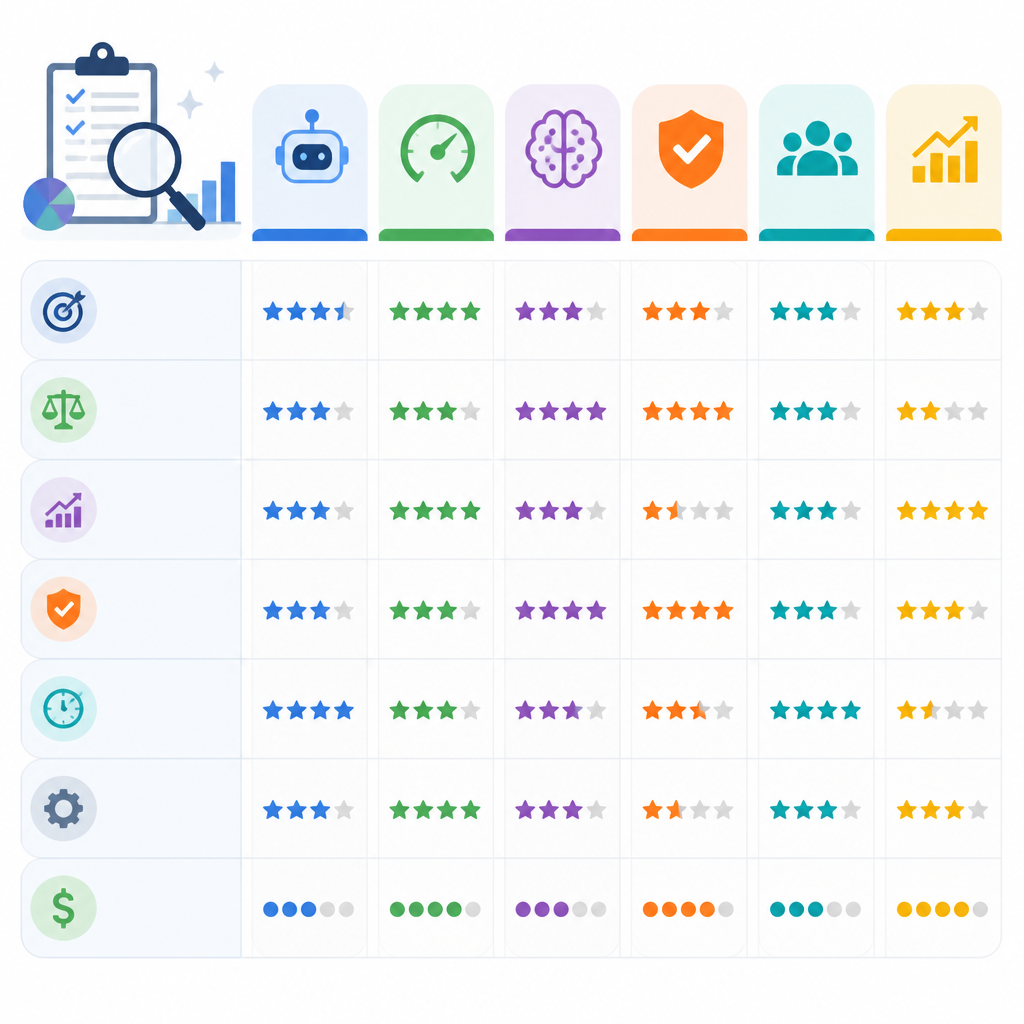
For fast-moving product teams, the big differentiator is whether the tool can turn real usage into a repeatable test system. That is where the combination of traces, datasets, and scoring matters. If you are only running isolated prompt tests, you miss the regressions that show up after deployment.
Here is the practical split the article implies:
- Braintrust fits teams that want one system for experimentation, evaluation, and monitoring.
- OpenAI is often part of the judge layer, not the full workflow.
- Anthropic is another common judge model for subjective scoring.
- LangChain matters when teams want framework compatibility.
The article’s comparison logic is refreshingly opinionated: if your team is already juggling prompts, traces, and production monitoring, a tool that only covers one slice will slow you down. If you are still early, a lighter setup may be enough.
That is also why the article keeps coming back to dataset management. Good evals depend on good examples, and the best examples usually come from real failures in production. A tool that makes it hard to capture those cases will age badly once traffic grows.
The real test is whether teams keep using it
Braintrust’s article is strongest when it talks about adoption, not features. A prompt evaluation platform is only useful if engineers and PMs keep using it after the first week. That means the setup has to be quick, the results have to be readable, and the workflow has to match how people already work.
The article’s own criteria make that clear: evaluation depth, playground quality, collaboration, integrations, dataset management, monitoring, and developer experience. Those are the things that decide whether a tool becomes part of the process or just another tab in the browser.
My read is that Braintrust is betting on a simple truth: the teams that win with AI will treat prompt quality like software quality, with the same habit of testing, review, and rollback. The tools that survive 2026 will be the ones that make that habit easy enough to keep.
If you are choosing a prompt evaluation stack now, the first question is not “which tool has the most features?” It is “which tool will still be in use after the third prompt regression?”
That is the question Braintrust is really answering, and it is the right one.
// Related Articles
- [TOOLS]
AWS Continuum turns AI coding into safer fixes
- [TOOLS]
Open-Generative-AI turns GitHub into a studio
- [TOOLS]
Why benchmark scores don’t predict your bill
- [TOOLS]
MCP Servers for Developers: 8 workflow gains in 2026
- [TOOLS]
Doubao turns a game prompt into a mini arcade
- [TOOLS]
Coding Plan turns Alibaba Cloud into IDE billing