Blackwell wins because agentic AI needs full-stack infrastructure
NVIDIA Blackwell is the right infrastructure bet for agentic AI because it delivers the best measured efficiency at scale.

NVIDIA Blackwell is the right infrastructure bet for agentic AI because it delivers the best measured efficiency at scale.
NVIDIA’s Blackwell Ultra NVL72 is not just faster on a new benchmark; it is the first platform shown to translate agentic AI workload demands into a measurable infrastructure advantage, with up to 20x more agents per megawatt than Hopper in Artificial Analysis’ AgentPerf results.
Agentic AI punishes weak infrastructure
Get the latest AI news in your inbox
Weekly picks of model releases, tools, and deep dives — no spam, unsubscribe anytime.
No spam. Unsubscribe at any time.
Agentic systems are not single-shot chatbots. They chain together many model calls, tool calls, file reads, code edits, and retries, which means latency compounds across the whole task. A system that looks strong on one inference request can fall apart when an agent has to keep context alive through dozens of steps.

That is why the benchmark matters. AgentPerf is built from real coding agent trajectories across 12+ programming languages, so it measures something closer to production than legacy inference tests do. If a platform can support more concurrent agentic tasks while hitting response and token-rate thresholds, it is doing more useful work, not just producing prettier throughput charts.
Blackwell’s advantage is architectural, not cosmetic
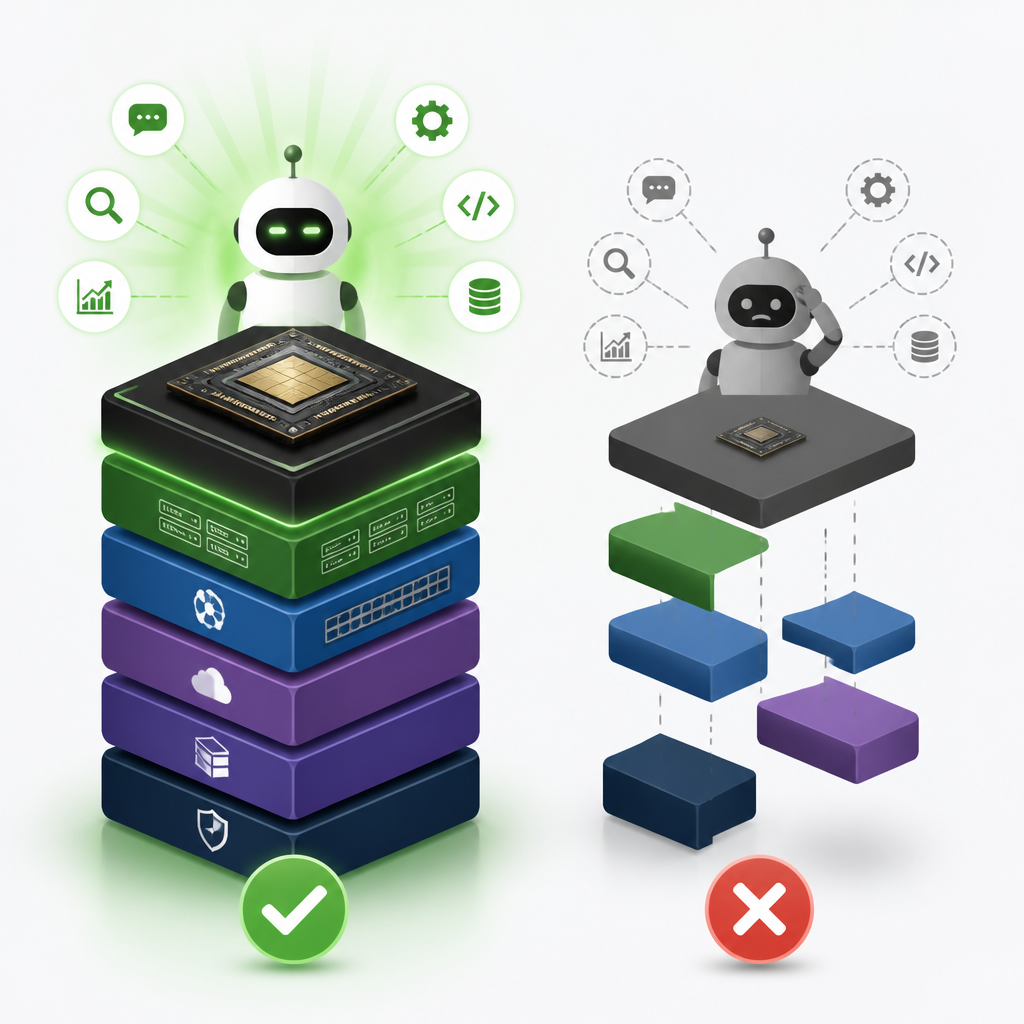
The headline number, up to 20x more agents per megawatt than Hopper on GB300 NVL72, is not a marketing flourish. It reflects rack-scale design, where 72 GPUs are tied into one system so large MoE models like DeepSeek V4 Pro can spread execution efficiently. In agentic workloads, that kind of integration matters more than isolated chip specs.
The software stack reinforces the hardware. CUDA kernels overlap communication and compute, while TensorRT LLM separates input processing from output generation so each stage can be tuned independently. That is the real point of Blackwell’s lead: the platform reduces the coordination tax that agentic workloads impose, so more of the power budget goes to actual work.
Energy efficiency is the real buying criterion
For enterprises, the benchmark’s power framing is the most important part of the story. Agents are not bought one at a time; they are deployed in fleets, and fleet economics are governed by cost per task, concurrency per rack, and productivity per watt. A system that supports more agents per megawatt directly lowers the cost of scaling an AI workforce.
The article’s examples make that concrete. Together AI is already serving Cursor on Blackwell, and DeepInfra is powering Pam.ai on Blackwell for dealership workflows like booking service appointments and handling outbound sales. Those are not lab demos. They are production workloads where infrastructure efficiency determines whether agentic AI is viable at all.
The counter-argument
The strongest objection is that NVIDIA is grading its own homework. AgentPerf is new, the published results cover one model class, and the benchmark simulates tool calls rather than executing them. Skeptics will also point out that real-world deployments depend on software quality, orchestration, network topology, and model choice, not just accelerator design.
That criticism is fair, but it does not erase the result. A benchmark does not need to model every production variable to be useful; it needs to isolate a real bottleneck. Agentic AI workloads are already defined by long chains of inference and coordination, and the benchmark’s design captures that stress far better than single-request inference tests ever did.
The limit is simple: AgentPerf is an early signal, not a universal verdict. But as a signal, it is strong enough to change procurement logic. If a platform leads on agent concurrency per watt under realistic coding trajectories, buyers should treat that as the baseline for evaluation, then validate their own stack on top of it.
What to do with this
If you are an engineer, stop optimizing agent systems as if they were chat endpoints and start measuring end-to-end task completion, concurrency, and watts per successful workflow. If you are a PM or founder, ask vendors for agentic benchmarks, not generic inference charts, and make infrastructure decisions around productive work per dollar and per watt. Blackwell’s lead shows that in agentic AI, full-stack efficiency is the product.
// Related Articles
- [RSCH]
Kimi K3 Is Already Doing Its Own Job
- [RSCH]
Private mode finding for regression and clustering
- [RSCH]
ExtractBench benchmarks schema-guided document extraction
- [RSCH]
TokTier cuts tokenization overhead for agentic LLMs
- [RSCH]
Systema turns AIVC scores into a harder test
- [RSCH]
Stablecoin remittances hit 9% in Bank of Italy test