Cloudflare’s 487-partner ecosystem on Partnerbase
Partnerbase tracks 487 Cloudflare partnerships, including Google, Microsoft, Oracle, Shopify, and VMware.

Partnerbase tracks 487 Cloudflare partnerships across technology and channel deals.
Cloudflare shows up on Partnerbase with 487 tracked partners, and that number tells you something simple: its product now plugs into a wide web of other vendors, resellers, and platform partners. The directory also names Cloudflare alongside companies like Google Cloud, Microsoft, Oracle, Shopify, and VMware.
That matters because partner pages are often a better signal than press releases. They show where a company is trying to sell, integrate, or co-market, and they hint at the operating model behind the product. In Cloudflare’s case, the list mixes giant platform vendors with smaller integration and services firms, which suggests a business that sells both to builders and through the channel.
| Metric | Value | What it suggests |
|---|---|---|
| Tracked partners | 487 | Cloudflare has a broad partner footprint |
| Google Cloud | Technology partner | Cloud and infrastructure adjacency |
| Microsoft | Technology partner | Enterprise distribution potential |
| Shopify | Technology partner | Commerce and web stack integration |
| VMware | Channel partner | Indirect sales and services motion |
What the 487-partner count says
Get the latest AI news in your inbox
Weekly picks of model releases, tools, and deep dives — no spam, unsubscribe anytime.
No spam. Unsubscribe at any time.
Partnerbase’s count is not a vanity metric. Once a company gets into the hundreds of partners, the ecosystem becomes part of the product story. Cloudflare’s list includes infrastructure names, security vendors, SaaS platforms, and services firms, so the company is not relying on a single route to market.

The mix also hints at how Cloudflare is positioned. It is not just a CDN or security vendor anymore. It touches identity, observability, cloud infrastructure, commerce, and developer tooling, which is exactly the kind of spread you would expect from a company trying to sit in the middle of modern web operations.
- 487 total partners are tracked on the page.
- Partner types include technology and channel relationships.
- The list includes enterprise vendors like IBM, Okta, and Datadog.
- Smaller firms such as Modus Create and Knack show services and integration depth.
For developers, that breadth matters because it usually translates into more integrations, more documented workflows, and fewer dead ends when you are stitching tools together. For buyers, it often means a vendor has enough market pull that other companies are willing to build around it.
The biggest names in the list
The top of the directory reads like a who’s who of enterprise software. Google, Microsoft, Oracle, and IBM all appear, which gives the page immediate credibility as a map of real business relationships rather than a marketing badge wall.
There is a practical angle here too. When a company like Cloudflare shows partner ties with cloud, security, and SaaS vendors, it becomes easier to sell into accounts that already use those tools. That is the value of ecosystem density: it lowers friction in procurement, integration, and deployment.
“The value of the network is proportional to the square of the number of its users.” — Robert Metcalfe
Metcalfe’s idea is old, but it still explains why partner directories matter. A company with 487 partners is not just collecting logos; it is building more paths for distribution and more reasons for other teams to care about its platform.
Technology partners versus channel partners
Partnerbase splits Cloudflare relationships into technology and channel categories, and that distinction is useful. Technology partners usually point to integrations, compatibility, or shared workflows. Channel partners point to resellers, service providers, and firms that help move the product into customer accounts.
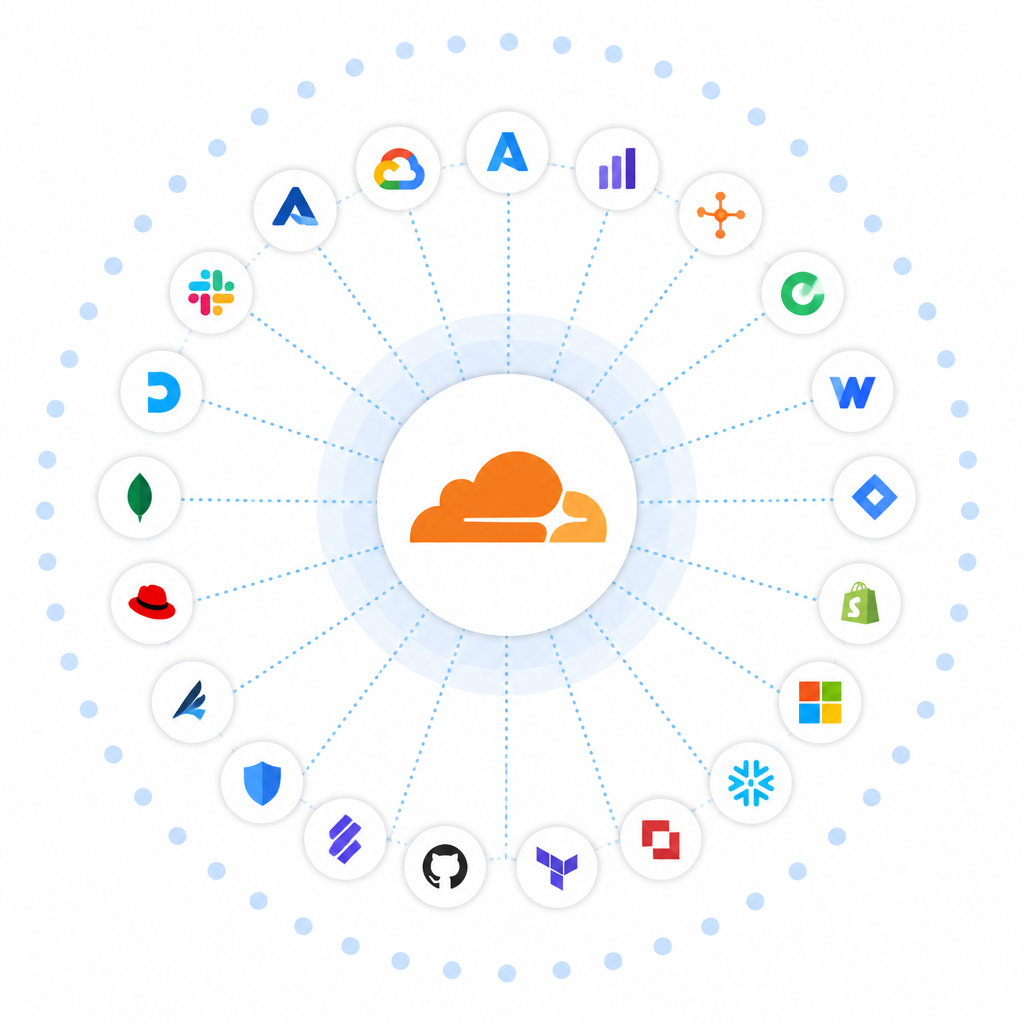
Cloudflare’s list includes both. On the technology side, you see names like Splunk, PagerDuty, Elastic, and HashiCorp. On the channel side, the page includes firms such as Wipro, TD SYNNEX, and Accenture.
- Technology partners point to product compatibility and integrations.
- Channel partners point to sales, implementation, and services support.
- Enterprise firms like Wipro and Accenture help Cloudflare reach large accounts.
- Developer and ops tools like HashiCorp and PagerDuty make the stack stickier.
That split is also a clue about Cloudflare’s go-to-market maturity. Purely product-led companies often have thin partner lists. Mature infrastructure vendors usually do not. Once a platform becomes part of the stack, the partner graph becomes part of how it sells.
How to read Partnerbase without overreading it
Partnerbase is useful, but it is still a directory, not a contract database. A listed partnership can mean a formal alliance, a reseller relationship, a technical integration, or simply a public association tracked by the site. The page itself even invites users to flag incorrect data, which is a reminder that this is a living dataset.
Still, the signal is strong enough to be useful. If you are evaluating Cloudflare, the page tells you it has broad external reach. If you are a founder building around Cloudflare, it suggests there is room to plug into an existing ecosystem instead of trying to sell in isolation.
- Partnerbase lets users report incorrect or missing data.
- The site also promotes Trace for company tracking and saved lists.
- Cloudflare’s ecosystem includes both large enterprises and smaller specialists.
- The page is useful for sales teams, analysts, and product teams doing market mapping.
If Cloudflare keeps expanding the way it sits between security, networking, and developer tooling, the next question is not whether its partner count grows. The real question is which partner category grows fastest: integrations, resellers, or strategic cloud alliances.
For now, the 487-partner figure says enough on its own. Cloudflare is no longer just a point product with a few integrations around the edges; it is a platform other companies are building around, selling with, and connecting to in public.
// Related Articles
- [IND]
Cloudflare’s OpenAI pilot is a smart bet on fresher search
- [IND]
Anthropic’s access cut shows speech limits in AI
- [IND]
GPT 5.6 becomes Microsoft 365 Copilot’s preferred model
- [IND]
WebX 2026 turns speaker hype into a conference brief
- [IND]
AI Weekly: 2026-07-06 ~ 2026-07-13
- [IND]
The AI Act should be treated as Europe’s operating system for AI