Cloudflare’s OpenAI pilot is a smart bet on fresher search
Cloudflare should use its network signals to make AI search fresher and more accurate.

20% of the web sits behind Cloudflare, and that scale can make AI search fresher.
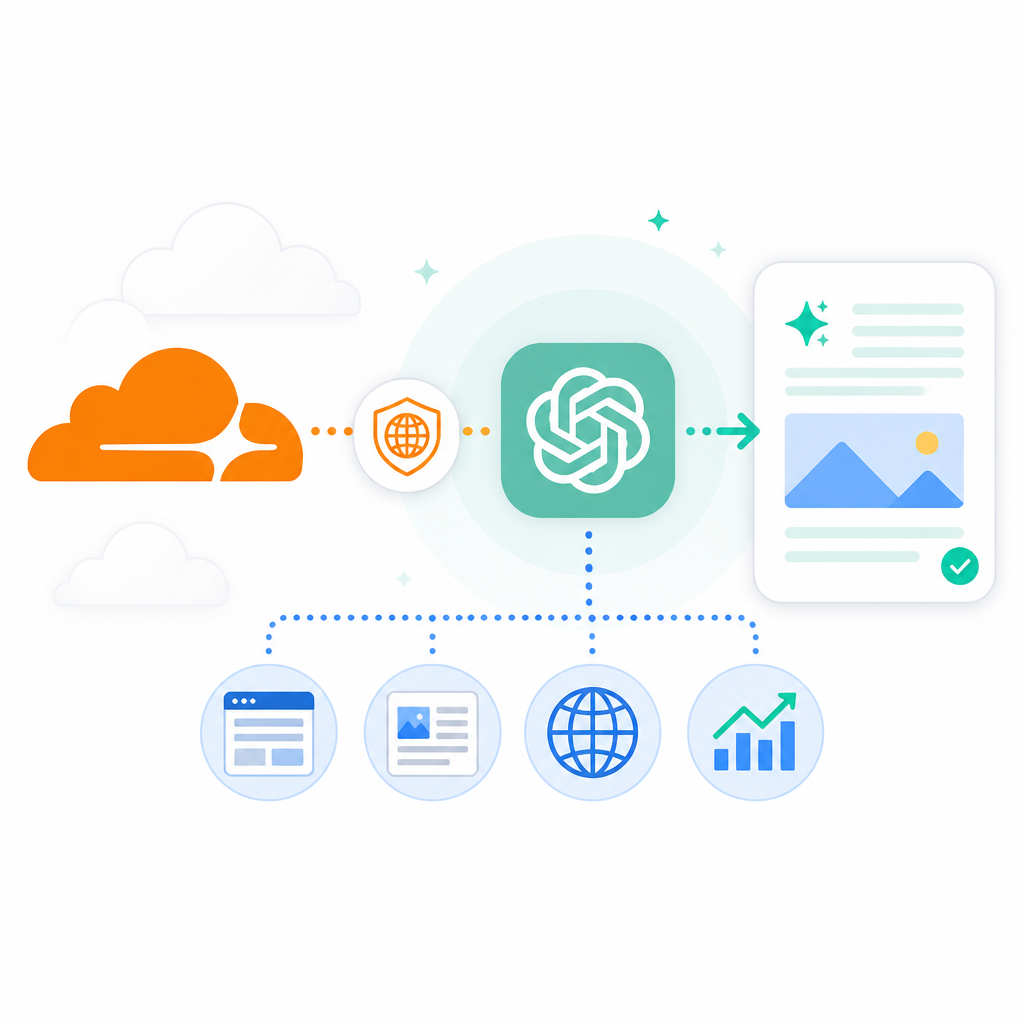
Cloudflare is right to bet that its network telemetry can improve AI search, because freshness and crawl efficiency are now the bottleneck, not raw model size. The company says more than 20% of the web sits behind its network, which means it sees content changes, traffic patterns, and delivery behavior at a scale search systems rarely get. Pair that with OpenAI’s frontier search stack and the pilot is not a vanity partnership; it is an attempt to solve a real indexing problem with a real distribution advantage.
Cloudflare has the one signal set AI search lacks
Get the latest AI news in your inbox
Weekly picks of model releases, tools, and deep dives — no spam, unsubscribe anytime.
No spam. Unsubscribe at any time.
Traditional crawlers work from the outside in. They fetch pages, infer change from repeated visits, and rely on heuristics that are often stale by the time an answer is generated. Cloudflare sits in the path of requests and content delivery, so it can observe freshness, traffic quality, and actual page changes in real time. That is a fundamentally better input for deciding what to crawl next and what to refresh first.

The practical value is obvious in fast-moving domains like news, ecommerce, and documentation. If a pricing page changes at noon, a crawler that discovers it hours later is already behind. If network-level signals can tell an AI search engine that a page is hot, changed, and worth revisiting, the system wastes fewer fetches and returns fewer outdated answers. That is not a minor optimization. It is the difference between search that feels current and search that feels broken.
This is also a distribution play, not just research
Cloudflare’s advantage is not only technical. It already sits in front of millions of sites, and that gives it a natural path to become part of the web’s discovery layer. A research pilot with OpenAI lets Cloudflare position itself as infrastructure for AI search rather than a passive content delivery vendor. In a market where every major platform wants a say in how content gets surfaced, that is a strategic move with long-term leverage.
OpenAI benefits for the same reason. Search quality depends on recency, relevance, and crawl efficiency, and those are expensive to improve at web scale. If Cloudflare can provide cleaner signals about what changed and where attention is shifting, OpenAI can spend less compute on blind crawling and more on answering well. That matters because AI search users do not care how elegant the backend is. They care whether the answer reflects what is true right now.
The counter-argument
The strongest objection is that this concentrates too much discovery power in two private companies. If Cloudflare becomes a gatekeeper for what AI search sees first, and OpenAI becomes the system that interprets it, the open web risks becoming more dependent on closed infrastructure. There is also a real privacy concern: network-level insight sounds useful until it starts to resemble surveillance, even if the pilot is limited to participating websites.
There is also a technical caution. Better signals do not automatically produce better answers. Crawl prioritization can improve freshness, but it cannot fix bad source material, hallucination, or ranking bias. If the pilot overstates what network telemetry can do, it will invite disappointment. That critique is fair, and it is exactly why this should stay framed as a research pilot rather than a grand redesign of search.
Still, the counter-argument does not beat the case for trying. The web already relies on intermediaries for routing, caching, security, and performance. Cloudflare is not inventing a new dependency; it is exposing a dependency that already exists and using it to reduce stale retrieval. The right standard is not purity. It is whether the system returns better, timelier answers without forcing publishers to do more work. On that measure, the pilot is worth pursuing.
What to do with this
If you are an engineer or product leader, treat this as a signal that AI search will increasingly reward fresh, structured, machine-readable content and fast change detection. Make sure your pages expose clear update semantics, stable metadata, and crawl-friendly architecture. If you are a founder, assume that discovery will shift toward systems that can see change sooner. The companies that win will not just publish content; they will make their content easy for networked AI to trust.
// Related Articles
- [IND]
Cloudflare’s 487-partner ecosystem on Partnerbase
- [IND]
Anthropic’s access cut shows speech limits in AI
- [IND]
GPT 5.6 becomes Microsoft 365 Copilot’s preferred model
- [IND]
WebX 2026 turns speaker hype into a conference brief
- [IND]
AI Weekly: 2026-07-06 ~ 2026-07-13
- [IND]
The AI Act should be treated as Europe’s operating system for AI