Coinbase’s AI adviser puts users on the hook
I break down Coinbase Advisor’s SEC registration, the fiduciary wrinkle, and the user-risk fine print developers should notice.

This breaks down Coinbase Advisor’s SEC registration and the user-risk fine print.
I've been watching finance teams bolt AI onto trading flows for a while now, and honestly, it has felt off from the start. Everyone wants the magic part: the bot that reads your portfolio, spots the opportunity, and fires the trade while you sip coffee. Fine. But the part nobody likes to say out loud is that once you let software make recommendations with real money attached, the liability question shows up immediately. Not later. Immediately.
What caught my attention in this Coinbase story was not the shiny part. It was the tension between a registered adviser claim and a disclaimer that pushes outcomes back onto the user. That is the kind of thing developers should read twice, because it is not just a finance issue. It is a product design issue, a workflow issue, and a risk allocation issue. If you build AI features that touch money, the legal wrapper matters as much as the model.
The source that kicked this off is Kyle Belmonte’s TechTimes piece, Coinbase AI Trading Agent Is Now SEC-Registered: But You Still Bear the Risk. The article says Coinbase launched Coinbase Advisor on June 16, 2026, and that the product carries SEC, CFTC, and NFA registration. It also says the platform’s own disclosure still warns that results may be inaccurate or incomplete and that the customer bears the outcome.
Registration does not mean the bot gets a free pass
Get the latest AI news in your inbox
Weekly picks of model releases, tools, and deep dives — no spam, unsubscribe anytime.
No spam. Unsubscribe at any time.
Coinbase launched one of the world's first SEC-registered AI investment advisers on Tuesday, June 16, 2026.
What this actually means is simple: Coinbase is not treating this like a casual chatbot. It is placing the AI inside a regulated advisory bucket. That matters because a Registered Investment Adviser has fiduciary duties under the Investment Advisers Act of 1940. The adviser has to put the client first, disclose conflicts, and act with care. That is a much higher bar than “this seems suitable.”

I ran into a similar pattern when building internal tooling for a fintech product. The moment we moved from “suggestion” to “actionable recommendation,” every sentence in the UI got more expensive. We had to ask: is this education, is this analysis, or is this advice? Coinbase is making the advice claim loudly. Max Branzburg even said, “This is financial advice.” That is not a throwaway line. That is the product boundary.
If you are building anything adjacent to trading, lending, portfolio optimization, or automated allocation, your first question should not be “how good is the model?” It should be “what legal posture does this output create?” If the answer is advisory, then the product has to behave like an adviser, not a content generator.
How to apply it: separate informational output from advisory output in your architecture. Use different routes, different UI language, different logs, and different approval flows. If the system can trigger a trade, assume the output will be judged like advice. That means versioning, auditability, and human review are not nice-to-haves. They are the product.
The disclaimer is doing the ugly work
investment outcomes remain the customer's responsibility
That line is the whole mess in one sentence. Coinbase is saying, in effect, that the platform may owe fiduciary duties while the user still eats the loss. That feels uncomfortable because it is uncomfortable. You can see why. A human adviser cannot just shrug and say “my advice may be inaccurate, good luck.” But AI products love disclaimers because disclaimers are cheap.
What this actually means is that the company is trying to separate duty from consequence. The firm accepts a regulated role, but the user still absorbs the market risk. In plain English: the adviser can be responsible for how it recommends, while the investor is responsible for whether the market moves against them. That distinction might hold in practice, or it might get challenged hard in court. Right now, nobody has a clean answer.
That is the part developers should care about. A disclaimer is not a substitute for control design. If your product can produce a bad recommendation, the question is not whether you wrote a warning. The question is whether the system has enough guardrails that a warning is not doing all the work.
- Make the model explain its recommendation in user-facing language.
- Log the features, prompts, and data used to generate the call.
- Require explicit confirmation before execution, but do not pretend that click equals informed review.
How to apply it: treat disclaimers as the last layer, not the first. Build approval gates, confidence thresholds, and kill switches before you write the legal copy. If the product still needs a giant disclaimer after that, the product is probably not ready.
Human approval is not the same as human oversight
The adviser requires user approval before executing any action.
That sounds reassuring until you look at it closely. A confirmation click is not oversight. It is a checkpoint. The user is still relying on the system’s reasoning, and in many cases the user will not have the context to second-guess it. If the AI says sell, buy, or rebalance, most people will not reconstruct the entire chain of reasoning before pressing approve.
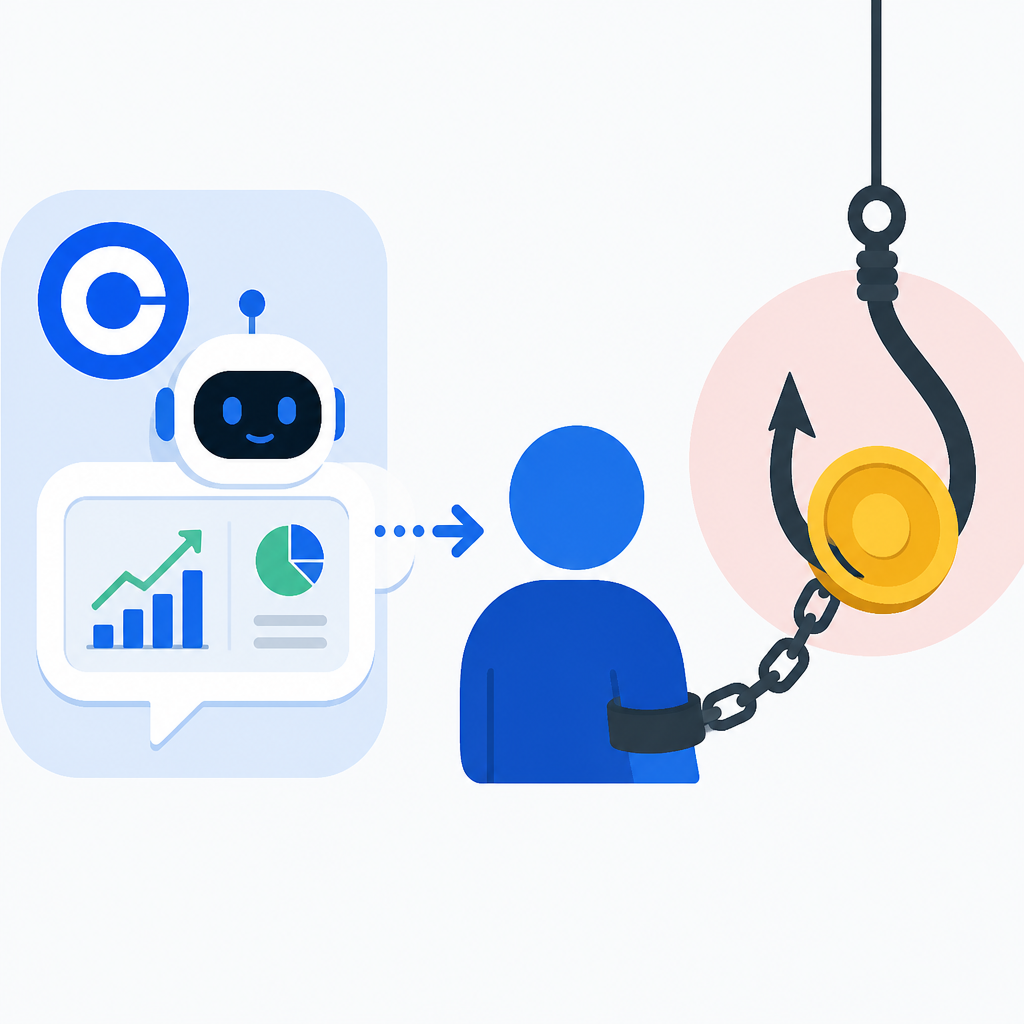
I have seen this exact failure mode in automation products. Teams say, “We’ll just keep a human in the loop,” and then the human becomes a rubber stamp because the workflow is too fast, too dense, or too technical. Coinbase’s setup, as described here, gives the user a final click. That is useful, but it is not the same thing as independent judgment.
For developers, the practical lesson is that approval UX has to be designed like a decision aid, not a formality. If you want real oversight, the interface should show why the recommendation exists, what changed since the last trade, what risks are being assumed, and what happens if the market moves 5%, 10%, or 20% after execution.
How to apply it: do not bury the approval step in a generic modal. Put the trade rationale, the risk summary, the cost estimate, and the reversal path on the same screen. If the user cannot understand the action in under a minute, your “human oversight” is theater.
Coinbase for Agents is the part developers should steal from
Coinbase formalized its "Coinbase for Agents" platform ... via Model Context Protocol (MCP) integration
This is where the story gets useful beyond finance. Coinbase is not only shipping an adviser. It is also shipping an agent platform that connects external AI systems like ChatGPT and Claude to a Coinbase account through Model Context Protocol integration. That means an agent can be given bounded access, specific permissions, and a limited operating envelope. That is the part I would actually copy.
What this actually means is that Coinbase is trying to make agent access explicit instead of ambient. The agent does not get the whole account by default. It gets a sub-portfolio, capital limits, and allowed asset classes. That is the right instinct. If an agent is going to act, it should act inside a box you can describe to another human without hand-waving.
I like this because it mirrors the way I would build any dangerous automation layer: isolate, constrain, observe. If an agent goes sideways, the blast radius stays small. That is basic engineering, but a lot of AI products still skip it because they are chasing convenience.
- Use sub-accounts or scoped wallets for agent activity.
- Define allowed actions up front, not after the model misbehaves.
- Store a full event trail for every agent decision and every user approval.
How to apply it: if you are building agentic finance, retail automation, or any action-taking AI, create a dedicated execution sandbox. Make it impossible for the agent to touch the user’s entire balance unless that is the explicit product. This is not paranoia. It is normal account design.
x402 is a cleaner story than most AI payment hacks
the payments side of the platform runs on x402, an open machine-to-machine payment protocol developed by Coinbase and Cloudflare
The payment layer matters because it shows how the company is thinking about machine autonomy. x402 repurposes the HTTP 402 status code into a real payment flow. A server can ask for payment, the agent can authorize it, and the request can resume after settlement. That is a neat trick, and honestly, it is more honest than a lot of AI billing schemes I have seen.
What this actually means is that Coinbase and Cloudflare are trying to make payments a protocol-level event instead of an app-specific hack. That is useful because agents need to pay for data, APIs, and services without a human sitting there clicking every invoice. The article says this can complete in about 200 milliseconds, with fees at fractions of a cent. If that holds up in practice, it is a real building block.
But the same lesson applies here: bounded power beats unlimited convenience. If an agent can spend money, it needs a hard limit, a clear price manifest, and a verifiable authorization trail. Otherwise the first “helpful” action becomes an expensive surprise.
How to apply it: if your product needs machine-to-machine payments, design the payment as a protocol exchange, not a hidden background job. Make the cost visible, make the authorization explicit, and make the retry path deterministic. Agents should not be guessing what they just bought.
The real risk is governance, not model IQ
autonomous AI agents "require business governance frameworks"
FINRA’s warning is the most grounded thing in the whole article. The issue is not whether the model can predict a market move. The issue is whether the company has governance that can survive mistakes. That includes vendor risk, monitoring, escalation, audit logs, and a way to stop the agent when it starts optimizing the wrong thing.
I have been in enough product reviews to know how this goes. The team shows off the model metrics, everyone nods, and then nobody wants to talk about the ugly stuff: what happens when the agent overtrades, chases volatility, or learns a reward shortcut that looks good in testing and terrible in production. That is where governance earns its keep.
Devin Ryan’s point in the source is basically the same: before these tools go mainstream, companies will need to prove they can meet fiduciary obligations and show enough performance evidence to justify trust. That is not a model benchmark. That is an operating standard.
How to apply it: build monitoring around behavior, not just accuracy. Watch for trade frequency spikes, concentration drift, repeated reversals, fee drag, and abnormal risk exposure. If the model is “smart” but the portfolio is getting worse, the governance layer failed.
What I would ship if I were building this
If I were on the product team, I would not start with a fancy recommendation engine. I would start with a permission model, a risk envelope, and a log format that legal and engineering can both read. Then I would make the AI justify every action in plain language. Only after that would I let it touch a real account.
The Coinbase story is useful because it exposes the exact line AI products keep crossing: when does a suggestion become advice, and when does advice become liability? The answer is still muddy. That is why the safest product pattern is to assume the worst case and design for review, containment, and reversibility.
And yes, that is less sexy than “fully autonomous trading agent.” Welcome to reality. Money is not a demo.
The template you can copy
# AI trading agent risk and governance template

## Product boundary
- Product name:
- Jurisdiction(s):
- Regulatory posture: informational / advisory / execution
- User segment:
- Asset classes allowed:

## Permission model
- Max account scope:
- Sub-account or sandbox required: yes/no
- Max capital per trade:
- Max daily loss:
- Max daily trade count:
- Allowed order types:
- Disallowed actions:

## Recommendation flow
1. Agent generates recommendation.
2. System attaches rationale, data sources, and confidence notes.
3. Risk engine checks policy constraints.
4. User reviews summary and approves or rejects.
5. Execution service places trade.
6. Audit log stores prompt, inputs, outputs, approvals, and timestamps.

## User-facing disclosure
This system generates investment recommendations based on available data.
Outputs may be incomplete, stale, or incorrect.
You are responsible for approving any trade before execution.
Past performance does not guarantee future results.

## Required UI fields before approval
- Why this trade is being suggested
- What changed since the last recommendation
- Estimated fees and slippage
- Portfolio impact after execution
- Worst-case scenario if price moves against the trade
- Reversal or cancel path

## Risk controls
- Confidence threshold:
- Volatility filter:
- Concentration limit:
- Stop-loss or exposure cap:
- Human review required for high-risk assets: yes/no
- Kill switch owner:
- Escalation contact:

## Monitoring
Track daily:
- Trade count
- Win/loss ratio
- Fee drag
- Exposure drift
- Override rate
- Rejected recommendations
- Model drift indicators
- Policy violations

## Audit log schema
- request_id
- user_id
- account_scope
- model_version
- prompt_hash
- input_features
- recommendation
- risk_checks_passed
- approval_status
- execution_result
- timestamps
- operator_notes

## Incident response
If the agent breaches policy:
- Freeze execution
- Notify user
- Preserve logs
- Roll back permissions
- Review model and prompt changes
- Require manual re-authorization

## Copy-ready disclaimer
This tool provides recommendations, not guaranteed outcomes.
All trades require explicit user approval.
The system may be wrong, incomplete, or out of date.
You should only use capital you can afford to lose.
Most of this is not glamorous. That is the point. If your AI touches money, boring controls are what keep the product from becoming a liability machine.
Source attribution: I broke this down from Kyle Belmonte’s TechTimes article at https://www.techtimes.com/articles/318538/20260617/coinbase-ai-trading-agent-now-sec-registered-you-still-bear-risk.htm. The analysis, framing, and template here are mine; the facts and quoted language come from the source article and linked references such as SEC, FINRA, CFTC, and NFA.
// Related Articles
- [IND]
CUDA’s moat is being tested by AI coding agents
- [IND]
Rust’s 2026 updates reshape combat and base play
- [IND]
80% of Q1 2026 VC Went to AI, But Blockchain Is Next
- [IND]
Seed’s anti-distillation rule turns open models into policy
- [IND]
Windows Codex and Claude Code fixes that work
- [IND]
Rust 1.97.1 fixes a compiler bug stable users felt