E3 Helps AI Agents Stop Over-Reading Simple Tasks
E3 teaches LLM agents to estimate task scope first, then expand only when verification fails.

LLM agents used to over-read everything; E3 makes them estimate scope first and expand only when needed.
- Research org: Unspecified in arXiv abstract
- Core data: 85% cost reduction on MSE-Bench
- Breakthrough: Estimate, execute a minimum path, then expand only after failed verification
Most agent systems still behave like a cautious but inefficient junior engineer: they keep reopening files, re-checking dependencies, and widening context even when the task is obviously small. This paper argues that the missing skill is not just better reasoning, but better judgment about how much reasoning a task actually deserves.
For developers, that matters because agent cost is not only about model tokens. It also shows up as extra file reads, unnecessary retrieval, slower edits, and more time spent auditing code the agent has already seen. The paper’s core idea is simple: a good agent should know when to stay narrow, and when to widen its search.
What problem this paper is trying to fix
Get the latest AI news in your inbox
Weekly picks of model releases, tools, and deep dives — no spam, unsubscribe anytime.
No spam. Unsubscribe at any time.
The authors focus on a common failure mode in LLM agents: maximum-context-first execution. Instead of starting with the smallest reliable plan, agents often pull in too much context too early. In practical terms, a one-line code change can turn into a mini codebase survey, even when the task only needs a local edit and a quick check.

The paper frames this as a missing capability: task-aware execution-scope estimation. Before committing compute and tool calls, the agent should judge three things: how hard the task is, what information it truly needs, and what the shortest reliable path looks like. That is a different problem from simply retrieving more or thinking longer.
To make that idea measurable, the authors formalize two concepts: minimum-sufficient execution and the Agent Cognitive Redundancy Ratio, or ACRR. The abstract does not give a full formula here, but the naming makes the goal clear: measure how much extra work an agent does beyond what the task actually requires.
How E3 works in plain English
The proposed method is called E3, short for Estimate, Execute, Expand. It is a three-stage policy for agent behavior. First, the agent estimates an initial operating point. Second, it executes a minimum viable path. Third, it expands scope only if verification fails.
That sequencing is the key shift. Traditional agents often expand first and justify later. E3 flips that default by making narrow execution the starting point, not the fallback. If the task can be solved with a small amount of context and a clean patch, the agent should stop there.
In engineering terms, E3 is trying to turn agent planning into a budgeted process. The agent does not assume every task deserves a full audit. It starts with the cheapest path that still has a reasonable chance of success, then pays for more context only when evidence says the smaller plan was not enough.
This is also why the paper emphasizes verification. The method is not “be lazy”; it is “be minimal until the checks fail.” That makes the approach more practical than a simple heuristic to read fewer files, because it still leaves room for expansion when the task genuinely needs it.
What the paper actually shows
The main benchmark is MSE-Bench, a deterministic benchmark of 121 edits in a capability-controlled simulator. On that setup, E3 matches the strongest baseline’s 100% success rate while cutting cost by 85%, tokens by 91%, and inspected files by 92%. It also beats a strong adaptive retrieval baseline by 16%.
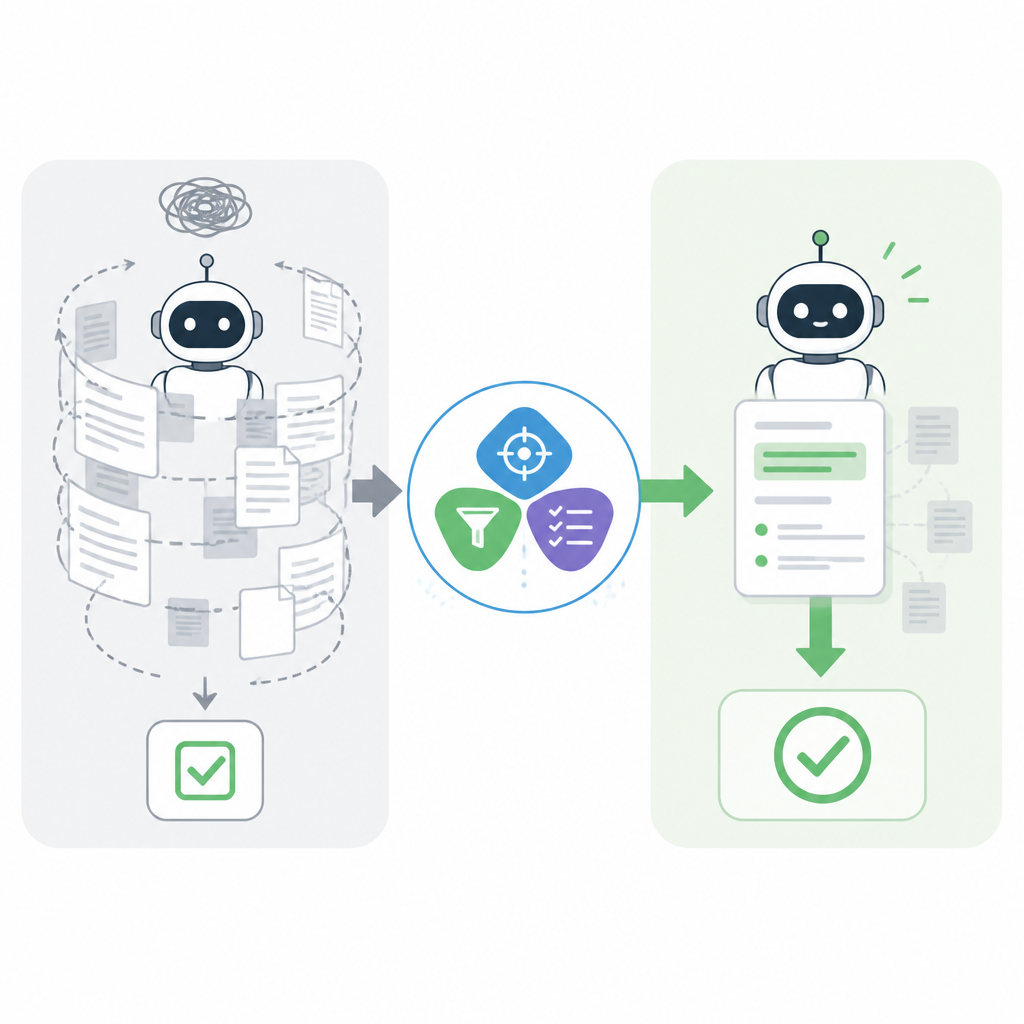
Those are large efficiency gains, and the paper says they hold under held-out instruction wording and essentially every cost weighting. That matters because it suggests the result is not just a quirk of one prompt or one scoring rule. The model is not merely learning a benchmark-specific trick; it is learning to avoid redundant work.
The paper also includes a companion real-model harness called LLM-Case. This uses a live gpt-4o agent editing a real open-source library, and each candidate patch is graded by actually running the project’s real pytest suite against a measured oracle. In that setting, the over-reading is described as milder but still real, and E3 is the leanest and fastest policy at comparable task success.
There is one caveat in that real-model setup: the paper says E3’s one shortfall was a provider rate-limit, not a wrong edit. That is important because it suggests the method’s weakness was operational, not algorithmic, at least in the case described.
The abstract does not provide broader benchmark numbers beyond these results, so there is no evidence here about how E3 behaves across many unrelated coding tasks, different model families, or non-engineering workflows. What we do have is a controlled probe of execution redundancy, plus a real-library validation that points in the same direction.
Why developers should care
If you are building AI coding tools, retrieval agents, or workflow automation, this paper is a reminder that “more context” is not always better. Extra reads cost latency and money, and they can also create noise that makes the agent less focused. A system that can estimate task scope up front may be cheaper without giving up success rate.
That has direct implications for agent architecture. Today’s default stack often assumes retrieval, chain-of-thought style expansion, or repeated inspection is the safe path. E3 suggests a different default: start with a bounded plan, then expand only when the evidence demands it. That could reduce unnecessary tool calls and make agent behavior more predictable.
There is also a product angle. If you are shipping an agent that edits code, runs tests, or navigates repositories, users will notice when it keeps reopening the same files. A complexity-aware policy could make the system feel faster and more competent, especially on simple tasks where overthinking is the main failure mode.
What is still open
The paper is careful to frame this as a controlled probe of execution redundancy, not a measurement of any deployed agent. That is the right level of caution. It means the result is promising, but it is not yet a blanket claim that all agents should adopt E3 unchanged.
There are still open questions about how well task-aware execution transfers to messier real-world settings: ambiguous requirements, partial tests, flaky environments, and tasks where the “minimum sufficient” path is hard to know in advance. The abstract also does not spell out the exact implementation details of ACRR or the decision rule behind the estimate stage, so readers should treat the paper as a framework plus evidence, not a drop-in recipe.
Even with those limits, the direction is useful. The paper pushes agent design toward engineering-grounded AI: systems whose effort is matched to the actual task, not to a blanket habit of consuming more context. For developers, that is a practical target, because efficiency is not just a cost issue; it is part of whether an agent feels reliable enough to trust.
Bottom line
E3 is a simple but pointed idea: make agents judge task complexity before they spend compute. On the evidence in this paper, that shift can preserve success while dramatically reducing redundant work, especially on small code edits and similar workflow tasks.
For teams building agentic tools, the takeaway is not just “save tokens.” It is to design agents that can recognize when a task is simple enough to solve with a minimal path, and when they truly need to widen the search.
- Task-aware execution is the paper’s main contribution, not a new model.
- E3 starts narrow and expands only after verification fails.
- The strongest results are efficiency gains without losing success on the reported benchmarks.
// Related Articles
- [RSCH]
Claude's J-space is not consciousness, but it matters
- [RSCH]
TerraZero trains driving agents with no demos
- [RSCH]
The Seriality Gap in Video Diffusion Models
- [RSCH]
Anthropic’s J-space is useful, but not the breakthrough people want
- [RSCH]
A low-dimensional theory for Transformer reasoning
- [RSCH]
Metacognition in LLMs: what the field knows