TerraZero trains driving agents with no demos
TerraZero is a procedural driving simulator that trains autonomous driving agents from scratch with self-play and no human demonstrations.

TerraZero trains autonomous driving agents from scratch with self-play and no human demonstrations.
- Research org: Unspecified in arXiv abstract
- Core data: 1.3M agent-steps per second
- Breakthrough: CPU simulation with GPU inference over a zero-copy path
How do you train a driving policy that is fast, realistic, and broad enough to cover rare safety cases without relying on human demonstrations?
That is the gap TerraZero is trying to close. The paper describes a procedural driving simulator and self-play training stack built for reinforcement learning at scale, with the goal of making training efficient enough for large runs while still keeping enough structure from real maps to matter for autonomous driving.
For engineers, the interesting part is not just that it is another simulator. It is the combination of simulation throughput, map grounding, and scenario diversity in one pipeline. The authors argue that this matters because logged driving data is dense in routine behavior but sparse in the long tail, which is exactly where safety problems tend to show up.
What problem TerraZero is trying to fix
Get the latest AI news in your inbox
Weekly picks of model releases, tools, and deep dives — no spam, unsubscribe anytime.
No spam. Unsubscribe at any time.
Training autonomous driving agents is a balancing act. If the simulator is too slow, reinforcement learning becomes expensive and awkward to scale. If it is too simplified, the policy may learn behavior that does not transfer well to real roads. If it only reproduces logged scenes, it can miss the long-tail situations that are most important for safety.
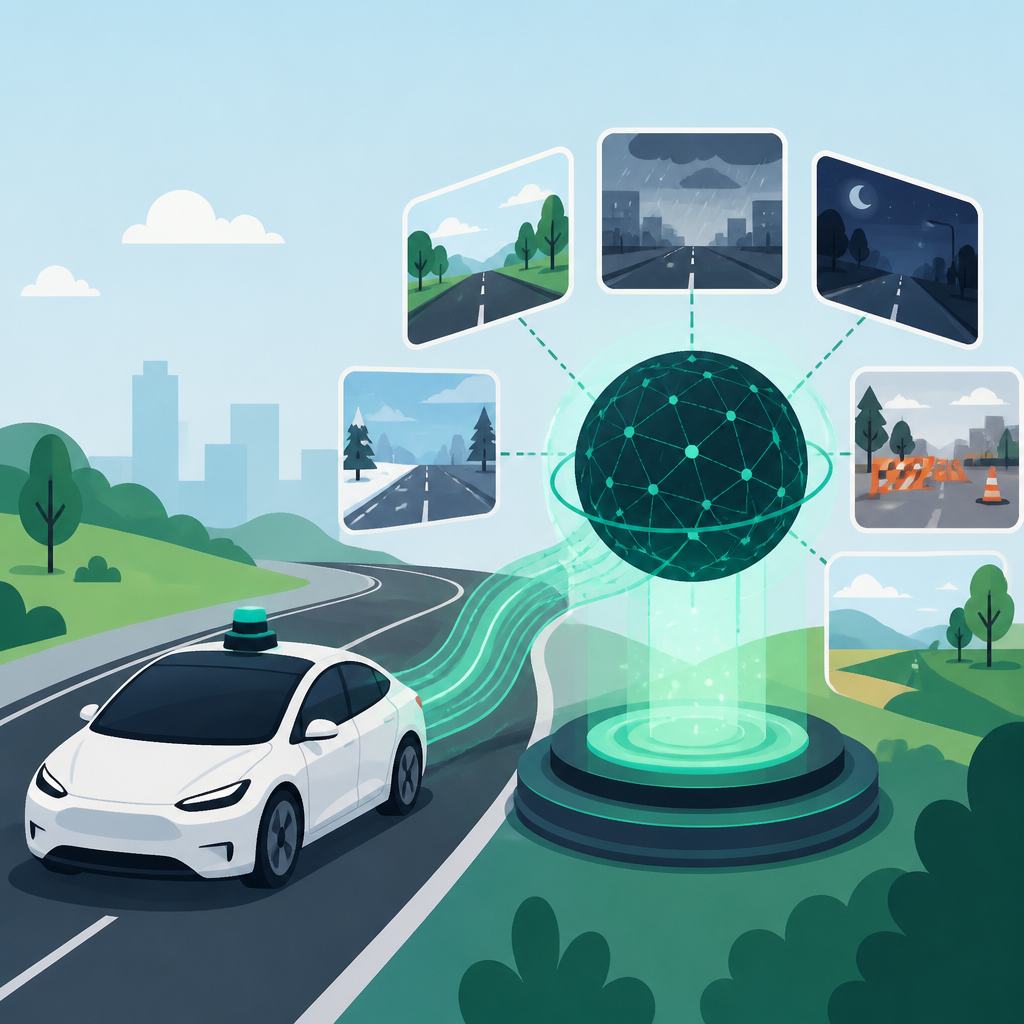
TerraZero is built around that three-way tension. The paper says existing object-level simulators are slower, while lighter single-agent systems leave out heterogeneous agents, multiple dynamics models, and full traffic-rule enforcement. In other words, the usual tradeoff is speed versus fidelity versus diversity, and TerraZero is meant to push on all three at once.
The simulator also takes a specific stance on data. Instead of treating logged driving data as a full training set, TerraZero uses it as a source of real-world map geometry. That lets the system rebuild a map and then fill it with randomized road users and controllers, rather than replaying only what was recorded.
How the method works in plain English
At the core of TerraZero is a configurable C engine. Simulation runs on the CPU, policy inference runs on the GPU, and the two communicate through a zero-copy path. The paper says this setup reaches 1.3M agent-steps per second on a single server-grade GPU.
That throughput is the enabling detail. When a training loop can step that fast, reinforcement learning becomes much more practical for large-scale experimentation. The paper frames TerraZero as a stack for self-play, not just a static environment, so the agent can learn by interacting with the simulator rather than imitating a fixed dataset.
Another important design choice is randomization. TerraZero randomizes agent dynamics, rewards, and sizes per episode. It also populates each map with randomized rule-based road users and signal controllers. The result is that one map can produce an unbounded set of scenarios, which is the paper’s answer to the long-tail coverage problem.
The paper also emphasizes that the same stack can serve two roles. It can train driving policies across dynamics for cars and trucks, and it can also act as a sim-agent system that jointly controls vehicles, pedestrians, and cyclists. That makes it more flexible than a narrow ego-vehicle-only setup.
What the paper actually shows
The most concrete system number in the abstract is the throughput figure: 1.3M agent-steps per second on a single server-grade GPU. The authors say this is far faster than existing object-level simulators. The abstract does not provide the detailed comparison table, so that speed claim should be read as a directional statement from the paper rather than a full benchmark breakdown here.
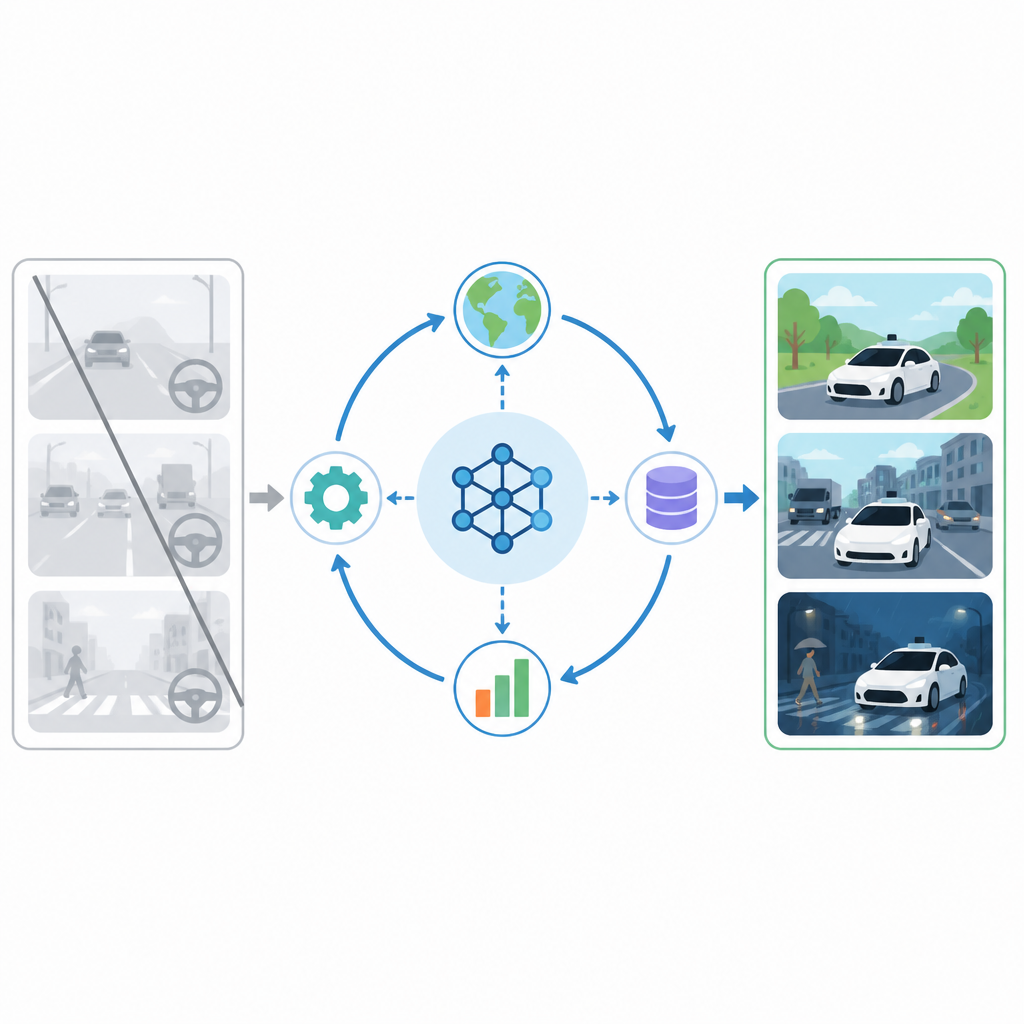
On the learning side, the paper says every reported policy trains from scratch with reinforcement learning alone. There are no human demonstrations and no fallback planner at inference. That is a strong claim because it removes two common crutches in driving systems: imitation learning from expert logs and hand-engineered safety or control fallback logic.
According to the abstract, the trained policies generalize zero-shot across cities and datasets, including emergent left-hand-traffic driving without explicit supervision. That is a useful signal for anyone building policies that need to move between regions or map styles without retraining on every new city.
The reported evaluation results are also specific. As an ego policy, TerraZero is described as the first fully learned policy to top the InterPlan long-tail benchmark, ahead of larger learned planners. On routine-driving val14, it ranks among the best approaches and is described as the safest, with the best collision and time-to-collision scores. On Waymo Open Sim Agents realism, the same recipe outperforms other demonstration-free methods and is competitive with the strongest reference-anchored self-play method.
There are no exact benchmark numbers in the abstract for those leaderboard claims, so the paper summary gives relative placement rather than full scores. That means the abstract supports the direction of the result, but not a detailed numeric comparison.
Why developers should care
If you work on autonomy, simulation, or RL infrastructure, TerraZero is interesting because it shows a path to training without depending on human demos. That matters when demonstrations are expensive, incomplete, or biased toward common behavior rather than edge cases.
The procedural map-plus-randomization approach is also practical. Instead of needing a unique recorded dataset for every scenario class, TerraZero tries to expand one map into many episodes by varying traffic participants, controllers, dynamics, rewards, and sizes. That is a useful pattern for teams trying to cover rare but important cases without exploding data collection costs.
The zero-copy CPU/GPU setup is another engineering lesson. High-throughput RL systems often bottleneck on data movement as much as on model compute. TerraZero’s architecture is a reminder that simulator design and training design are tightly coupled; if you want scale, you need to think about the memory path as much as the policy network.
Limits and open questions
The abstract is strong on system design and headline results, but it leaves some important details open. It does not give full benchmark tables, ablation results, or the exact setup behind the 1.3M agent-steps-per-second measurement. It also does not explain how much each design choice contributes individually, such as the zero-copy path versus the procedural randomization.
There is also a broader question about realism. TerraZero keeps fidelity by retaining heterogeneous agents, multiple dynamics models, and traffic-rule enforcement, but the abstract still describes a procedural simulator rather than a full real-world replay system. For practitioners, that means the interesting question is not whether it is realistic in an absolute sense, but whether it is realistic enough for the tasks it targets.
Finally, the paper’s zero-demonstration claim is compelling, but it also raises the bar. Training only with reinforcement learning can be powerful if the reward and environment are well designed, but it can also be brittle if those pieces are not. The abstract does not spell out reward shaping details, so readers should treat the method as promising but still worth scrutinizing in the full paper.
Even with those caveats, TerraZero points to a clear direction: a driving stack that uses real maps, procedural traffic, and fast self-play to train policies that can generalize beyond the data they were never shown.
- Fast RL simulators are becoming a core autonomy infrastructure problem, not just a research detail.
- Procedural map grounding can expand one dataset into many scenarios without replaying logs verbatim.
- Zero-demo self-play is attractive, but it depends heavily on reward design and simulator fidelity.
// Related Articles
- [RSCH]
Claude's J-space is not consciousness, but it matters
- [RSCH]
The Seriality Gap in Video Diffusion Models
- [RSCH]
E3 Helps AI Agents Stop Over-Reading Simple Tasks
- [RSCH]
Anthropic’s J-space is useful, but not the breakthrough people want
- [RSCH]
A low-dimensional theory for Transformer reasoning
- [RSCH]
Metacognition in LLMs: what the field knows