Fable 5 ban exposed a model-routing race
Anthropic blocked Fable 5, and four open models answered before access was restored.

Anthropic’s Fable 5 ban exposed how quickly open models can replace a blocked provider.
Anthropic briefly cut off access to its Claude-based Fable 5 setup, and four open models responded before access came back. That tiny window matters because it shows how fast agent systems can fail over when one model disappears.
| Item | Detail |
|---|---|
| Blocked model | Fable 5 |
| Open models that responded | 4 |
| Vendor | Anthropic |
| Story date | Jun 18, 2026 |
What the ban actually showed
Get the latest AI news in your inbox
Weekly picks of model releases, tools, and deep dives — no spam, unsubscribe anytime.
No spam. Unsubscribe at any time.
The interesting part of this story is not the ban itself. It is the speed of the response. Once Anthropic restored access, the open models had already shown that model availability is a routing problem, not a static vendor choice.

That matters for anyone building AI agents, especially systems that depend on one model for planning, code execution, or tool calls. If the primary model disappears, the fallback path has to be ready before the outage, not after it.
This is also why the WebAssembly angle in the source piece is worth taking seriously. If agent runtimes can execute model-adjacent logic in a constrained, portable environment, then the security blast radius drops. The question is no longer whether an agent can call a model. It is whether the whole pipeline can keep working when that model is blocked, slow, or misbehaving.
- 4 open models answered during the access gap.
- The interruption was short enough to expose automatic fallback behavior.
- The story ties model availability to runtime security, not just inference quality.
Why WebAssembly keeps coming up in agent security
WebAssembly (Wasm) keeps showing up in security conversations because it gives developers a tighter execution boundary than a typical server process. For AI agents, that boundary matters. Tool execution, plugin code, and untrusted model outputs can all run inside a smaller blast radius.
That does not make Wasm a magic fix. It does make it a practical one. If you are trying to stop an agent from wandering through your filesystem, talking to the wrong API, or executing arbitrary code, execution isolation is the first thing to get right.
“WebAssembly is portable, secure by default, and fast.” — Luke Wagner, Mozilla
That quote is old, but it still maps cleanly onto the problem here. Agent systems need portability because they move across clouds and runtimes. They need security because they touch credentials and internal data. They need speed because nobody wants a safety layer that turns every tool call into molasses.
The Fable 5 incident is a reminder that model selection and runtime security are converging. Teams that treat them as separate decisions will keep getting surprised when one vendor policy, one outage, or one account issue breaks the whole chain.
Open models are becoming the fallback plan
The strongest signal in this story is not that open models exist. It is that they were ready to answer immediately. That makes open-weight systems more than a research curiosity. They are becoming the insurance policy for production AI.
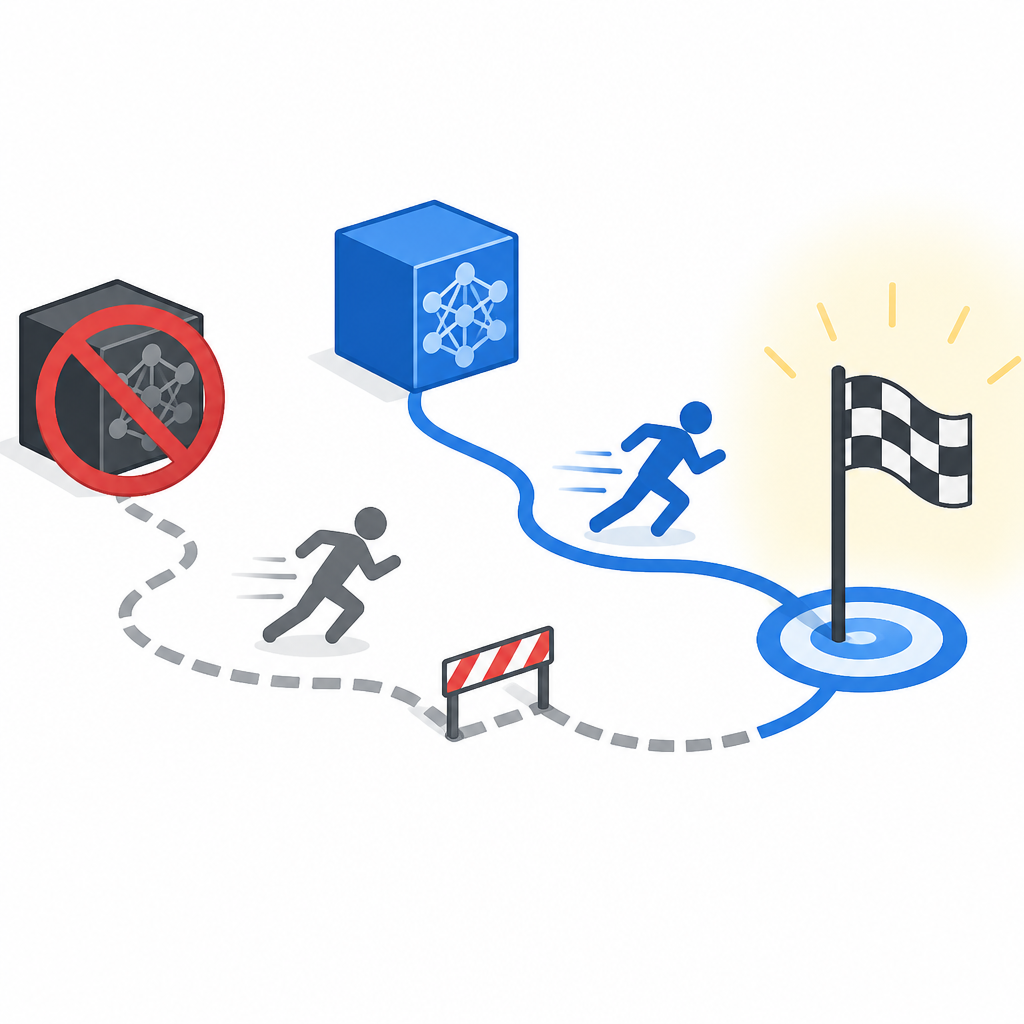
For teams shipping agents, this changes the architecture conversation in a concrete way. You need a primary model, a backup model, and a policy for what happens when both disagree. You also need a way to keep the agent’s tools inside a controlled runtime, because model fallback does nothing if the fallback path can still trigger unsafe behavior.
- Primary model outage risk is now a product issue, not an infrastructure footnote.
- Open models reduce dependency on a single vendor’s access policy.
- Runtime isolation matters even more when you add automatic failover.
There is also a business angle. If your agent stack can swap models without rewriting the surrounding code, you have more negotiating power with vendors and less downtime when a service changes terms. That is a practical reason to care about open models even if your production quality still comes from a proprietary API today.
For now, the lesson is simple: model routing needs the same discipline as traffic routing in distributed systems. If one endpoint disappears, your system should already know where to send the next request.
What builders should do next
If you are building agent infrastructure, the next move is to separate model choice from execution safety. Put model selection behind a policy layer, keep tool execution in a restricted runtime, and test failover before you need it.
That means treating WebAssembly as more than a portability story. It can be part of the control plane for AI agents, especially when those agents need to run untrusted logic or survive vendor interruptions.
The practical takeaway is blunt: assume one model will go missing, and design for it now. The teams that do that will spend less time recovering from access issues and more time shipping agents that keep working when the default path breaks.
If the next few months bring more vendor bans, account suspensions, or policy changes, the winners will be the teams that already built fallback paths and runtime boundaries into their stack.
// Related Articles
- [AGENT]
Fine-tune a small LLM for legal labeling
- [AGENT]
SALA Boosts Long Context on Edge AI
- [AGENT]
Anthropic’s breach proves AI agents need hard security limits
- [AGENT]
GenAI.mil turns a scary prompt into a report
- [AGENT]
EPAM’s OpenAI deal turns pilots into production
- [AGENT]
Prompt engineering is overrated for Claude Code